132/11kV transformer REF Protection frequent tripping

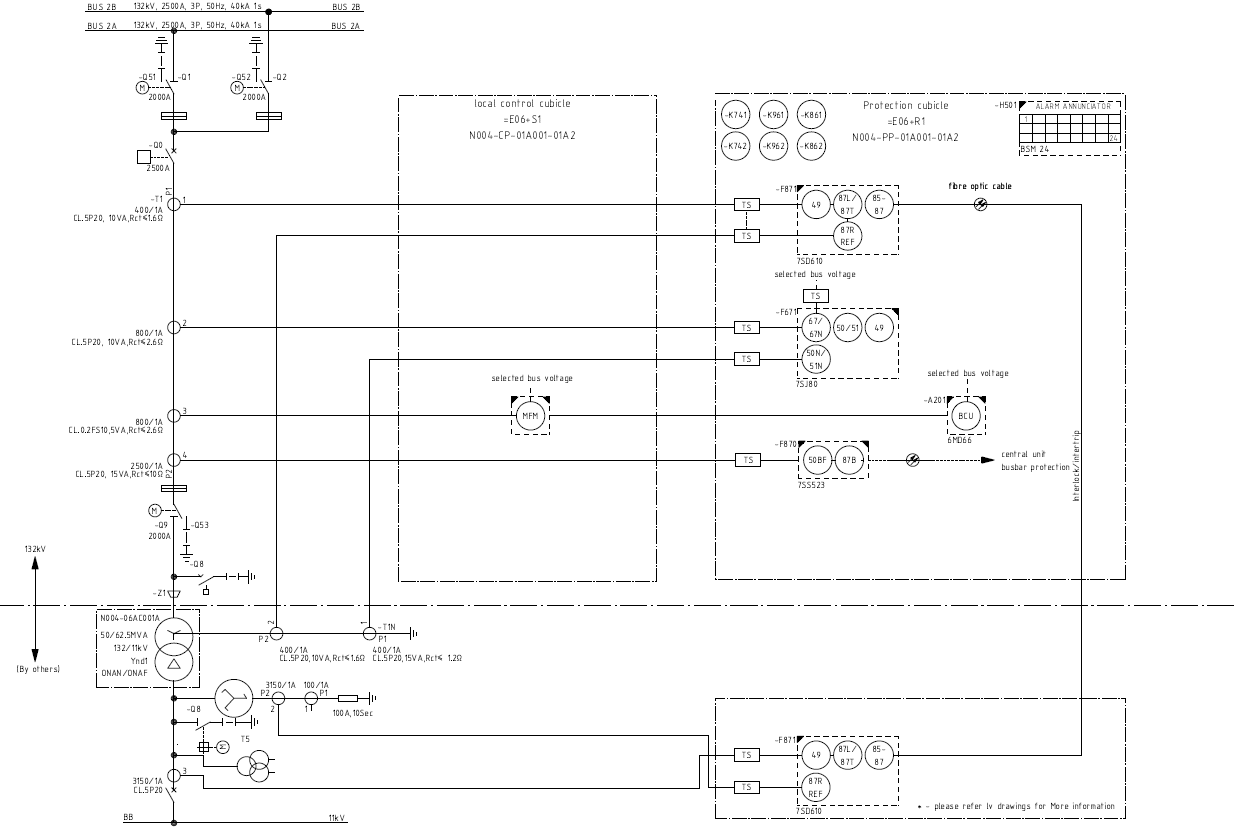
 This is an issue I've noticed all across Iraq, but I'll give you an example that I'm currently working on. We have a 132/11 kV YNd1 transformer, the primary is fed from a GIS, and secondary has a Zigzag NET with NER and a CT on the neutral point. this CT is used for REF protection.

 when we operated this transformer frequent tripping happens due to REF protection, some people say that this is due to grid instability and frequent voltage variation, others say that it's related to the current entering the neutral point due to instability. I'm not convinced by those claims and I think there's a deeper issue or reason.

 Please note that this is common around Iraq, so it might be related to the grid (in some places REF is disabled), but what I want to know is the reason behind this phenomenon.
Parents
  • I assume that, as well as checking for actual faults, you have verified the relay settings and any shunt / stabilising resistance required for the scheme according to the network, equipment and conditions. After a nuisance trip I would make sure to check both the calculated settings and what's actually been applied (has someone mis-set or nudged a variable resistor, for example).

    Pedantry I think, but it looks like the REF is only operating on the N-E link. I presume in practice the relay has actually got the phase CTs also (it appears the relay itself has but I don't know the device and it may be a separate input)

    The REF CTs appear to be merely 5P20. As a minimum I would normally expect class PX with a defined knee point Ukp and DC resistance Rc, although on this scale I would probably also insist that all four in a set were the same make & model, or at least pay close attention to the IV curves. It may be then that the CTs are not sufficiently linear, particularly on through-faults or other out-of-zone events, causing them to operate.

    The CTs look to be single ratio but multi-tap is common. Could you have been supplied CTs with two taps without knowing and have one or more on the wrong tap? Have seen that before due to a mistake at the marshalling box.

    Is the nuisance tripping coincident with other network operations e.g. energisation of transformers elsewhere? It may be worth seeing whether your device has inrush harmonic blocking available.

    There aren't any shown on the SLD, but I assume that no-ones been clever and swapped the earthing transformer for one with an auxiliary winding for substation loads.

Reply
  • I assume that, as well as checking for actual faults, you have verified the relay settings and any shunt / stabilising resistance required for the scheme according to the network, equipment and conditions. After a nuisance trip I would make sure to check both the calculated settings and what's actually been applied (has someone mis-set or nudged a variable resistor, for example).

    Pedantry I think, but it looks like the REF is only operating on the N-E link. I presume in practice the relay has actually got the phase CTs also (it appears the relay itself has but I don't know the device and it may be a separate input)

    The REF CTs appear to be merely 5P20. As a minimum I would normally expect class PX with a defined knee point Ukp and DC resistance Rc, although on this scale I would probably also insist that all four in a set were the same make & model, or at least pay close attention to the IV curves. It may be then that the CTs are not sufficiently linear, particularly on through-faults or other out-of-zone events, causing them to operate.

    The CTs look to be single ratio but multi-tap is common. Could you have been supplied CTs with two taps without knowing and have one or more on the wrong tap? Have seen that before due to a mistake at the marshalling box.

    Is the nuisance tripping coincident with other network operations e.g. energisation of transformers elsewhere? It may be worth seeing whether your device has inrush harmonic blocking available.

    There aren't any shown on the SLD, but I assume that no-ones been clever and swapped the earthing transformer for one with an auxiliary winding for substation loads.

Children
No Data