Why are some broadband routers emitting ultrasound?

I'd recently been cajoled into changing ISP and having FTTP installed. The new ISP quickly sent out their router and I've had chance to test it for ultrasound emissions before having the telephone line replaced with a fibre cable. I did this knowing that I'd been in a house where my tinnitus was being stimulated and found that the broadband router positioned a few feet away, was emitting a sharp 21 kHz signal.

Here's what the ultrasound app I use revealed for the new ISP's router once it had completed its boot up sequence:
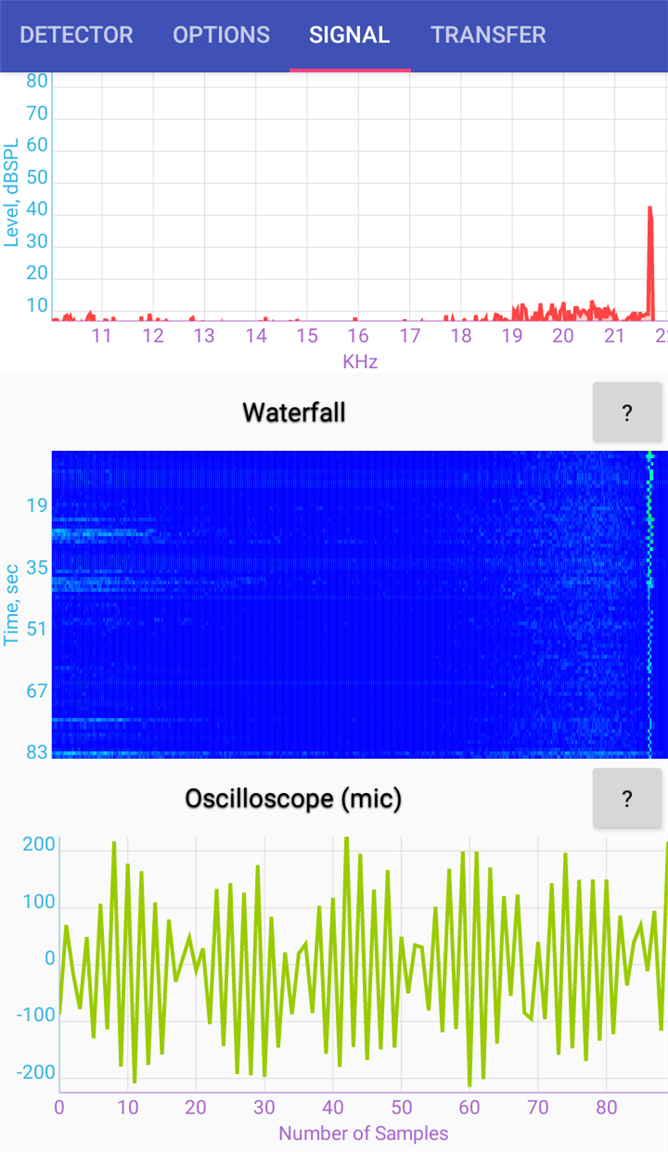
That's over 40 dB at 21.75 kHz, measured around 6 to 8 inches away. The ultrasound was being emitted by the router itself, not the power supply built into the mains plug a couple of feet away. When I'm exposed to ultrasound up to at least 30 kHz, it results in the perception of a high-pitched audible tone at approximately 14 kHz, my tinnitus tone, thanks to suffering from the "ultrasound hearing" phenomenon, as discovered previously. (See the discussion:Reasons why I suffered tinnitus, insomnia, chronic fatigue, and other health problems after having digital electricity meters installed ) (Also, I know the range as my dentist uses a 30 kHz dental descaler, painfully at times.)

Frequencies between 21 and 22 kHz are just over the top of the normal audible range for human hearing, particularly very young children, so for some people they may hear the exact tone. If these emissions are somehow accidental, then it may be possible that some routers emit sound just under 20 kHz. Cats and dogs have much more sensitive hearing than us and would have no problem hearing tones well over 20 kHz as normal sounds, probably very unpleasantly.

If you search online, you will be told that routers do not emit ultrasound, but this is clearly untrue. I've now found 2 out of the 4 I've tested doing so, subject to the microphone's limit of 22 kHz.

There's no purpose, at least not that I know about, for routers to emit ultrasound, so the simple question is; why?

Parents
  • Mostly buzzing and feezling of ferrite cores in switching  step-down regulators. The mains is stepped down to 12V or something that can sensibly be piped a few metres, but inside the router a no of other voltages are required for logic  typically 3.3V 5V and perhaps higher voltages for a pseudo phone line if one is fitted.

    At each stage, where there is a voltage change, a linear regulator would have to dissipate significant heat, and a switching design is more suitable.

    some theory 
    https://learnabout-electronics.org/PSU/psu31.php  stepping down

    https://learnabout-electronics.org/PSU/psu32.php stepping up.

    Usually the raw switching is at a far higher frequency, typically hundreds of kHz, with fast switching MOSFETs in modern commercial electronics, (or in military stuff, low MHz and gallium nitride devices....) 

    What happens with many such stages on a common supply is that there are beat frequencies generated between them and these are however lower, and quite often in the region you suggest. Additionally, loads vary with network traffic and flashing lights etc and this leads to additional lower frequency modulation of the switching wave-forms. Also when lightly loaded some deigns can  'squegg' i.e. stop altogether when the output target is exceeded, and then restart as the voltage on the reservoir capacitor falls leading to burst of a a few cycles of operation interspersed with pauses again this can occur at lower ultrasound frequencies but in a very hard to predict way.

    The main acoustic generation mechanism is magnetostriction in inductors (the same same reason 50Hz transformers buzz at 50Hz and click and thud when switched on and off), additionally some semiconductors and certain designs of ceramic capacitor are mildly piezo electric.

    Mike.

  • Usually the raw switching is at a far higher frequency, typically hundreds of kHz,

    But also is quite often in the 10s of kHz range. I've also got a USB charger (which will only be a simple single stage converter) that must be in the low kHz since even at my age I can hear it!

  • Unless it is an unusually heavy power supply, it is far more likely that what you can hear is a squegging frequency, and there are short bursts of oscillation with an audio frequency repetition rate - in effect you are not hearing the transformer buzz, but the regularly repeated HF version of a transformer inrush thud- this is far more likely to be at an audio rate.
    Silicon is cheaper than ferrite core material gram for gram and has been for about 20 years now, so its the latter that is skimped, and that pushes you up in frequency ;-) 

    If you have a scope then  a loop of a few cm of wire to give some tens of turns around a  finger sized former, (perhaps not too tight if wound around an actual finger), slid around over the outside of the plastic case will serve as a millivolt level magnetic leakage pick up - the waveforms can be pretty horrible on cheaper kit! 

    you can also buy commercial probes based on SMD coils as the pick up for checking a power supply oscillator is running.
    These amplify the AC induced by the leaking magnetic field and if it exceeds a threshold, light the 'its running' LED. Crude but occasionally useful.

    Mike.

Reply
  • Unless it is an unusually heavy power supply, it is far more likely that what you can hear is a squegging frequency, and there are short bursts of oscillation with an audio frequency repetition rate - in effect you are not hearing the transformer buzz, but the regularly repeated HF version of a transformer inrush thud- this is far more likely to be at an audio rate.
    Silicon is cheaper than ferrite core material gram for gram and has been for about 20 years now, so its the latter that is skimped, and that pushes you up in frequency ;-) 

    If you have a scope then  a loop of a few cm of wire to give some tens of turns around a  finger sized former, (perhaps not too tight if wound around an actual finger), slid around over the outside of the plastic case will serve as a millivolt level magnetic leakage pick up - the waveforms can be pretty horrible on cheaper kit! 

    you can also buy commercial probes based on SMD coils as the pick up for checking a power supply oscillator is running.
    These amplify the AC induced by the leaking magnetic field and if it exceeds a threshold, light the 'its running' LED. Crude but occasionally useful.

    Mike.

Children
  • One day when I'm really bored - or happen to have one of my scopes in the bedroom! (I've fitted this charger with a time switch because it was so annoying at night.)

    More urgent job is mending my beloved c. 1990 Tektronix analogue / digital scope which sadly died (emitting brown smells) last time I used it a few days ago...

    Simplest search coil I used to use when I was doing this stuff in the day job was just clipping the earth lead of the scope probe to the tip. As you say, it was horrifying how much rubbish even that would pick up from SMPSUs. Somewhere I must still have the design details for a BBC designed search coil for audio frequency work which I used across the audio and railway signalling industries which worked extremely well up to a few 10s of kHz. Fortunately when I changed industry no-one touched my old filing cabinet, so when I phoned up a year after I left the design was still exactly where I left it!