Protection for very long circuits using different cable sizes along the route

I am installing cables for circuits, some of which are > than 700mts for roadside systems.

Protection has been a challenge and many cables have been massively oversized for all, or part, of their length.

One particular cable run is protected by a 40A MCB.  The first 400mts are in 120mm2 SWA up to a splitter switch.

From the splitter switch it continues for a further 250mts in 35mm2 SWA.

Trimble passes the circuit.

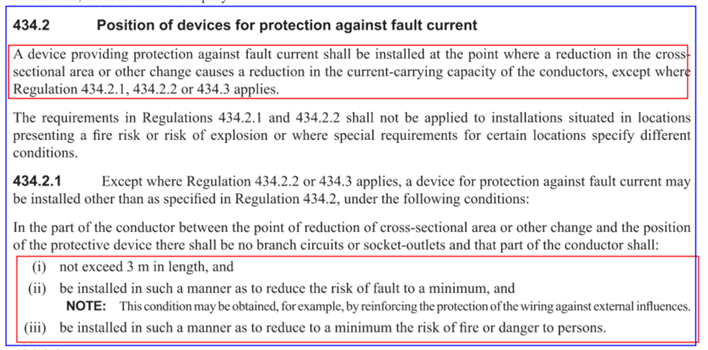
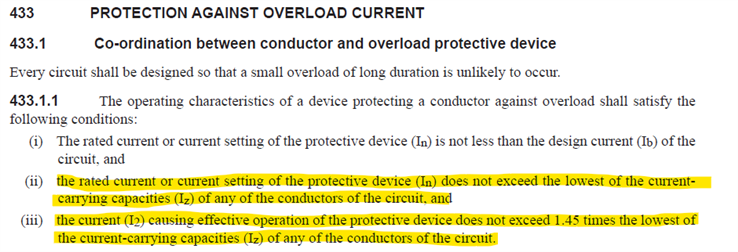
But, the discussion point is the cable size reduction.  I think it falls within 433.1.1, protection for all conductors within a circuit, and a fellow designer feels that it requires further protection as per 434.2.1 as it continues in a smaller CSA.

The protection has been sized as if the cable is 35mm2 for its full length, but the Zs would have fallen outside of the limits of the tripping times.

My understanding of 434.2.1 - conductor size reduction, is that it allows a short run of cable to be used on a protection size larger than the cable would normally be protected by, hence the 3mtr limitation on length, and doesn't apply to this type of circuit.

Discrimination for any further protection device will be almost impossible to add as it already has a number of levels of protection.

Any thoughts please?
Parents
  • I'd agree - as long as the upstream protective device still provides adequate protection for the smaller c.s.a. cable, there's no need to have a protective device at the point of reduction. 434.2.2 can still apply even if 434.2.1, doesn't to my mind.

       - Andy. 

  • agree - there is no harm in having a smaller breaker nearer the origin. Indeed pretty much the only way to avoid step up transformers for  long runs is to have a cable that from a rating perspective is  "fat" for most of the run, and may be "thin" at either or both ends. So the MCB or fuse, should be sized below the overload limit of the thinnest cable. For a 40A MCB, you could have a short section  of 6mm2 or more, at the ends, or indeed anywhere along the line and size the rest for volt drop . It does of course need documenting so that someone does not later decide to up-size the breaker to a larger one, because they thought it was a heavier cable for the full length.

    Mike.

    PS  later edit In terms of voltage drop for large steady loads things get economic, and worth considering step up and transformers at both ends  much above  about 1m per volt, or 1kV per km  as a rule of thumb. You can push this by a small factor (2 or 3 ) for light or intermittent loads where losses in transformers  still get you before losses in those oversized cables, but it is a quick ready reckoner of distance for when to whistle through your teeth and shake your head sadly and expensively at the initial discussion stages.,,,

Reply
  • agree - there is no harm in having a smaller breaker nearer the origin. Indeed pretty much the only way to avoid step up transformers for  long runs is to have a cable that from a rating perspective is  "fat" for most of the run, and may be "thin" at either or both ends. So the MCB or fuse, should be sized below the overload limit of the thinnest cable. For a 40A MCB, you could have a short section  of 6mm2 or more, at the ends, or indeed anywhere along the line and size the rest for volt drop . It does of course need documenting so that someone does not later decide to up-size the breaker to a larger one, because they thought it was a heavier cable for the full length.

    Mike.

    PS  later edit In terms of voltage drop for large steady loads things get economic, and worth considering step up and transformers at both ends  much above  about 1m per volt, or 1kV per km  as a rule of thumb. You can push this by a small factor (2 or 3 ) for light or intermittent loads where losses in transformers  still get you before losses in those oversized cables, but it is a quick ready reckoner of distance for when to whistle through your teeth and shake your head sadly and expensively at the initial discussion stages.,,,

Children
No Data