Have you ever walked past a transformer and noticed that steady humming sound?

Have you ever walked past a transformer and noticed that steady humming sound?

Whether it's a distribution transformer mounted on a pole or a large transformer in a substation, that familiar "hummmm" is almost always present.

Many people assume it's a sign that something is wrong.

Surprisingly, that hum is usually a sign that the transformer is working exactly as designed.

So, where does the sound come from?

The answer lies in a phenomenon known as magnetostriction.

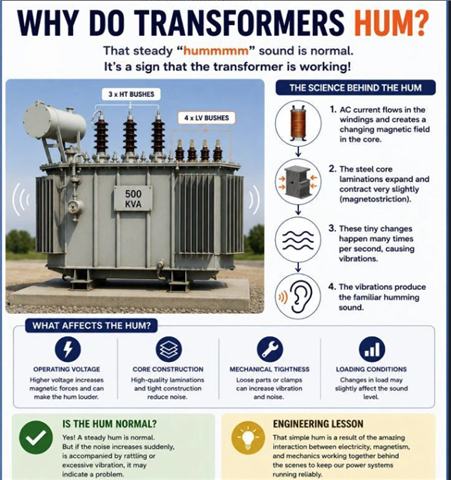
When alternating current (AC) flows through a transformer's windings, it creates a continuously changing magnetic field inside the transformer core.

As the magnetic field changes, the steel core expands and contracts by a tiny amount, far too small to see with the naked eye.

However, this process occurs many times every second, causing the core and surrounding components to vibrate slightly.

Those vibrations create the humming sound we hear.

What Can Affect the Hum?


White check mark Operating Voltage

Higher voltage levels can increase magnetic forces within the core, making the hum more noticeable.

White check mark Core Construction

Well-designed transformer cores with high-quality laminations help reduce vibration and noise.

White check mark Mechanical Tightness

Loose bolts, clamps, or internal components can amplify the humming sound.

White check mark Loading Conditions

Changes in load may slightly affect the sound level, although the hum is primarily related to the magnetic field.

Is the Hum Always Normal?

In most cases, yes.

A steady and consistent hum is a normal part of transformer operation.

However, a sudden increase in noise, rattling sounds, excessive vibration, or unusual buzzing may indicate a developing problem that requires inspection.

Engineering Lesson

One of the most fascinating things about engineering is that everyday phenomena often have a scientific explanation behind them.

That simple transformer hum is a reminder that electricity, magnetism, and mechanics are constantly working together behind the scenes to keep our power systems running.

Parents
  • An interesting point is that transformer noise is closely related to the core flux density, which is approximately proportional to V/f. Under normal operation, magnetostriction produces vibration predominantly around twice the supply frequency, so for a 50 Hz system, a significant component of the audible core noise can occur around 100 Hz. This also explains why overvoltage or low-frequency operation can increase the noise level: the higher V/f ratio increases the core flux density and can push the core closer to saturation. Harmonics in the supply waveform can further introduce additional vibration and acoustic components. So, transformer noise can actually provide useful information about the electrical as well as mechanical condition of the transformer.

  • Hmm, Doesn't this potentially conflate two (possibly 3) different things?  

    As a young engineer (c 1980) at NEI Parsons I worked on an early V/f measurement unit for cycle by cycle checking of V & f to avoid transformer saturation during start up (bringing up to speed) [used a3ph->6ph transformer, 6 phase rectification, V-to-f converter, summed count per cycle to produce a digital indication]. All based on the assumption of smooth sine wave, and worries about back EMF and saturating while energising the system transformer. 

    So it was that the magneto-restriction and saturation are based on very similar physical effects. We also have load current as an potential confounding factor as line side equipment will typically be at a well defined frequency (though not generators an run-up to synchronisation)..

    An interesting subject

Reply
  • Hmm, Doesn't this potentially conflate two (possibly 3) different things?  

    As a young engineer (c 1980) at NEI Parsons I worked on an early V/f measurement unit for cycle by cycle checking of V & f to avoid transformer saturation during start up (bringing up to speed) [used a3ph->6ph transformer, 6 phase rectification, V-to-f converter, summed count per cycle to produce a digital indication]. All based on the assumption of smooth sine wave, and worries about back EMF and saturating while energising the system transformer. 

    So it was that the magneto-restriction and saturation are based on very similar physical effects. We also have load current as an potential confounding factor as line side equipment will typically be at a well defined frequency (though not generators an run-up to synchronisation)..

    An interesting subject

Children
No Data