Effective Utilization of Solar Power in the electricity industry during summer.

During summer where there is reasonable amount of sunlight considering the longer day phenomenon.

  • Can we say that electricity generation from solar PV systems is under-utilized?
  • What other possible ways or strategies other than battery storage could be most suitable in handling the excess electricity production from PV systems in the summer period?

In my thoughts, I believe there should be more capital investments in solar PV and mini grids system owing to the numerous merits which are not limited to; low maintenance and operating cost, carbon footprint reduction, job creation, enhanced energy independence and inexhaustible and renewable source of energy.

However, concerns still draws on its limitations such as; need for storage (battery), concerns regarding land use, seasonal variation, high initial capital cost, and its intermittency of output which is dependent on the season, weather and time factor especially during winter.

  • Is there anything else that could enhance or sustain solar power generation?
  • The biggest question is:

    Is this a national asset,  or, is it a corporate finance, profit driven, asset?

    One gets the feeling that there is a lot of 'gaming the system' between popular government desires, regulator rule book, and generation company investments and 'stubbornness'.

    Only then can we really look at the differing storage time period and scales of support, from two cycles up to two seasons, (and even 2 years for hydro storage etc.)

  • Can we say that electricity generation from solar PV systems is under-utilized?

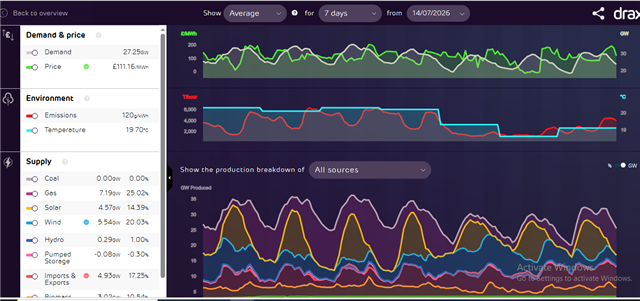
    From the point of view of are we using all the PV output - the answer is probably no at the moment (at least in the UK). If you look at this for example: https://electricinsights.co.uk/#/dashboard?period=7-days&start=2026-07-14 you'll see that even in the height of summer PV generation (yellow) seems to follow the daily peak in demand quite nicely, and there's still some combustion based generation going on even during peak PV production - so we're still using renewables to displace fossil (mostly gas) generation - so 100% of PV generation gets usefully used. AFAIK solar systems don't normally get asked to reduce output in the same way that large wind farms can be. No doubt that some are using immersion-heater diverters - which I suppose isn't really the ideal use of high grade electricity (solar thermal would be better) - but I suspect that's a small piece of a big picture.

    In time though, we'd hope that renewable production would increase and so we should get to the point (maybe not in the too distant future now) where PV production does exceed instantaneous demand - and then it would be under-utilised as you say. Home battery storage is are already making inroads in that area, grid-scale batteries also. Pump-storage (e.g. Dinorwig) was one of the traditional grid-scale storage solutions. My feeling is that we could have a lot more smaller scale pump-storage (if lower head than Dinorwig) - around these parts ("up North") we often see chains of two or three reservoirs down the same valley - I reckon some modest pump-storage could be incorporated into those at reasonable costs (all the big civils has already been done for you) and with only a modest loss of peak water storage capacity. Schemes to alter demand to match available generation is another road (again not new in principle) and in many ways easier then it used to be as many of the new loads (EVs and heat pumps) aren't that time critical.

      - Andy.

  • Thanks for using this in explaining and supporting your points. Quite useful and beneficial!

  • Thanks for bringing this up: Is this a national asset, or is it a corporate finance, profit driven, asset? where possible, if we consider this aspect in forming a development blueprint it would be more beneficial and self-sustaining. There is need for more critical evaluation considering the type of economy run by the government.

    Regards.

  • get to the point (maybe not in the too distant future now) where PV production does exceed instantaneous demand

    Are you sure that we are not already there Andy?  My supplier (EON) and I believe others are offering rewards to use more electricity at certain times of the day, usually between 1.00 pm and 3.00 pm, when I use - 0 kW, my solar feeding into the grid.

    David

  • Are you sure that we are not already there Andy? 

    It is possible - I'm just guessing about the inputs based on the observed output and a (partial) understanding of the rules. Some things don't altogether make sense ... e.g. at times the wholesale price is -ve (suggesting an oversupply - try 2nd July at about 17:20 for an example if you're looking at the Drax charts) yet we're still burning gas (usually the most expensive) - so there's certainly more going on than meets the eye (maybe they can turn down gas generation, but turning it off is more difficult?) I suspect much of the "oversupply" comes from wind rather than PV (not that makes a difference in the big picture), but in terms of the OP's question it's not the PV that gets curtailed - so in that sense the PV is "all used" - so fully utilised as it were.

      - Andy.