Effective Utilization of Solar Power in the electricity industry during summer.

During summer where there is reasonable amount of sunlight considering the longer day phenomenon.

  • Can we say that electricity generation from solar PV systems is under-utilized?
  • What other possible ways or strategies other than battery storage could be most suitable in handling the excess electricity production from PV systems in the summer period?

In my thoughts, I believe there should be more capital investments in solar PV and mini grids system owing to the numerous merits which are not limited to; low maintenance and operating cost, carbon footprint reduction, job creation, enhanced energy independence and inexhaustible and renewable source of energy.

However, concerns still draws on its limitations such as; need for storage (battery), concerns regarding land use, seasonal variation, high initial capital cost, and its intermittency of output which is dependent on the season, weather and time factor especially during winter.

  • Is there anything else that could enhance or sustain solar power generation?
Parents
  • Can we say that electricity generation from solar PV systems is under-utilized?

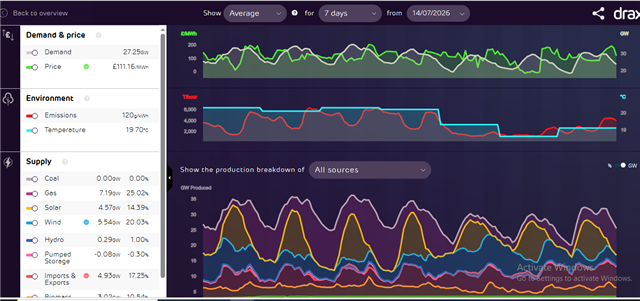
    From the point of view of are we using all the PV output - the answer is probably no at the moment (at least in the UK). If you look at this for example: https://electricinsights.co.uk/#/dashboard?period=7-days&start=2026-07-14 you'll see that even in the height of summer PV generation (yellow) seems to follow the daily peak in demand quite nicely, and there's still some combustion based generation going on even during peak PV production - so we're still using renewables to displace fossil (mostly gas) generation - so 100% of PV generation gets usefully used. AFAIK solar systems don't normally get asked to reduce output in the same way that large wind farms can be. No doubt that some are using immersion-heater diverters - which I suppose isn't really the ideal use of high grade electricity (solar thermal would be better) - but I suspect that's a small piece of a big picture.

    In time though, we'd hope that renewable production would increase and so we should get to the point (maybe not in the too distant future now) where PV production does exceed instantaneous demand - and then it would be under-utilised as you say. Home battery storage is are already making inroads in that area, grid-scale batteries also. Pump-storage (e.g. Dinorwig) was one of the traditional grid-scale storage solutions. My feeling is that we could have a lot more smaller scale pump-storage (if lower head than Dinorwig) - around these parts ("up North") we often see chains of two or three reservoirs down the same valley - I reckon some modest pump-storage could be incorporated into those at reasonable costs (all the big civils has already been done for you) and with only a modest loss of peak water storage capacity. Schemes to alter demand to match available generation is another road (again not new in principle) and in many ways easier then it used to be as many of the new loads (EVs and heat pumps) aren't that time critical.

      - Andy.

  • Thanks for using this in explaining and supporting your points. Quite useful and beneficial!

  • get to the point (maybe not in the too distant future now) where PV production does exceed instantaneous demand

    Are you sure that we are not already there Andy?  My supplier (EON) and I believe others are offering rewards to use more electricity at certain times of the day, usually between 1.00 pm and 3.00 pm, when I use - 0 kW, my solar feeding into the grid.

    David

  • Are you sure that we are not already there Andy? 

    It is possible - I'm just guessing about the inputs based on the observed output and a (partial) understanding of the rules. Some things don't altogether make sense ... e.g. at times the wholesale price is -ve (suggesting an oversupply - try 2nd July at about 17:20 for an example if you're looking at the Drax charts) yet we're still burning gas (usually the most expensive) - so there's certainly more going on than meets the eye (maybe they can turn down gas generation, but turning it off is more difficult?) I suspect much of the "oversupply" comes from wind rather than PV (not that makes a difference in the big picture), but in terms of the OP's question it's not the PV that gets curtailed - so in that sense the PV is "all used" - so fully utilised as it were.

      - Andy.

  • As I understand it, many of the solar inverters (esp domestic) are just grid follower style (uses excess voltage to drive the current into the grid, rather than phase advance).

    The grid needs 'forming' generation, with it's rotating inertia energy storage (for phase lead & fault current), and in the usual gaming of the regulations, the gas plant is left available to provide that rotating inertia/energy store.

    Regulation at a distance doesn't regulate the profit motive...

  • My understanding of the current supply chain for storage batteries is that it is characterised by highly concentrated production in China (although currently shifting towards countries such as Korea).

    Does the UK have sufficient resilience in the production and procurement of the battery products to allow for expansion in micro-storage and utilisation (either on a site specific basis or local network)?

Reply
  • My understanding of the current supply chain for storage batteries is that it is characterised by highly concentrated production in China (although currently shifting towards countries such as Korea).

    Does the UK have sufficient resilience in the production and procurement of the battery products to allow for expansion in micro-storage and utilisation (either on a site specific basis or local network)?

Children
  • Well there was https://en.wikipedia.org/wiki/Britishvolt - but that didn't end well. I suspect the underlying problem is that Chinese labour is far cheaper than UK labour, so as long as people here want UK wages but only pay Chinese prices for the products they buy, things aren't going to change much in the manufacturing sector. 

    It seems the government do have a "strategy": https://www.gov.uk/government/publications/uk-battery-strategy (although I can't say I've read it yet)

    But in the meantime I suspect it'll just be a matter of buying from far east provided the conditions are tolerable. At least you only need to buy a battery once (plus perhaps a replacement perhaps a decade down the line) and then it's yours to use over and over - unlike say oil or gas where you can only use it once and the have to re-buy.

       - Andy.

  • It seems the government do have a "strategy": https://www.gov.uk/government/publications/uk-battery-strategy (although I can't say I've read it yet)

    The trouble is that a British strategy is nothing like a Chinese one. China has decided that clean technology is of major importance to the country. The government will ensure that raw material supplies are not interrupted, R&D happens and that factories are given priority. If they have to buy a mine in another country, that's what they will do.

    Meanwhile the British government might give a bit of regeneration grant to someone building a factory, and anything else is their problem.

  • Hmm and we do love meetings and strategy documents, as a substitute for progress, and we even consider reports to be deliverables..

    I have been told a tale that  after one unusually indecisive  meeting in particular, that  a very exasperated senior military type commented that at least if we had to go to war tomorrow, we could throw plenty of filing cabinets full of weighty documents at the enemy but sadly really not much else.
    It was probably a bit of an exaggeration, but equally it is more or less correct to observe that we are the country that's been electrifying our railways for a little over 120 years, and now has about a third done, so in another quarter millennium it might be finished, though of course the initial frenetic pace might have to slow down.
    In terms of batteries and so on, we will buy the near completed articles in, much as we do with nuts and bolts ,and then whinge about the price.

    Mike.