This discussion has been locked.
You can no longer post new replies to this discussion. If you have a question you can start a new discussion

EICR and IR Testing

Former Community Member
Oh the bane of IR testing on EICRs

Now its just impracticle to disconnect all loads to carry out IR testing, I think everyone can agree on that. And that Phase and Neutral are connected then tested to earth.


This is what I do, and then test @250V as to avoid damaging any equipment in the installation. And unless the IR value was <.5 Meg, would not bother me. What BS7671 states, but BS7671 is maybe somewhat unclear in that if that voltage (250V) was used then .5meg value should used, but that value should only be used on SELV, and PELV. Now experience also tells me that even if you had a return 0.0, and then did Kohms by using the ohms setting, even values of 100Kohms are fine. (Actually can be much lower than this) and we are pretty clear that its not the cable reurning these values.


So question is when doing an EICR @ 250V, at what point would you recommend an FI? For me the value would have to be <.5Meg
  • From a fire point of view an insulation pass at 10k to 20k  would be approaching a  more dangerous limit - but only  if it really was all resistance, and concentrated at one point, we would be looking at  circa  15mA -  (10 k ohms would be 23mA) so  3 to 4 watts of dissipation. For sensible volumes (a few cubic mm of material) you do need a few watts to get things hot enough to do damage, but that is in that ballpark.

    Of course, the same dissipation spread over several metres of damp mineral insulated cable would not be an issue- you'd need to be losing tens to hundred watts per metre of length to get that hot..

    The other problem is that any insulation tester able to hold up the sort of test current you'd need at hundreds of volts, is actually lethal, so having a higher test limit makes the meter safer to use, as it can be designed to current limit at a mA or two and read low resistances unreliably.
  • Former Community Member
    0 Former Community Member
    Andy

    Another great response! much apprecited, yes indeed when doing a ramp test the OPD can open at 15mA.

    Brilliant thank you

  • Michael Moore:

    Oh thats easy its 7.666Kohm

    0.008Megohm


    Which is what I alluded to on a Facebook group, and it completely baffled the bafoons there, who were apparently teachers!


    Ah, but.. RCDs can validly trip at a residual current of anything between 50% and 100% of IΔn so you should really be looking at keeping leakage below 15mA rather than 30mA for reliability (so perhaps 15.3kΩ rather than 7.6)


    There again d.c. insulation tests only indicate simple resistance - in a real system they'll be some capacitive coupling that'll allow some extra residual current to flow too (so perhaps something significantly higher than 15.3kΩ)


    Also there'll likely be leakage from appliances which likely won't be part of a fixed wiring test (even if they many appliances will have components switched off - e.g. pumps and motors of washing machines so likely to avoid the test) - so again you might want to add a significant margin on for that too..


       - Andy.


  • Former Community Member
    0 Former Community Member
    Oh thats easy its 7.666Kohm

    0.008Megohm


    Which is what I alluded to on a Facebook group, and it completely baffled the bafoons there, who were apparently teachers!


  • So what do you consider the minimum insulation value required is to be able to install RCD protection to an existing installation?


    Andy B.
  • Former Community Member
    0 Former Community Member
    It rather depends what failure mode you are expecting, actually neither 230V nor 500V will 'jump' very far without assistance - much like a welding rod, contact has to be made either mechanically or by a signifiant over-voltage, and then an arc can be drawn out to a volume of hot gas limited only by the available power. Usually when this finally goes out the conductors have burnt back well beyond any re-striking distance. Equally for finding nails in the wire, trapped wires in backboxes or similar, a battery and bell set would probably do.

    I agree a 500V test will find a few things a 250V test will not, and a 1000V test will find a few more.

    In some ways the standard 500V test looks a bit feeble, given the overvoltage  categories defined in IEC 61010-1

    1500V for Cat I, (operation with protective low voltage), battery-operated devices, car electrics)

    2500V for Cat II  (household appliances, portable electrical appliances) and

    4000V for Cat III (loads with direct fixed connection, distribution, fixed installation appliances in the distribution system)


    Thanks for your answer, but was looking for testing LV in regards to BS7671, and at no point does that publication suggest using these values.
  • Former Community Member
    0 Former Community Member
    John Peckham:

    Sorry Chris but fairness has never been one of my weaknesses.


    IR often creeps up if the IR test button is held down especially if the installation is large as with a good IR the installation acts like a capacitor with the DC from instrument charging the capacitor. 


    I would never IR test L/L on a periodic as you can never be sure everything electronic has been disconnected and I am not keen on a claim on my insurance.


    When doing periodic, and doing IR Testing L-N to E Im happy with 4 meg, and will note that on the test as global test. Just dont have the time or to start stripping the install down, and then, well actually nothing as everything is mnow above 200Meg


  • Former Community Member
    0 Former Community Member
    Chris Pearson:
    John Peckham:

    Chris


    You have fallen in to the usual trap of not understanding the major difference between Initial Verification and Periodic Inspection and Testing.


    John, that's a bit unfair!


    My point was that for a periodic, L-N testing is unnecessary and as the OP said, practically impossible. How would you test a socket circuit with SRCD or USB where the manufacturer's instructions are that it should be disconnected when IR testing?


    As an aside, when testing at stages during erection, to start with the IR rapidly goes up to > 999 MΩ; but after a while it creeps up more slowly, especially when testing live to CPC. > 500 MΩ is certainly enough for me, but one could stop pressing the button as soon as it gets over 2 MΩ, or any value in between.


    As OP, Im doing EICRs, so witjhout being rude not interested Initial Verication, which of course is where the cables are most likely to get most damage. And With BS87671 stating that 1meg is aceppatble is a complete cop out IMO. 


  • Former Community Member
    0 Former Community Member
    Sparkingchip:

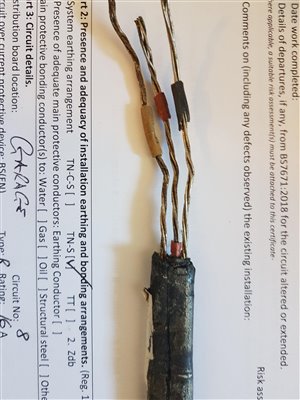
    I went south of the river last Thursday to do what should have been a straightforward job, until I saw the cable that supplied the central heating system that I was planning to extend.


    You do have to appreciate just how bad the insulation is on some cables that are in use without tripping a RCD or MCB in a relatively new dual RCD consumer unit.


    cc3c406e19459a9746a2bb1eee2815e0-original-20200820_144553.jpg


    Goes to show that doing IR test dont realluy prove the safety of the install.


  • Former Community Member
    0 Former Community Member
    Not really a trap, I was trying to appease people on a facegroup group, and it was hurting, so needed some good professional answers, which I am getting here.