This discussion has been locked.
You can no longer post new replies to this discussion. If you have a question you can start a new discussion

Unusual cable?

Some people collect stamps, I collect cable. Preferably as short encapsulated paperweights, although I do have others, such as a piece of TAT1 and a piece of the original transatlantic telegraph cable of 1866.


One of my paperweights is a 6-core lead covered cable, each core 0.125 sq. inches copper rated at 11,000 volts WP (which I guess is Working Pressure which translates to Working Voltage) It was produced for the City of Sheffield by the Western Electric Company London. No date given.


Why use a 6-core cable? Seems to be putting all ones eggs in one basket if used for a two circuit system. Had it been for a lower voltage, then perhaps an ac feed to a mercury arc rectifier, but surely not at 11 kV?

Clive
  • Sometimes such cables were used for sensitive and sophisticated fault detection. Two cores in parallel for each phase, should under normal circumstances share the current equally. The two cores for each phase were passed through the SAME current transformer but in OPPOSITE directions and thereby producing no output from the CT.

    Most faults or failures would upset this balance, and the CT output could be used to trip the feeder circuit breaker.


    Commonly used in coal mines, oil refineries, ordnance depots, and other places were any open arcing from a failed cable could have very serious consequences, a failure between any core and any other core should trip the feeder before open arcing results.


    Rather a costly and complicated system for an ordinary public supply though.
  • Apart from the obvious twin 3 phase HV circuits - rather like a modern 6 arm 'pylon'..

    0.125 squin  is close to modern 70mm2 , perhaps 200-300A per core depending on what we assume about insulation temperature. (so something like  5MW per triplet, 10MW for the whole cable, if we assumed modern  11kV phase to phase, 6kV to ground)


    Could have been 4 cores for 3 phases and earth and a DC supply or pilot - Sheffield had DC trams until about 1960 Or perhaps it pre-dates AC mains altogether  and just happens to be rated at 11kV but used for DC centre ground at 400/200/0 /-200 /-400 ?

    Mike

  • I suppose that it might have been for a large electric motor with star/delta starting, perhaps in an area with a flammable atmosphere, and the starter located remotely in say a substation.

    That would be very large motor indeed, but just about possible. Back in the day, direct steam engine drive was often preferred for that much horsepower. Either a reciprocating steam engine or a steam turbine.
  • ... or if DC rectification was involved 6 phase star/delta for rectifier inputs.
  • I had considered 6-phase, but surely that would be at the input voltage to the rectifier used?  Would there be a need for HV dc?  I reckon the cable is around 100 years old. Western Electric Company in London, from Wikipedia et al, it appears to have been involved between 1898 when they purchased a failing cable company in North Woolwich. It appears that they were acquired by ITT / STC in 1925. 

    Clive
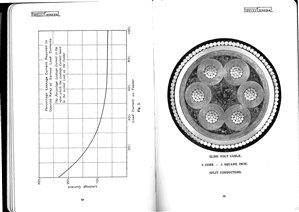
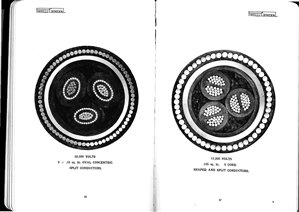
  • My 1925 Pirelli General Cable Book shows the same type of cable, without any explanation as to why that I have found yet as well as some other spilt core HV cables.


    c2219fbf00609d99d66e8c22b904dd91-original-20210531160831_0001.jpg

    3c7f9219c71ee01e7a665696c3cc4aae-original-20210531160831_0002.jpg
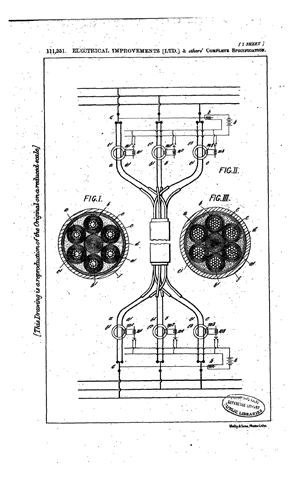
  • And here we have it, Callender-Hunter Six Core Split Conductor System Patent No. 111351/1916

    https://worldwide.espacenet.com/patent/search/family/032250089/publication/GB111351A?q=GB111351


  • Well spotted Roger, and from that patent,  in all its 1916 spotty glory, an early precursor to some of the ideas behind the RCD or earth fault relay, as well as cable protection. Note the Z winding of the two wires in each core so it sums to zero in normal operation.


    548c330d7d35a6bc802335dafe61d930-original-gb_111351_a-callender-patent.png
  • Nice find there Roger.

    There were some clever electrical brains back then a hundred years ago.

    Clive
  • There's still plenty of this in the ground, still serving our communities, even though the cores are now generally jointed together and protected more conventionally. The giveaway for split conductor is generally that the pairs of cores are lightly insulated from each other.


    I'm sure you'll all realise that, at the time, these were transmission mains, so they deserved decent protection. Split conductor was, in some ways, a cheap and cheerful alternative to full unit protection (eg Merz Price). At least in the northeast, it was used only for a few years after the Great War, after which we reverted to unit schemes


    I suspect that there was also a degree of making a virtue out of necessity: if the breakers available at the time were relatively small, then it would make sense to use two breakers per circuit