This discussion has been locked.
You can no longer post new replies to this discussion. If you have a question you can start a new discussion

Unusual cable?

Some people collect stamps, I collect cable. Preferably as short encapsulated paperweights, although I do have others, such as a piece of TAT1 and a piece of the original transatlantic telegraph cable of 1866.


One of my paperweights is a 6-core lead covered cable, each core 0.125 sq. inches copper rated at 11,000 volts WP (which I guess is Working Pressure which translates to Working Voltage) It was produced for the City of Sheffield by the Western Electric Company London. No date given.


Why use a 6-core cable? Seems to be putting all ones eggs in one basket if used for a two circuit system. Had it been for a lower voltage, then perhaps an ac feed to a mercury arc rectifier, but surely not at 11 kV?

Clive
Parents


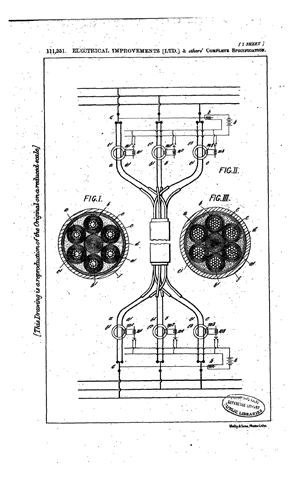
  • Well spotted Roger, and from that patent,  in all its 1916 spotty glory, an early precursor to some of the ideas behind the RCD or earth fault relay, as well as cable protection. Note the Z winding of the two wires in each core so it sums to zero in normal operation.


    548c330d7d35a6bc802335dafe61d930-original-gb_111351_a-callender-patent.png
Reply


  • Well spotted Roger, and from that patent,  in all its 1916 spotty glory, an early precursor to some of the ideas behind the RCD or earth fault relay, as well as cable protection. Note the Z winding of the two wires in each core so it sums to zero in normal operation.


    548c330d7d35a6bc802335dafe61d930-original-gb_111351_a-callender-patent.png
Children
No Data