


Everything you want to know about TT earthing form the IET Wiring Matters an be found here

Everything you want to know about TT earthing form the IET Wiring Matters an be found here
A good intro.
Possibly strange use of ‘ADS’. I consider that an RCD also automatically disconnects the supply, just not from measuring the live current alone as fuse or MCB would.
I'd have probably said ‘over current protection’ or even "fuse/mcb" to make it totally clear.
Missing items.
1) Insulating the top foot or so of an electrode by boxing in the top, greatly reduces the step voltage risk, as the peak potential on the surface is then reduced, and also slightly current limited, by the volume of earth in series with the bare foot even standing pretty much right on top of it. For valuable livestock this is worth considering.
2) It is a good idea (mandated in many parts of the planet) for grid or tape electrodes, where there are buried joints that cannot be seen, to attach two wire tails and not in the same place. A ring round continuity test between the two points of connection can then be performed at the surface to verify the underground joints are not rotting off.
3) The DNO electrode resistance may not be that great - if your electrodes are lower impedance than theirs, then during faults there is potential to lift the substation neutral some way off true ground.
4) Higher touch voltages possible than for TN, is the reason for shorter ADS times.
Mike.
"the earth electrode should be installed at a depth sufficient to reach the water table of the soil to remain effective." (my emphasis) seems a bit over-zealous. Around here two or three feet down remains damp enough even during summer droughts, but as we're on a hillside the actual water table is likely to be much much deeper - probably several tens of metres - really not a practical depth.
I might take slight issue with Fig 1 too - to my mind the consumer's electrode is part of the consumer's installation, not the supply system (e.g. isn't included in the oft quoted 21 Ohms Ze for TT systems) - so really it should be to the right of the dotted line.
- Andy.
Agree, I'd not spotted that. The water table is the level a well will fill to not the earth being damp enough to let the ions move which is much nearer the surface. Clearly unless you live in a valley the water table could be someway down…
Here for example all those red triangles indicate bore hole depths of 30m plus, green is 10-30m blue is 10m or less, black is not measured .. Spot the valleys..
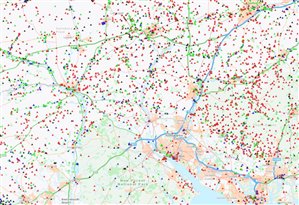
Not to worry, 4 ft rod is typically 50 to 100 ohms here, actually if the hole fills with water it usually means you hit something driving it in, not the water table - and building control like soakaways which would not work if the water was that near the surface.
Mike.
I had some yew hedging which died of phytophthera, which thrives in wet land. I was advised to replace the soil. I did, but in the course of so doing, my trench filled within a few inches of the surface (at 9 m above sea level). I think that it was simply run-off, but it did not dry out much even in good weather.
My old garage pit, which was too shallow for me at 5' 7", used to fill up about half a wellington boot's depth, so I think that is a reasonably accurate estimate of the level of the water table. That is probably consistent with the depth of our sokaways.
After a dry autumn, my vegetable patch is pretty dry down to 2': I know because I have been digging out bindweed. ? However, if it were always like that, nothing would grow.
So I conclude that a 2 m earth rod will always have wet feet here, but in fact, most of it will always be moist.
We're about to take you to the IET registration website. Don't worry though, you'll be sent straight back to the community after completing the registration.
Continue to the IET registration site

