This discussion has been locked.
You can no longer post new replies to this discussion. If you have a question you can start a new discussion

Leakage from underfloor steel conduit trench

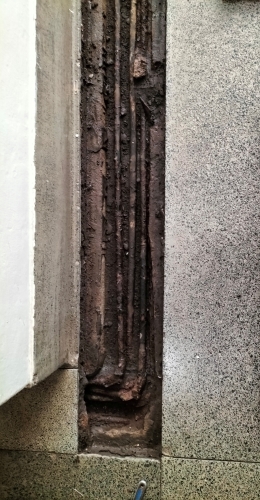
I recently inspected an old building whose wiring is drawn in underfloor steel conduits in a trench openable from the floors above (1st and 2nd floor)., and branching of to lighting and power points.  Despite the rust as shown here, the installation is in ‘working condition’.  However, there are two concerns. 

First, water ingress from cleaning is staining the soffit/ceiling under and it's a nuisance to users. Second, the old wiring used the steel conduit system as a CPC and rust could have reduced it's effectiveness.

I have thought of covering/encasing the trench permanently but two issues arise. How to deal with draw-off points at corners and at 10m interval; and the possibility that rewiring may be rendered impossible in the future.

I would appreciate any comment from anyone who has had to reckon with this such a challenge and how they approached it.
6ef10e5c47824bb2036fbbbdb1293ace-huge-img20210927120405-1.jpg
Parents
  • Kenneth Kibet Samoei: 


    how are these trenches supposed to drain - that needs fixing first. Foam fill may actually make it worse if water is then trapped and can only escape via light fittings etc.

    Thank you so much Statter, Z and Mike for your comments. 

    From the look of it, it appears that water wasn't supposed to get into these trenches, so the issue of draining wasn't a consideration. 

    The floor finish is terazzo and water is from cleaning. It is an old building (1920s) and I think the knowledge about how to care for the floors has long been forgotten.  I also suspect that there could've been a means a sealing the joint between the cover and the rest of the floor. So the foam idea seems promising, despite the concerns raised on the same.

     I welcome any perspective on those who have dealt with electrics for buildings from that era. 

     I acknowledge that this isn't entirely electrical but you'd agree that in built environment, boundaries are blurred. 

    This installation seems unfit for continued service. The inspection bends were never meant to be waterproof and will allow water into the conduit. The water may run into wiring accessories and cause problems. If the covers are left off to allow ventilation it may take weeks for the system to dry out. But the poor condition of the conduit still remains. A rewire is in order. Reg. 522.3 applies here, so B.S. 7671 is not being complied with.

    Z.

Reply
  • Kenneth Kibet Samoei: 


    how are these trenches supposed to drain - that needs fixing first. Foam fill may actually make it worse if water is then trapped and can only escape via light fittings etc.

    Thank you so much Statter, Z and Mike for your comments. 

    From the look of it, it appears that water wasn't supposed to get into these trenches, so the issue of draining wasn't a consideration. 

    The floor finish is terazzo and water is from cleaning. It is an old building (1920s) and I think the knowledge about how to care for the floors has long been forgotten.  I also suspect that there could've been a means a sealing the joint between the cover and the rest of the floor. So the foam idea seems promising, despite the concerns raised on the same.

     I welcome any perspective on those who have dealt with electrics for buildings from that era. 

     I acknowledge that this isn't entirely electrical but you'd agree that in built environment, boundaries are blurred. 

    This installation seems unfit for continued service. The inspection bends were never meant to be waterproof and will allow water into the conduit. The water may run into wiring accessories and cause problems. If the covers are left off to allow ventilation it may take weeks for the system to dry out. But the poor condition of the conduit still remains. A rewire is in order. Reg. 522.3 applies here, so B.S. 7671 is not being complied with.

    Z.

Children
No Data