This discussion has been locked.
You can no longer post new replies to this discussion. If you have a question you can start a new discussion

Leakage from underfloor steel conduit trench

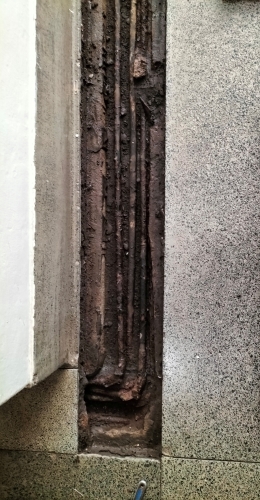
I recently inspected an old building whose wiring is drawn in underfloor steel conduits in a trench openable from the floors above (1st and 2nd floor)., and branching of to lighting and power points.  Despite the rust as shown here, the installation is in ‘working condition’.  However, there are two concerns. 

First, water ingress from cleaning is staining the soffit/ceiling under and it's a nuisance to users. Second, the old wiring used the steel conduit system as a CPC and rust could have reduced it's effectiveness.

I have thought of covering/encasing the trench permanently but two issues arise. How to deal with draw-off points at corners and at 10m interval; and the possibility that rewiring may be rendered impossible in the future.

I would appreciate any comment from anyone who has had to reckon with this such a challenge and how they approached it.
6ef10e5c47824bb2036fbbbdb1293ace-huge-img20210927120405-1.jpg
  • Hello

    Tests over time will show any deterioration of CPC function especially if the results are graphed.  Is there space to draw in a separate CPC if required.  If its close to the limit you might want to replace or supplement anyway.

    One option you could consider would be to fill the trench with an expanding foam.  If you chose this carefully it will be waterproof and soft enough to be removable if you need access to the conduits.  If you go this way make a carefully dimensioned drawing showing inspection covers, joints etc relative to permanent building structures or dimension same on a photograph.  Also tape up / over any screws that you might want to remove.

    If you do fill with foam do it a metre at a time and place a plastic sheet and heavy board over the top to confine the foam.  You will need quite a lot of weight to keep it in and level with the top of the trench.  The foam wont normally stick to polythene so that can then be peeled off carefully.

    Hope this helps.

  • Could expanding foam cause cable overheating?

    Rewiring is in order I think.


    Z.

  • As I see it there are 2 problems - the water and the corrosion.

    how are these trenches supposed to drain - that needs fixing first. Foam fill may actually make it worse if water is then trapped and can only escape via light fittings etc.

    It is hard to be sure in the pic, but that conduit looks quite far gone, or it may be rubbish or brown leaves.. To stay in service needs enough metal not only to carry the amps of a full fault to blow a fuse or whatever but also to fulfil the conduit's other purpose - of mechanical protection

    If it is still OK and could be brushed clean and painted with kurust or hamerite, then it may go for a bit longer, but the water ingress needs solving, and that is  not really an electrical issue.

    If you do rewire, some or parts, could you use SWA, or even plastic conduit. In either case joins need  to be submersible if that water ingress is not solved first.

    Mike

  •  

    how are these trenches supposed to drain - that needs fixing first. Foam fill may actually make it worse if water is then trapped and can only escape via light fittings etc.

    Thank you so much Statter, Z and Mike for your comments. 

    From the look of it, it appears that water wasn't supposed to get into these trenches, so the issue of draining wasn't a consideration. 

    The floor finish is terazzo and water is from cleaning. It is an old building (1920s) and I think the knowledge about how to care for the floors has long been forgotten.  I also suspect that there could've been a means a sealing the joint between the cover and the rest of the floor. So the foam idea seems promising, despite the concerns raised on the same.

     I welcome any perspective on those who have dealt with electrics for buildings from that era. 

     I acknowledge that this isn't entirely electrical but you'd agree that in built environment, boundaries are blurred. 

  • Kenneth Kibet Samoei: 


    how are these trenches supposed to drain - that needs fixing first. Foam fill may actually make it worse if water is then trapped and can only escape via light fittings etc.

    Thank you so much Statter, Z and Mike for your comments. 

    From the look of it, it appears that water wasn't supposed to get into these trenches, so the issue of draining wasn't a consideration. 

    The floor finish is terazzo and water is from cleaning. It is an old building (1920s) and I think the knowledge about how to care for the floors has long been forgotten.  I also suspect that there could've been a means a sealing the joint between the cover and the rest of the floor. So the foam idea seems promising, despite the concerns raised on the same.

     I welcome any perspective on those who have dealt with electrics for buildings from that era. 

     I acknowledge that this isn't entirely electrical but you'd agree that in built environment, boundaries are blurred. 

    This installation seems unfit for continued service. The inspection bends were never meant to be waterproof and will allow water into the conduit. The water may run into wiring accessories and cause problems. If the covers are left off to allow ventilation it may take weeks for the system to dry out. But the poor condition of the conduit still remains. A rewire is in order. Reg. 522.3 applies here, so B.S. 7671 is not being complied with.

    Z.

  • could the stone covers be supposed to be sealed with mastic or tar or similar ? It probably needs someone who understands 1920s floor construction to consult. I  presume the wiring is newer, and 1960s at the oldest, - any 1920 wiring would almost certainly be unsuitable for modern conditions, so it must  been re-wired before , maybe when the floors came up then, some re-sealing idea was forgotten.

    Can you remove one of the corner elbow covers on a rusty one and see what the wires is/are  like within ? I'd be nervous of assumed ‘ working condition’  it may be nearer end of life than you realise.

    Mike

  • Hi Kenneth, my views just for your reference:

    For long term, I would suggest replacing the complete circuits with armoured cable if technically and financially feasible.

    For temporary or short term, if you can solve the water seepage problem and the cables inside the conduit are still in healthy status, I would consider simply laying a single core armoured cable to serve as CPC. However, being a responsible manner, the site owner should have to regularly check the situation and when the conduit is not serviceable, the site still have to perform a complete rewiring.

    Finally, if they are old final circuits without RCB protection, do consider to add it.

    WF