This discussion has been locked.
You can no longer post new replies to this discussion. If you have a question you can start a new discussion

EV Points

New apartment block of 12 units with 18 associated parking spaces. The contractor has brought a 80A TPN supply from the intake position to a new DB in fibreglass housing mounted on a steel frame near the car park. Ducting has been laid to 9 points to provide for twin sockets that will cover all spaces if necessary. The intention is to provide a DLM (dynamic load management) system such that the 80A per phase will never be exceeded and priority can be set. The units will have RFID that will allow billing. 
Part S does not apply, but suppose it did, also suppose that at least 12 points were required, would this be an acceptable arrangement given that each charge point is supposed to provide at least 7Kw? 

by the way, using IPad, I could not get the cursor back to correct or modify what I have just written! 

  • I would consider it just acceptable. EACH charge point should be able to provide 7 kw, but I am not convinced that ALL need to be able to supply 7 kw at the same time. Even if every resident obtains an EV are they all going to need a 7 kw charge at the same time. ? Remember that many of these vehicles will see little use and be charged in an hour or two.

    I would prefer a 100 amp three phase supply as that will permit of simultaneous us of three 7 kw chargers on each phase. 

  • As a stand alone arrangement, it is fine and in fact we have provided several similar arrangements albeit commercial. What I am interested in, is how one might interpret the Building Regulations set out in Part S, if it were applicable. 

  • I agree with broadgage. Each EVCP should be capable of supplying 7 kW, but not necessarily all together.

    In fact the Regulations do not specify 7 kW. They say (my emphasis):

    "Minimum standards of an electric vehicle charge point

    44J.(1) For the purposes of this Part and Part S of Schedule 1, an electric vehicle charge point must meet the following minimum standards.

    (2) It must be capable of providing a reasonable power output for each parking space for which it is intended to be used.

    (3) It must be run on a dedicated circuit.

    (4) It must be compatible with all vehicles which may require access to it."

    In any event, the AP is not determinative:

    "Complying with the guidance in the approved documents does not guarantee that building work com- plies with the requirements of the regulations – the approved documents cannot cover all circumstanc- es. Those responsible for building work must consider whether following the guidance in the approved documents is likely to meet the requirements in the particular circumstances of their case.

    There may be other ways to comply with the requirements than those described in an approved doc- ument. If those responsible for meeting the requirements prefer to meet a requirement in some other way than described in an approved document, they should seek to agree this with the relevant building control body at an early stage."

  • Ducting has been laid to 9 points to provide for twin sockets that will cover all spaces if necessary. The intention is to provide a DLM (dynamic load management) system such that the 80A per phase will never be exceeded and priority can be set. The units will have RFID that will allow billing.


    Assuming single-phase, 6 "sockets" (in BS 7671 "charging points") per phase, I would see this as a wholly acceptable option, as:

    (a) The minimum allowance for a charging point is 10 A per phase (see IET CoP for reasoning, but basically at least 10 A per single-phase point is required to actually charge most EVs).

    (b) "Diversity" is permitted in BS 7671, and this includes for "load curtailment".

    (c) When there is power available from the system, provided 7 kW "active load curtailment" EVSE is installed, then the individual charging points meet the 7 kW requirement.

  • Whilst this appears to be satisfactory, the supply MUST be able to provide the 80A continuously 24/7 for it to actually comply. Therefore the building supply must provide for this plus the diversified load of 12 flats, which if have electric cooking or heating probably ought to be considered at 30 A each or another 120A per phase. The minimum supply needs to be 200A, but I wonder if it is? I suspect that it is 100A 3 ph, which would work for the flats alone but would not work with the charging points at all unless the TOTAL load is monitored for curtailment.

    I am fairly unhappy with this load curtailment idea anyway, if I wanted to use my car I expect it to be fully charged, and this could well fail very badly. Finding my car at 25% on a cold day when I have to drive 250 miles would be a disaster, the idea that people do not use cars much comes from a city-oriented mindset that is not representative.

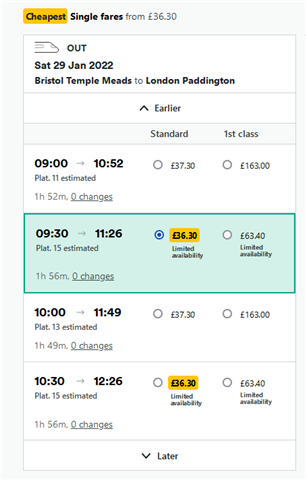
    I will tell you why this "public transport" idea does not work. I wanted to go by train from Bristol to London on 29th of January with my partner. I looked to book but the price is astronomical. We can go standing class for about £300 return, or first for only £700! I call it standing class because there are NO bookable seats! By car, it would cost me a small fraction of this, even with huge parking charges, recently about £70 per day in central London. Of course, I would need a fully charged car so could not trust this system above. Brunel would turn in his grave, and even I have difficulty not doing so, particularly as roads in Bristol have been closed for 2 years due to alleged "electrification", which will be slower than the HS125s we used to have (60 minutes door to door). This minor "upgrade" is taking longer than the original building of the line, so much for progress!

  • An aside on public transportation. Bielefeld-Cologne is further than Temple Meads-Paddington. Standard price just under €100 return second class; €50 if you shell out once a year for a "Bahncard 50" at €230 which halves the cost of any ticket. (Price is per travelled km.)

    I used to be able to get to Bristol by rail from Bielefeld for less than €200 return. (Every couple of years for a conference.) I had to have luck on a €130 ticket to London St. Pancras (it more often cost me €180+), but then Bristol was an add-on €50. As was Oxford, York, Edinburgh......  

    Have you tried flying? :-) 

  • I will tell you why this "public transport" idea does not work. I wanted to go by train from Bristol to London on 29th of January with my partner. I looked to book but the price is astronomical. We can go standing class for about £300 return, or first for only £700!

    I've no idea who you asked about the fares but they seem to have got their decimal points in the wrong place. I've just looked at a well known on-line tail ticket site and both of you should be able to get to London on that date for less than £75. Probably less if you'd booked further in advance or could manage with a less civilised departure time. Return is usually less than two singles.

    and there are options to book seats on the next page too.

    I'd grant you that the rail ticketing system is rather a mess and very confusing to the casual traveller - traditional "walk on" fares have all but disappeared for long distance these days - the train companies much prefer you to book in advance and often operate an "airline" style ticket price system - i.e. the price varies very considerably depending on how many empty seats they think they're going to be left with. Walk-on prices are often pitched to encourage pre-booking, but anyone who can sell you a ticket should really offer you the cheapest available.

    But all that is a consequence of politics and marketing - rather than any fault in the underlying transport technology - and could easily be fixed if the political will existed.

       - Andy.

  • IF you can guarantee to be at the station on time, advance tickets are fine, but if you are late, you pay twice; and if you are early, you get bored.

    Recently, when I had to leave my motor car at the main stealers just under 8 miles away as the crow flies, I thought that I would try out public transport. It took me 2½ hours to get home by public transport.

  • There's some quote along the lines of "you'll have to prise "this is the bit I can't remember" from my cold, dead, fingers" which is how I feel about my 5 cylinder 2.5 litre diesel engined car. I once lived near Swindon and our brood were in London, the sheer cost of using the train, never mind the inconvenience meant we always drove.