


What do you put on an EICR when there is no/faulty smoke detectors in a domestic property?
What do you put on an EICR when there is no/faulty smoke detectors in a domestic property?

That is an interesting and article & indirectly suggests that 80% of fires occur in homes with fire alarms probably because they are pretty common. It is important to balance this with the fact that fires are mercifully rare - most houses will reach demolition and never have seen one, so most of the folk not checking their alarms because it is not very likely, are in a way correct, it is not very likely. (compared to say a car crash or tripping over the stair carpet).
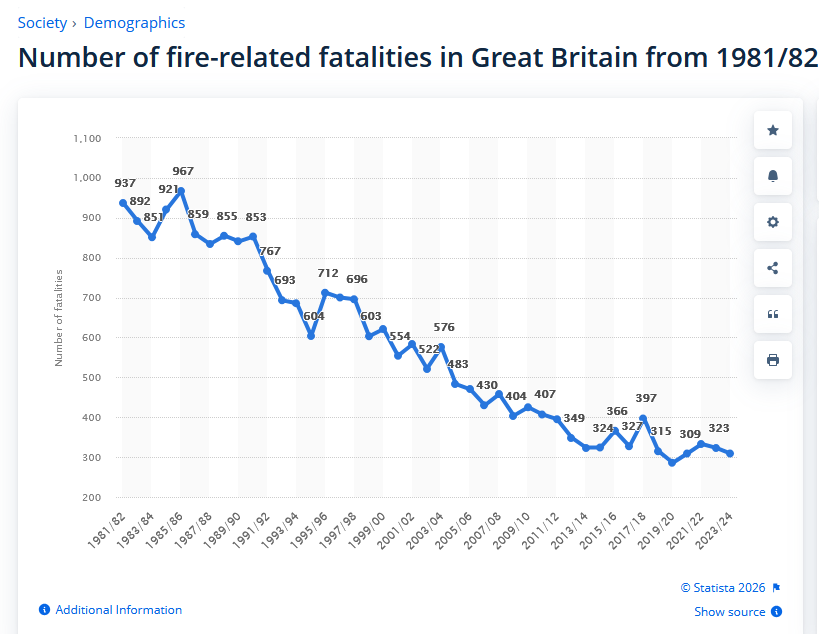
Even if we disabled all fire alarms at once, we'd never get back to the rate we had before they were invented, as we no longer have open fires, or anything like as many people smoking indoors, or worse smoking in bed..
I wonder how much of an up-tick they would consider serious.
Mike.

As a Friday Folly, it would be interesting to see if of all the same people that were surveyed about testing smoke alarms monthly how often they test their RCBO every 6 months. (Hopefully when they change their clocks for daylight saving) I suspect fewer people test their RCD in the UK than test their smoke alarm.
Now this could indeed be masking an issue. Does the RCD actually work as intended?
Eg of fails
Type AC RCBO in the domestic dwelling being blinded by DC
Jamed/Fused/seized mechanism
Unable to re-initialise circuit due to device fault

As far as domestic alarms are concerned, somebody needs to be there to hear them, which isn't much use if vandals have broken in and set fire to the place.
Of course if the real purpose is to alert any occupants so that they may escape, that does not really matter. ;-)
suggests that 80% of fires occur in homes with fire alarms
Well, it is easy to demonstrate associations and give a probability, but much more difficult to show that A caused B, or B caused A, or C caused both short of randomized controlled trials.
I doubt that open fires caused many houses to burn down, but gas appliances still blow up the odd house.
Perhaps people with (functioning) smoke alarms are more risk-averse and, accordingly, careful?
suggests that 80% of fires occur in homes with fire alarms
Well, it is easy to demonstrate associations and give a probability, but much more difficult to show that A caused B, or B caused A, or C caused both short of randomized controlled trials.
I doubt that open fires caused many houses to burn down, but gas appliances still blow up the odd house.
Perhaps people with (functioning) smoke alarms are more risk-averse and, accordingly, careful?
We're about to take you to the IET registration website. Don't worry though, you'll be sent straight back to the community after completing the registration.
Continue to the IET registration site