Cable size between equipotential earth bonding bar and distribution board in a Group 1 medical location

The IET regulations require that the resistance of the conductors, including the resistance of the connections, between the terminals for the protective conductor of socket-outlets and of fixed equipment or any extraneous-conductive-parts and the equipotential bonding busbar (EBB) shall not exceed 0.2 Ω.

However the cable connection between the EBB and the Main Distribution board, is not defined, (identified in red in the image below) - either in terms of:

 1 - maximum resistance 

2 - minimum cable size 

3 - if the cable needs to connect to the distribution board that serves the room or should go back  to the Main distribution board.

4 - if there are number of EBB's can they be connected by a single cable in a daisy chain arrangement back to the distribution board.
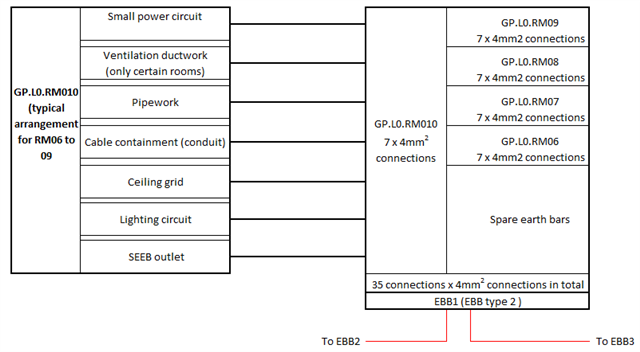
Is any able to provide guidance on the four questions above?

Parents
  • BS 7671 doesn’t specify a minimum size for the conductor between the EBB and the distribution board, but best practice aligns with:

    1. Resistance: Keep total resistance (including terminations) as low as practicable—typically ≤0.2 Ω applies to protective conductors within the location, not the EBB-to-board link.
    2. Size: Match or exceed the largest protective conductor serving circuits in that medical location; often 6 mm² or 10 mm² copper is used.
    3. Connection point: Ideally to the distribution board feeding the Group 1 location, not necessarily the main LV board.
    4. Multiple EBBs: Daisy-chaining is permitted if each link meets continuity and fault-current capacity requirements, but a dedicated radial is preferred for reliability.

    Refer to BS 7671 Section 710 and HTM 06-01 for healthcare-specific bonding guidance.

Reply
  • BS 7671 doesn’t specify a minimum size for the conductor between the EBB and the distribution board, but best practice aligns with:

    1. Resistance: Keep total resistance (including terminations) as low as practicable—typically ≤0.2 Ω applies to protective conductors within the location, not the EBB-to-board link.
    2. Size: Match or exceed the largest protective conductor serving circuits in that medical location; often 6 mm² or 10 mm² copper is used.
    3. Connection point: Ideally to the distribution board feeding the Group 1 location, not necessarily the main LV board.
    4. Multiple EBBs: Daisy-chaining is permitted if each link meets continuity and fault-current capacity requirements, but a dedicated radial is preferred for reliability.

    Refer to BS 7671 Section 710 and HTM 06-01 for healthcare-specific bonding guidance.

Children
No Data