Cable size between equipotential earth bonding bar and distribution board in a Group 1 medical location

The IET regulations require that the resistance of the conductors, including the resistance of the connections, between the terminals for the protective conductor of socket-outlets and of fixed equipment or any extraneous-conductive-parts and the equipotential bonding busbar (EBB) shall not exceed 0.2 Ω.

However the cable connection between the EBB and the Main Distribution board, is not defined, (identified in red in the image below) - either in terms of:

 1 - maximum resistance 

2 - minimum cable size 

3 - if the cable needs to connect to the distribution board that serves the room or should go back  to the Main distribution board.

4 - if there are number of EBB's can they be connected by a single cable in a daisy chain arrangement back to the distribution board.
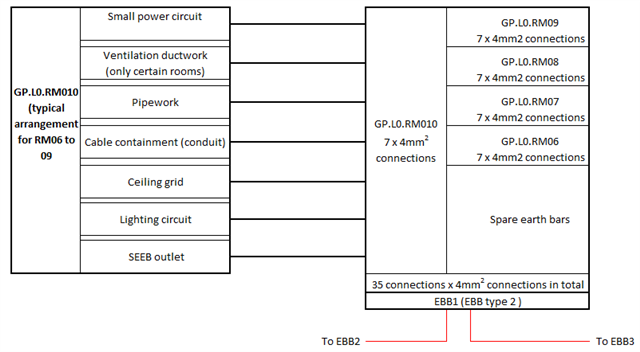
Is any able to provide guidance on the four questions above?

  • However the cable connection between the EBB and the Main Distribution board, is not defined, (identified in red in the image below) - either in terms of:
    2 - minimum cable size

    710.415.2.3 The EBB shall be connected to the system earthing using a protective conductors having a cross-sectional area greater than or equal to the largest cross-sectional area of any conductor connected to the EBB.

    4 - if there are number of EBB's can they be connected by a single cable in a daisy chain arrangement back to the distribution board.

    Connections shall be so arranged that they ... can be individually disconnected.

    To my mind, that is not consistent with a "daisy chain".

  • Thank  you for that.

    Question 1 and 2 - is answered by regulation 710.415.2.3 

    Question 4 - is answered: they should be individual connections so that they can be individually disconnected

    Can you advise regarding Question 3?

    - if the cable needs to connect to the distribution board that serves the room or should go back  to the Main distribution board.

  • Well, 710.415.2.3 is silent on the location, so I would say anywhere. Fig 710.2, which shows a typical theatre layout, simply has a bit of G/Y labelled, "CONNECTION TO PROTECTIVE EARTH IN DISTRIBUTION SYSTEM". One end is connected to the EBB and the other to a rectangle labelled, "TN DISTRIBUTION SYSTEM" from which I conclude that the local DB rather than the origin suffices.

    HTH.

  • BS 7671 doesn’t specify a minimum size for the conductor between the EBB and the distribution board, but best practice aligns with:

    1. Resistance: Keep total resistance (including terminations) as low as practicable—typically ≤0.2 Ω applies to protective conductors within the location, not the EBB-to-board link.
    2. Size: Match or exceed the largest protective conductor serving circuits in that medical location; often 6 mm² or 10 mm² copper is used.
    3. Connection point: Ideally to the distribution board feeding the Group 1 location, not necessarily the main LV board.
    4. Multiple EBBs: Daisy-chaining is permitted if each link meets continuity and fault-current capacity requirements, but a dedicated radial is preferred for reliability.

    Refer to BS 7671 Section 710 and HTM 06-01 for healthcare-specific bonding guidance.

  • The 0.2 Ω limit applies to all protective conductor connections to the EBB. Between the EBB and the main board, the cable should be sized for fault current (typically ≥6 mm² copper) and can either connect directly to the main board or via local distribution, as long as total resistance stays ≤0.2 Ω. Daisy-chaining multiple EBBs is acceptable if this criterion is met. Always verify with post-installation testing (BS 7671).

  • There is another criterion not listed in the OP.

    Effectively, Regulation 710.411.3.2.5 imposes a touch-voltage limit of 25 V AC / 60 V DC (see Regulation 710.415.2.2).

    This effectively modifies the formulae in Regulation 415.2.2 to:

    R ≤ (50 V)/Ia for AC circuits

    R ≤ (120 V)/Ia for DC circuits

  • Good point. The touch-voltage limits (25 V AC / 60 V DC) indeed set the maximum earth resistance for safe operation. Using a practical approach often recommended for protective device calculations:

    AC circuits: R<50/Ia

    DC circuits: R<120/Ia

    This ensures that protective devices operate quickly enough to prevent hazardous touch voltages. It’s especially relevant in IT supply systems or where earth faults may not immediately clear.

    Worth noting: the “50 V / 120 V” approach is a conservative interpretation to account for device operating times and tolerances, not the absolute touch-voltage limits.

  • This ensures that protective devices operate quickly enough to prevent hazardous touch voltages.

    More the other way around, I'd suggest. Supplementary bonding provides no guarantees to reduce Zs, but rather it limits the available touch voltages within the location. Note that Ia relates to rather long (5s) disconnection times (pretty useless for shock protection by itself) and so much higher touch voltages may well occur where disconnection times are shorter (because the actual fault currents would be higher than Ia).

    For most common protective devices there is a relationship though - if a fault current that yields 50V opens the device within 5s, then all else being equal if the current increases to what would produce 120V then it should open within 0.4s and 0.2s for 240V etc. or thereabouts. - so the 50V rule is more of a barometer for staying below the C1 curve rather than an absolute limit of itself. Substituting 25V for 50V just halves the height of that performance curve.

       - Andy.

  • More the other way around, I'd suggest. Supplementary bonding provides no guarantees to reduce Zs, but rather it limits the available touch voltages within the location.

    Yes ... and no.

    There's no guarantee the touch-voltage will be limited to 50 V AC or 120 V DC (in general, Section 415, or in medical locations, 25 V AC or 60 V DC, Section 710). However, if the touch-voltage is not limited to those voltages, a protective device will operate.

    The voltages are therefore only limited to the stated voltages for fault currents that won't operate the protective device in time ... so where, according to Section 419, disconnection times can't be met, and supplementary local equipotential bonding is applied, the touch-voltages are limited to 50 V AC or 120 V DC (in general) or 25 V AC or 60 V DC (in medical locations according to Section 710), because the prospective fault current has not reached Ia.

    This ensures that protective devices operate quickly enough to prevent hazardous touch voltages.

    Well, again, not quite.

    As described above, the real situation is a combination of the responses from  and  .

    In short:

    Supplementary local equipotential bonding limits the touch-voltage between simultaneously-accessible exposed-conductive-parts in faults where protective devices cannot operate in the specified time. In cases where protective devices operate in the specified time, the touch-voltage can be reduced, but unless R≤Utouch-voltage-limit/Ipf, the touch-voltage will not necessarily be limited to the relevant touch voltage limit Utouch-voltage-limit (25 V AC, 50 V AC, 60 V DC or 120 V DC depending on whether general rules or Section 710 applies) for the given prospective fault current Ipf.

  • In cases where protective devices operate in the specified time, the touch-voltage can be reduced, but unless R≤Utouch-voltage-limit/Ipf, the touch-voltage will not necessarily be limited to the relevant touch voltage limit Utouch-voltage-limit (25 V AC, 50 V AC, 60 V DC or 120 V DC depending on whether general rules or Section 710 applies) for the given prospective fault current Ipf.

    In practice, calculating what the actual touch-voltage might be between any two simultaneously-accessible exposed-conductive-parts is very difficult because of parallel paths, which is why we need to stick to 'theoretical maxima' based on some current or other, either Ia or Ipf. Unless the CPCs connecting the two simultaneously-accessible exposed-conductive-parts are relied upon for the bonding, The actual touch-voltage is typically less than the theoretical maximum for the given current, because not all of that current flows in one conductor.