Cable size between equipotential earth bonding bar and distribution board in a Group 1 medical location

The IET regulations require that the resistance of the conductors, including the resistance of the connections, between the terminals for the protective conductor of socket-outlets and of fixed equipment or any extraneous-conductive-parts and the equipotential bonding busbar (EBB) shall not exceed 0.2 Ω.

However the cable connection between the EBB and the Main Distribution board, is not defined, (identified in red in the image below) - either in terms of:

 1 - maximum resistance 

2 - minimum cable size 

3 - if the cable needs to connect to the distribution board that serves the room or should go back  to the Main distribution board.

4 - if there are number of EBB's can they be connected by a single cable in a daisy chain arrangement back to the distribution board.
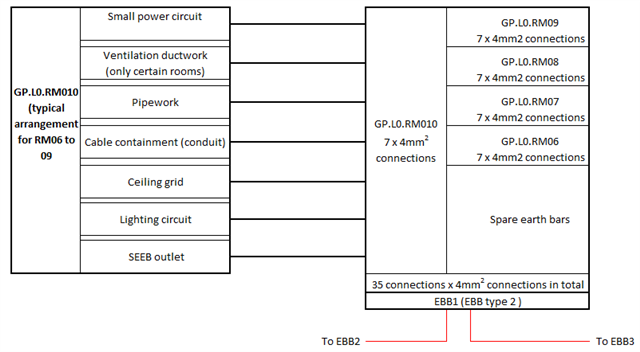
Is any able to provide guidance on the four questions above?

Parents
  • There is another criterion not listed in the OP.

    Effectively, Regulation 710.411.3.2.5 imposes a touch-voltage limit of 25 V AC / 60 V DC (see Regulation 710.415.2.2).

    This effectively modifies the formulae in Regulation 415.2.2 to:

    R ≤ (50 V)/Ia for AC circuits

    R ≤ (120 V)/Ia for DC circuits

Reply
  • There is another criterion not listed in the OP.

    Effectively, Regulation 710.411.3.2.5 imposes a touch-voltage limit of 25 V AC / 60 V DC (see Regulation 710.415.2.2).

    This effectively modifies the formulae in Regulation 415.2.2 to:

    R ≤ (50 V)/Ia for AC circuits

    R ≤ (120 V)/Ia for DC circuits

Children
  • Good point. The touch-voltage limits (25 V AC / 60 V DC) indeed set the maximum earth resistance for safe operation. Using a practical approach often recommended for protective device calculations:

    AC circuits: R<50/Ia

    DC circuits: R<120/Ia

    This ensures that protective devices operate quickly enough to prevent hazardous touch voltages. It’s especially relevant in IT supply systems or where earth faults may not immediately clear.

    Worth noting: the “50 V / 120 V” approach is a conservative interpretation to account for device operating times and tolerances, not the absolute touch-voltage limits.

  • This ensures that protective devices operate quickly enough to prevent hazardous touch voltages.

    More the other way around, I'd suggest. Supplementary bonding provides no guarantees to reduce Zs, but rather it limits the available touch voltages within the location. Note that Ia relates to rather long (5s) disconnection times (pretty useless for shock protection by itself) and so much higher touch voltages may well occur where disconnection times are shorter (because the actual fault currents would be higher than Ia).

    For most common protective devices there is a relationship though - if a fault current that yields 50V opens the device within 5s, then all else being equal if the current increases to what would produce 120V then it should open within 0.4s and 0.2s for 240V etc. or thereabouts. - so the 50V rule is more of a barometer for staying below the C1 curve rather than an absolute limit of itself. Substituting 25V for 50V just halves the height of that performance curve.

       - Andy.