Cable size between equipotential earth bonding bar and distribution board in a Group 1 medical location

The IET regulations require that the resistance of the conductors, including the resistance of the connections, between the terminals for the protective conductor of socket-outlets and of fixed equipment or any extraneous-conductive-parts and the equipotential bonding busbar (EBB) shall not exceed 0.2 Ω.

However the cable connection between the EBB and the Main Distribution board, is not defined, (identified in red in the image below) - either in terms of:

 1 - maximum resistance 

2 - minimum cable size 

3 - if the cable needs to connect to the distribution board that serves the room or should go back  to the Main distribution board.

4 - if there are number of EBB's can they be connected by a single cable in a daisy chain arrangement back to the distribution board.
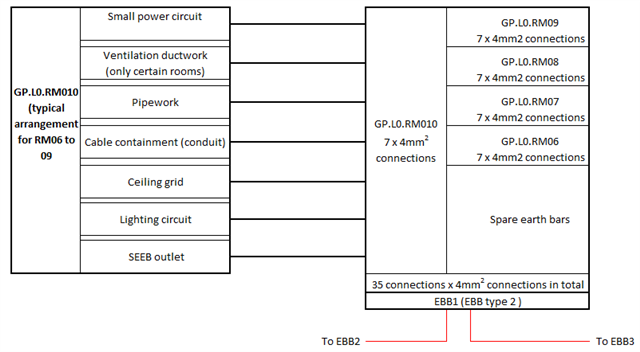
Is any able to provide guidance on the four questions above?

Parents
  • More the other way around, I'd suggest. Supplementary bonding provides no guarantees to reduce Zs, but rather it limits the available touch voltages within the location.

    Yes ... and no.

    There's no guarantee the touch-voltage will be limited to 50 V AC or 120 V DC (in general, Section 415, or in medical locations, 25 V AC or 60 V DC, Section 710). However, if the touch-voltage is not limited to those voltages, a protective device will operate.

    The voltages are therefore only limited to the stated voltages for fault currents that won't operate the protective device in time ... so where, according to Section 419, disconnection times can't be met, and supplementary local equipotential bonding is applied, the touch-voltages are limited to 50 V AC or 120 V DC (in general) or 25 V AC or 60 V DC (in medical locations according to Section 710), because the prospective fault current has not reached Ia.

    This ensures that protective devices operate quickly enough to prevent hazardous touch voltages.

    Well, again, not quite.

    As described above, the real situation is a combination of the responses from  and  .

    In short:

    Supplementary local equipotential bonding limits the touch-voltage between simultaneously-accessible exposed-conductive-parts in faults where protective devices cannot operate in the specified time. In cases where protective devices operate in the specified time, the touch-voltage can be reduced, but unless R≤Utouch-voltage-limit/Ipf, the touch-voltage will not necessarily be limited to the relevant touch voltage limit Utouch-voltage-limit (25 V AC, 50 V AC, 60 V DC or 120 V DC depending on whether general rules or Section 710 applies) for the given prospective fault current Ipf.

  • In cases where protective devices operate in the specified time, the touch-voltage can be reduced, but unless R≤Utouch-voltage-limit/Ipf, the touch-voltage will not necessarily be limited to the relevant touch voltage limit Utouch-voltage-limit (25 V AC, 50 V AC, 60 V DC or 120 V DC depending on whether general rules or Section 710 applies) for the given prospective fault current Ipf.

    In practice, calculating what the actual touch-voltage might be between any two simultaneously-accessible exposed-conductive-parts is very difficult because of parallel paths, which is why we need to stick to 'theoretical maxima' based on some current or other, either Ia or Ipf. Unless the CPCs connecting the two simultaneously-accessible exposed-conductive-parts are relied upon for the bonding, The actual touch-voltage is typically less than the theoretical maximum for the given current, because not all of that current flows in one conductor.

  • so where, according to Section 419, disconnection times can't be met, and supplementary local equipotential bonding is applied, the touch-voltages are limited

    Although it us unusual for section 419 to apply - in common circumstances ADS for all the circuits in the location will work well within the times specified in section 411 (let alone 5s), but still supplementary bonding (in medical locations) is required. So I suspect it's as much a case of reducing touch voltages during ADS disconnection times as far as reasonably practical, rather than just covering cases where ADS doesn't occur (in time).

    Ditto in bathrooms - supplementary bonding is still demanded where not all circuits have 30mA RCD protection - even if all circuits have disconnections times <0.4s by MCB or fuse.

       - Andy.

  • So I suspect it's as much a case of reducing touch voltages during ADS disconnection times as far as reasonably practical, rather than just covering cases where ADS doesn't occur (in time).

    In general, yes, for socket-outlets and most equipment fed from the TN or TT supply ... the medical IT system, slightly different perhaps as it's not designed to disconnect on first fault, but for those circuits, Ia would be selected for the protective device(s) that are intended to operate on a second fault.

    Ditto in bathrooms - supplementary bonding is still demanded where not all circuits have 30mA RCD protection - even if all circuits have disconnections times <0.4s by MCB or fuse

    Agreed, although that still permits up to 50 V AC touch-voltage, which, granted, has not been seen to be problematic in causing death, but certainly I think it's the current [excuse the pun] thinking that 50 V AC wouldn't necessarily protect someone who is submerged in a bath.

Reply
  • So I suspect it's as much a case of reducing touch voltages during ADS disconnection times as far as reasonably practical, rather than just covering cases where ADS doesn't occur (in time).

    In general, yes, for socket-outlets and most equipment fed from the TN or TT supply ... the medical IT system, slightly different perhaps as it's not designed to disconnect on first fault, but for those circuits, Ia would be selected for the protective device(s) that are intended to operate on a second fault.

    Ditto in bathrooms - supplementary bonding is still demanded where not all circuits have 30mA RCD protection - even if all circuits have disconnections times <0.4s by MCB or fuse

    Agreed, although that still permits up to 50 V AC touch-voltage, which, granted, has not been seen to be problematic in causing death, but certainly I think it's the current [excuse the pun] thinking that 50 V AC wouldn't necessarily protect someone who is submerged in a bath.

Children
No Data