Cable size between equipotential earth bonding bar and distribution board in a Group 1 medical location

The IET regulations require that the resistance of the conductors, including the resistance of the connections, between the terminals for the protective conductor of socket-outlets and of fixed equipment or any extraneous-conductive-parts and the equipotential bonding busbar (EBB) shall not exceed 0.2 Ω.

However the cable connection between the EBB and the Main Distribution board, is not defined, (identified in red in the image below) - either in terms of:

 1 - maximum resistance 

2 - minimum cable size 

3 - if the cable needs to connect to the distribution board that serves the room or should go back  to the Main distribution board.

4 - if there are number of EBB's can they be connected by a single cable in a daisy chain arrangement back to the distribution board.
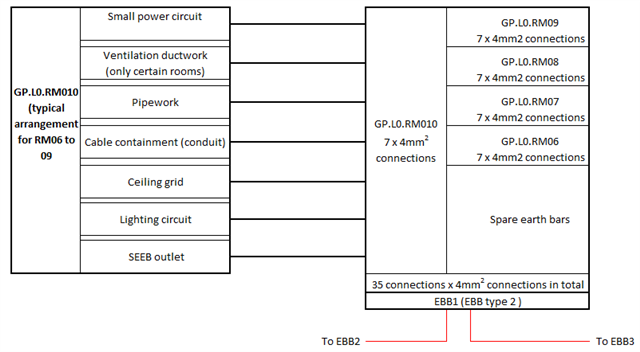
Is any able to provide guidance on the four questions above?

Parents
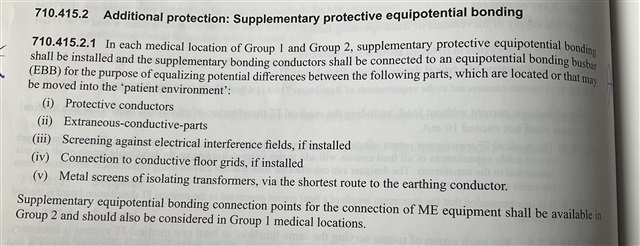
  • The requirement is for Supplementary protective equipotential bonding:

    A quote from The IET Wiring Matters issue 76 July 2019.

    What is supplementary protective bonding?

    A supplementary protective bonding conductor is used to connect simultaneously accessible exposed conductive parts and accessible extraneous-conductive-parts to prevent a hazardous potential difference from occurring between them. It is usually only required in special locations, such as rooms containing a bath or shower or when automatic disconnection of the supply cannot be achieved.

    https://electrical.theiet.org/media/2139/issue-76-july-2019.pdf

    So, are the touch voltages and circuit protective devices disconnection times completely irrelevant, because both the parts you may be simultaneously touching could have 240 volts on them indefinitely and that is the issue the Additional Protection provided by the supplementary protective equipotential bonding is intended to resolve?

  • So, are the touch voltages and circuit protective devices disconnection times completely irrelevant, because both the parts you may be simultaneously touching could have 240 volts on them indefinitely and that is the issue the Additional Protection provided by the supplementary protective equipotential bonding is intended to resolve?

    It would only work that way, if you based the resistance between simultaneously-accessible conductive parts on achieving the relevant voltage for the prospective fault current ... but the formulas in 415.2 bases it on Ia, not Ipf.

    There is a good reason to do so

    BS7671 does not actually mention “Touch voltage” it refers to simultaneously accessible parts.

    Agreed ... but we do see the term in the latest IEC 60364-7-710, and also we saw it in the Draft for Public Comment for what is now planned to be Amendment 4:2026.

    Whilst what we are talking about is a hand-to-hand touch-voltage, I agree that BS 7671 and IEC 60364-7-710 appears to be happy with a calculation based on Ia and a voltage of 25 V AC / 60 V DC, with a stipulated maximum resistance of 0.2 Ω, whereas product standards would measure touch-voltage and touch-current with a test circuit that mirrors a theoretical impedance of the human body.

    There's certainly a very good reason NOT to do that in Sections 701, 702 and 710 ... because the body impedance under some conditions in those locations is, to the best of my knowledge, not accurately known, or at least documented, at this time.

Reply
  • So, are the touch voltages and circuit protective devices disconnection times completely irrelevant, because both the parts you may be simultaneously touching could have 240 volts on them indefinitely and that is the issue the Additional Protection provided by the supplementary protective equipotential bonding is intended to resolve?

    It would only work that way, if you based the resistance between simultaneously-accessible conductive parts on achieving the relevant voltage for the prospective fault current ... but the formulas in 415.2 bases it on Ia, not Ipf.

    There is a good reason to do so

    BS7671 does not actually mention “Touch voltage” it refers to simultaneously accessible parts.

    Agreed ... but we do see the term in the latest IEC 60364-7-710, and also we saw it in the Draft for Public Comment for what is now planned to be Amendment 4:2026.

    Whilst what we are talking about is a hand-to-hand touch-voltage, I agree that BS 7671 and IEC 60364-7-710 appears to be happy with a calculation based on Ia and a voltage of 25 V AC / 60 V DC, with a stipulated maximum resistance of 0.2 Ω, whereas product standards would measure touch-voltage and touch-current with a test circuit that mirrors a theoretical impedance of the human body.

    There's certainly a very good reason NOT to do that in Sections 701, 702 and 710 ... because the body impedance under some conditions in those locations is, to the best of my knowledge, not accurately known, or at least documented, at this time.

Children
No Data