How might the proposed changes to UK mains voltage limits affect older electrical infrastructure?

Hi all,
I’m looking for some expert insight into how proposed changes to UK mains voltage limits, particularly any shift away from the nominal 230 to 240 volt range, might affect older electrical infrastructure.
Our site is fed directly from a DNO transformer, although only two of its output connections are currently in use and we’re unsure how many it has in total. The infrastructure was originally designed and installed in the 1980s and includes legacy three-phase motors and analogue control systems that were built to operate on 240 volts single-phase and 440 volts three-phase.
We also have a step-down transformer that is fed by a three-phase 125 amp supply and provides 110 volts at 50 hertz. This is used to meet extra-low voltage requirements in our training environment. In addition, there is a separate system currently locked out that runs on 115 volts at 60 hertz, which is temporarily offline due to a failed frequency converter. This is scheduled for replacement shortly.
I’m particularly interested in understanding how any changes to mains voltage might affect the transformers themselves, both the DNO-fed unit and our internal step-down transformers. I would also appreciate any thoughts on the risks to analogue control systems calibrated for 240 and 440 volts, potential safety or compliance concerns from undervoltage or harmonics introduced by modern supply variations, and any practical mitigation strategies or retrofit options for mixed-voltage and mixed-frequency setups.
Any advice, experiences, or references to standards would be greatly appreciated.
Thanks in advance
  • www.eca.co.uk/.../ena-consultation-on-change-to-lower-statutory-voltage-limit

  • Opening the 'acceptable' voltage eye too wide also rather degrades the idea of the O-PEN detection by voltage deviation as it decreases the range of fault conditions that can be detected with good confidence.

    This MIGHT require a manual firmware update in a working EV charger at your own cost or that of the installer

  • I'm not saying the trip constants cannot be modified - more that now the range of possible phase imbalances that might exist that could mask the detection of an open circuit PEN, and the effective voltage offset between neutral/CPC  and true earth before it is guaranteed to operate is increased.

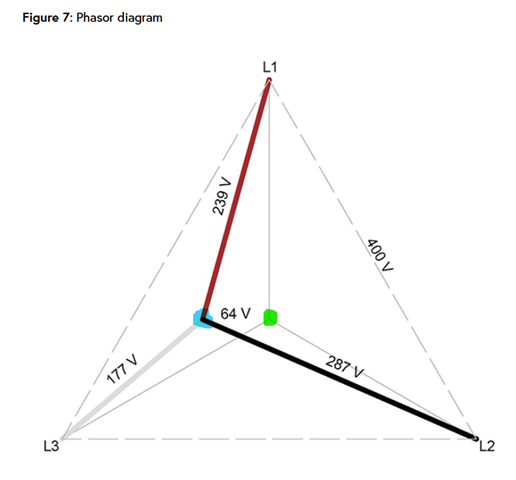
    Consider this vectorgram lifted from an earlier topic A charger on L1 does not disconnect, but clearly things are not going well.

    If the 3 sides are not 400V to start with, but instead allowed to wander in 'length' independently anywhere between 360 to 440 (*), then the range of triangle shapes is such that the overlap between legitimate conditions that must not trip, and fault conditions that we therefore cannot detect, increases, and in area terms by about 40%. In terms of probability, it may be worse than that, as if the normal load state is some reasonable attempt at balance, then it may be that the most likely resultant condition for a fault state is to be dis-proportionally near the centre - not all areas inside the triangle are equally probable, but I have no numerical evidence for the degree of that.

    For example,

    1) if a phase to phase voltage of 440 is just about OK, and yet a phase to neutral voltage of 220 is also OK, then one undetectable condition is total loss of load on one phase and equal loads on the remaining 2 well balanced ones, so that the false neutral is centred between the 2 equally loaded phases, in effect the mid point of the side of the triangle.


    It is a standards fix to save on network reinforcement, so I expect it will come anyway,  and most things will be fine, but a few unlucky customers may have issues, and we need to understand what they are.

    Mike

    * I'm not sure of the independence either, as substations are Delta-star windings, and the angle between generator phases is the thing that is fixed, so perhaps not all triangle shapes are possible. 

  • This is a very pertinent question, particularly for legacy 1980s installations.

    Firstly, it is worth noting that the UK supply has been nominally 230 V since harmonisation, but in practice remains within the statutory tolerance defined in ESQCR and BS EN 50160 (typically 216–253 V). Therefore, most equipment originally designed for 240 V single-phase and 415/440 V three-phase has generally continued to operate without significant issues.

    Regarding transformers, both the DNO distribution transformer and internal step-down units are usually designed to accommodate ±10% voltage variation. The main concern would be thermal loading under sustained overvoltage conditions rather than immediate functional failure. Tap settings on the LV side may also be relevant if site voltage is consistently high.

    For legacy three-phase motors rated 440 V, operation on today’s nominal 400 V supply is typically acceptable, with only a modest reduction in torque margin. The more critical risks tend to arise from undervoltage effects on control circuits (relay chatter, contactor drop-out) rather than on the motors themselves.

    Analogue control systems calibrated for fixed 240/440 V supplies may indeed be more sensitive to modern power quality issues, particularly harmonics introduced by VSDs, UPS systems and EV charging. A power quality survey (voltage profile, THD, flicker) would be a sensible first step.

    In terms of mitigation, practical options include reviewing transformer tap positions, ensuring control transformers are correctly rated, and considering modernisation of critical analogue control components. Reference documents would include BS 7671, BS EN 50160 and IET Guidance Note 1/Power Quality.

    Overall, the change in nominal voltage itself is unlikely to be the primary issue — supply variation and power quality in mixed legacy/modern environments are usually the key factors.