PV Inverters - Some questions of understanding

Good afternoon

For the first time I was called to do a PV design for a hotel we are designing so excuse my 'beginner level' questions I am going to ask.

We have established (through the energy efficiency report) that we need 35kWp of PV panels on the roof.

The inverter I am thinking to use has max DC power 37.5kW to cover for the 35kWp we need.

The inverter say in the specs 3 MPPTs , 2 strings per MPPT.

Some initial questions

1. When the inverter say max DC power 37.5kW should I assume that this is the total sum across all 6 strings that can be connected?

2. Should I assume that the 2 strings per MPPT are connected internally within the inverter in parallel? Or i dont know what I am talking about? Because if the two strings of each MPPT are internally connected in parallel then I have to balance the voltages of the 2 strings to be quite equal. If they are connected internally in series then the voltages add and I may exceed the max voltage allowed. Or maybe they are not connected at all inside the inverter and they stay independent. Sorry if the question is a bit stupid. I am trying to understand what does the 2 strings per MPPT mean 

This is the terminals picture if it helps
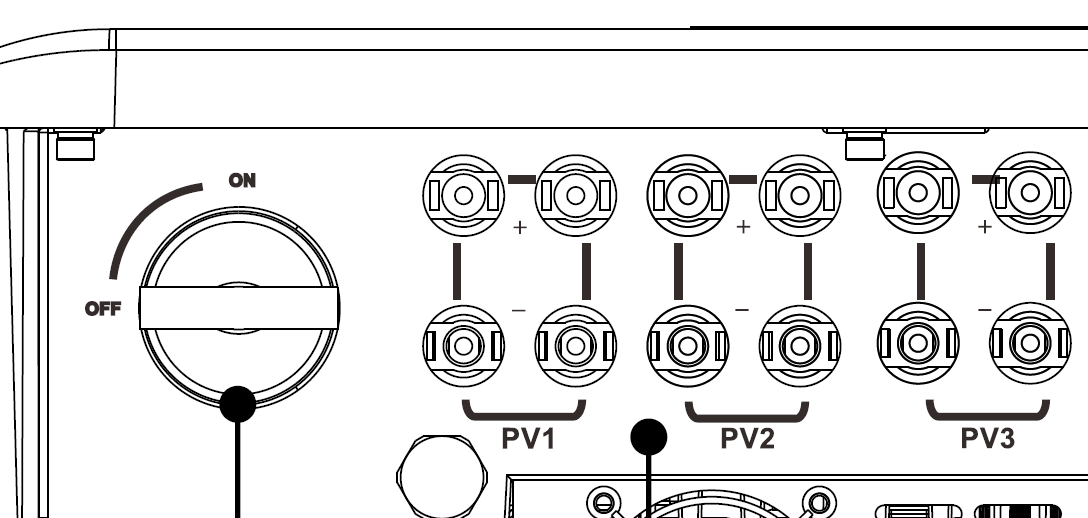
3. The AC power of the inverter is going to be balanced (current per phase) or it somehow depends on how I connect the strings on the DC side?


Any help will be much appreciated

Parents
  • We have established (through the energy efficiency report) that we need 35kWp of PV panels on the roof.

    Assumedly there's a definition in terms of actual energy performance somewhere, rather than just a rating. Do please check because this will affect what shading is acceptable, orientation etc, and also protect you against claims of underperformance in the future. You then need to do some calculations - or preferably, modelllng - to demonstate that it will meet that.

    1. When the inverter say max DC power 37.5kW should I assume that this is the total sum across all 6 strings that can be connected?

    As an overview, yes. But most of the time individual MPPTs also have separate ratings which you will need to check the manufacturer's data for. These may be neither symmetrical (I know of inverters which have an "A" MPPT greater than its "B" MPPT, the idea being you get a nice arrangement onto A with stragglers collected onto B) nor be a simple third of the total rating

    Should I assume that the 2 strings per MPPT are connected internally within the inverter in parallel?

    Yes. There will be no protection between strings "within" an MPPT group, unless otherwise specified. Hence for more than 2 strings you will likely need fuses to protect against reverse power overcurrents.

    Because if the two strings of each MPPT are internally connected in parallel then I have to balance the voltages of the 2 strings to be quite equal

    Yes they are and yes you do, exactly equal. I.e. same number of modules per string, in the same orientation.

    There are multiple "stages" within an inverter. An MPPT is a DC-DC converter which pushes DC current onto a common DC bus feeding the inverter bridge which converts the DC to AC. It is the MPPT which "chooses" the array operating voltage (by PWM shenanigans) to find the optimim point on the IV curve it's presented with, so having separate MPPTs means you can have different parts of the array operate independently, reducing mismatch effects.

    3. The AC power of the inverter is going to be balanced (current per phase) or it somehow depends on how I connect the strings on the DC side?

    Yes (unless somehow you've got several single phase inverters).

    Many inverters don't actually need a neutral (but many do for the auxiliaries, and lots would need to be reconfigured for G99 checks etc so don't omit it without reading the manual!)

    Any help will be much appreciated

    I know it's not a design manual but I strongly recommend you review the IET CoP for PV

Reply
  • We have established (through the energy efficiency report) that we need 35kWp of PV panels on the roof.

    Assumedly there's a definition in terms of actual energy performance somewhere, rather than just a rating. Do please check because this will affect what shading is acceptable, orientation etc, and also protect you against claims of underperformance in the future. You then need to do some calculations - or preferably, modelllng - to demonstate that it will meet that.

    1. When the inverter say max DC power 37.5kW should I assume that this is the total sum across all 6 strings that can be connected?

    As an overview, yes. But most of the time individual MPPTs also have separate ratings which you will need to check the manufacturer's data for. These may be neither symmetrical (I know of inverters which have an "A" MPPT greater than its "B" MPPT, the idea being you get a nice arrangement onto A with stragglers collected onto B) nor be a simple third of the total rating

    Should I assume that the 2 strings per MPPT are connected internally within the inverter in parallel?

    Yes. There will be no protection between strings "within" an MPPT group, unless otherwise specified. Hence for more than 2 strings you will likely need fuses to protect against reverse power overcurrents.

    Because if the two strings of each MPPT are internally connected in parallel then I have to balance the voltages of the 2 strings to be quite equal

    Yes they are and yes you do, exactly equal. I.e. same number of modules per string, in the same orientation.

    There are multiple "stages" within an inverter. An MPPT is a DC-DC converter which pushes DC current onto a common DC bus feeding the inverter bridge which converts the DC to AC. It is the MPPT which "chooses" the array operating voltage (by PWM shenanigans) to find the optimim point on the IV curve it's presented with, so having separate MPPTs means you can have different parts of the array operate independently, reducing mismatch effects.

    3. The AC power of the inverter is going to be balanced (current per phase) or it somehow depends on how I connect the strings on the DC side?

    Yes (unless somehow you've got several single phase inverters).

    Many inverters don't actually need a neutral (but many do for the auxiliaries, and lots would need to be reconfigured for G99 checks etc so don't omit it without reading the manual!)

    Any help will be much appreciated

    I know it's not a design manual but I strongly recommend you review the IET CoP for PV

Children
No Data