PV Inverters - Some questions of understanding

Good afternoon

For the first time I was called to do a PV design for a hotel we are designing so excuse my 'beginner level' questions I am going to ask.

We have established (through the energy efficiency report) that we need 35kWp of PV panels on the roof.

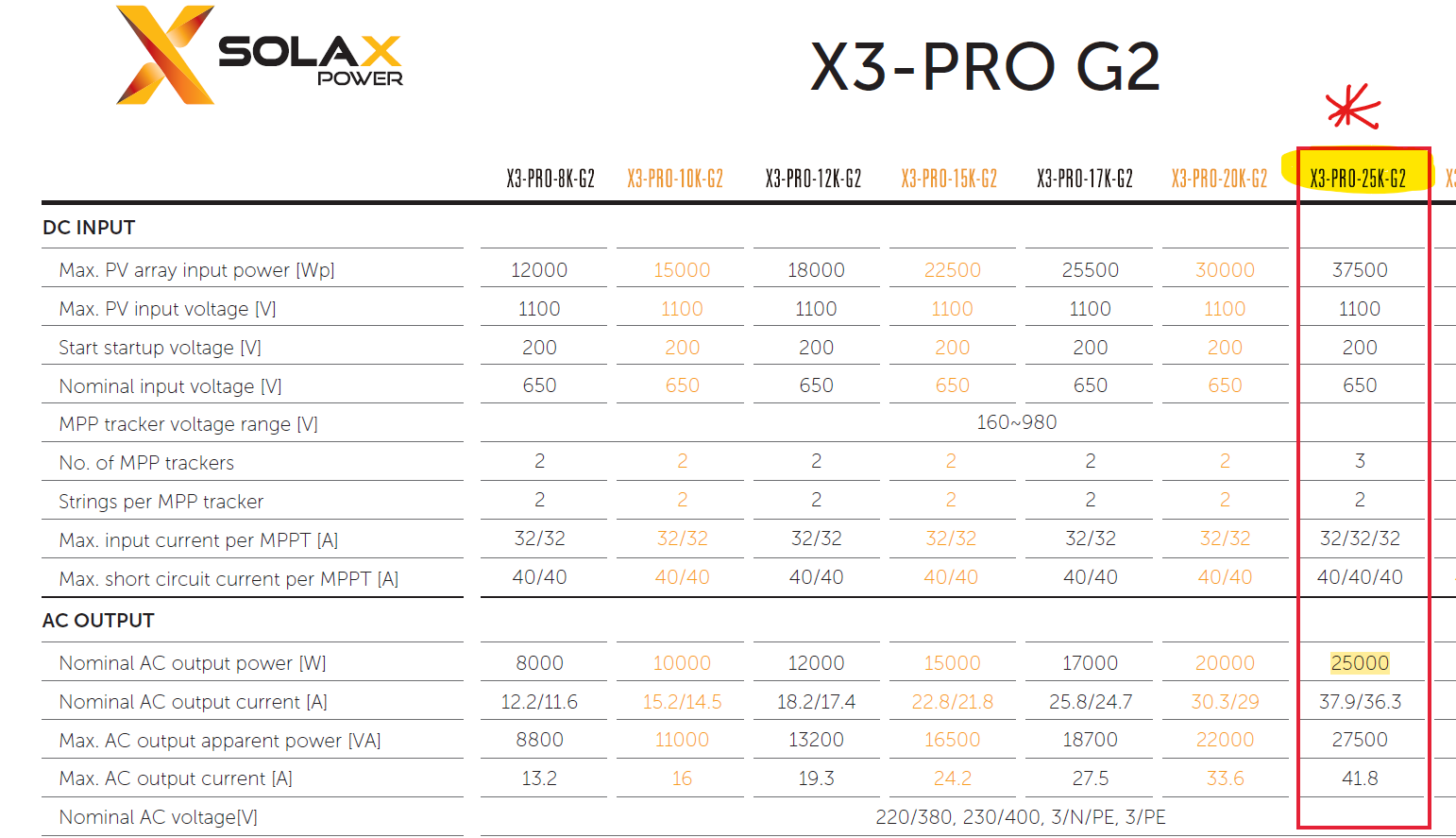
The inverter I am thinking to use has max DC power 37.5kW to cover for the 35kWp we need.

The inverter say in the specs 3 MPPTs , 2 strings per MPPT.

Some initial questions

1. When the inverter say max DC power 37.5kW should I assume that this is the total sum across all 6 strings that can be connected?

2. Should I assume that the 2 strings per MPPT are connected internally within the inverter in parallel? Or i dont know what I am talking about? Because if the two strings of each MPPT are internally connected in parallel then I have to balance the voltages of the 2 strings to be quite equal. If they are connected internally in series then the voltages add and I may exceed the max voltage allowed. Or maybe they are not connected at all inside the inverter and they stay independent. Sorry if the question is a bit stupid. I am trying to understand what does the 2 strings per MPPT mean 

This is the terminals picture if it helps
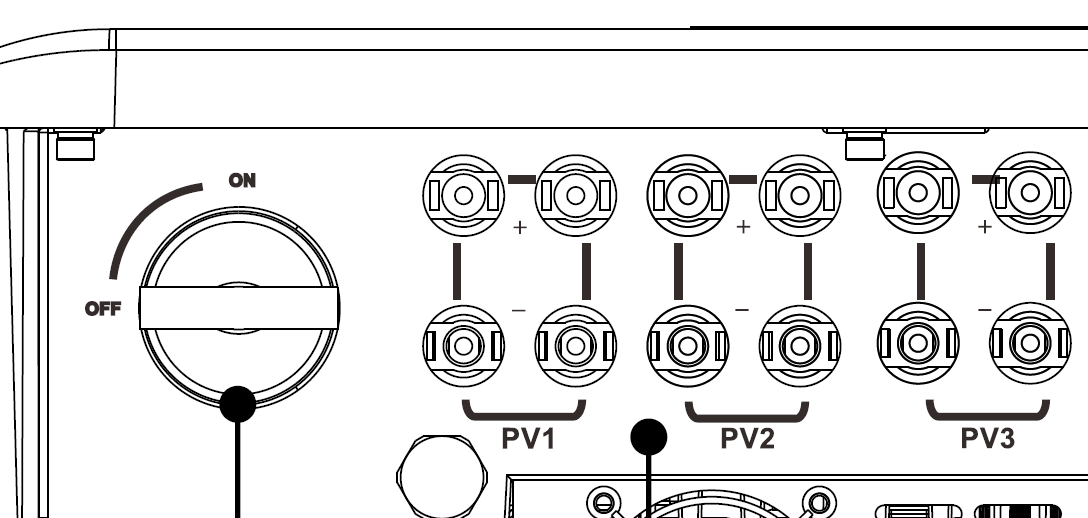
3. The AC power of the inverter is going to be balanced (current per phase) or it somehow depends on how I connect the strings on the DC side?


Any help will be much appreciated

  • When the inverter say max DC power 37.5kW should I assume that this is the total sum across all 6 strings that can be connected?

    I'd say that was the maximum total - there might even be an assumption that it's evenly divided (e.g. max 12.5kW per MPPT or max 6.25kW per string). It's not unknown for inverters to be rated somewhat lower than the panel outputs though - on the basis that much of the UK (especially more northern areas) don't ever get to 'standard' conditions, and the loss of output on the rare occasions output is maxed out doesn't justify the cost of a larger inverter (I've a 2.14kWp system with a 2kW inverter).

    what does the 2 strings per MPPT mean 

    Good question about the series/parallel connection internally - I don't know, I'd suggest asking the manufacturer. But on the basis of the MPPT is meant to optimise the panel outputs I would have thought the two strings would have to be pretty much matched for it to work properly - i.e. same number of same type of panels, subject to the same aspect/shading - otherwise what'll be optimal for one string won't be optimal for the other. I could be wrong, but that's my (erring on the side of safety) guess.


    The AC power of the inverter is going to be balanced (current per phase) or it somehow depends on how I connect the strings on the DC side?

    I would hope that everything went onto the same DC bus and the three inverters ran from there - often you have two MPPTs on single phase inverters - and one might be used for East facing panels and the other for West facing. It would be odd if the 3-phase inverter was less flexible in that respect - but I've been wrong before.

      - Andy.

  • you clearly have a unit in mind as you show the connector drawings - if you tell us what model it is, it may be possible to be more specific with the answer - usually such things are in the documentation, if somewhat disguised or can be deduced from the performance data.

    And given the way inverters work, I'd expect each of  the panel strings to be boost converted up to a common DC bus, at some  voltage higher then any of them and then that DC is then sliced and diced to generate the 3 phases. But as always, there maybe some manufacturer specific caveats.
    Mike.

    PS missed the exam question. The two strings into any one MPPT boost converter are in effect wired in parallel, but probably (well, I hope) diode combined, so if one is very weak, the winner  (higher voltage) takes all the load, or if the outputs are comparable, the current share out varies until the voltages are the same (i.e, the better lit one droops a bit more until it reaches the voltage the other, less well lit, string can sustain). As solar panels under a given level of solar flux are more or less constant current devices, this is not as poor practice as it sounds, but even so the 2 strings should made be as similar as possible, and if you have the choice it is more efficient to use one MPPT per string.

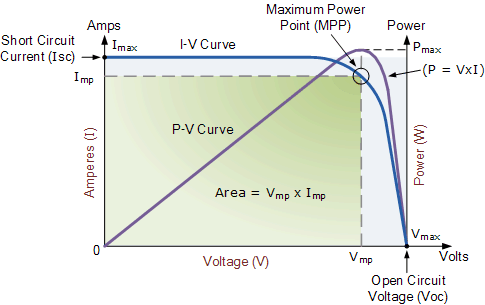
    Realize that the mppt alters its 'transformation ratio' (I know its DC and it is a lot of  switched mode cleverness, but this is a simplified explanation) to try to set the input impedance to try and get the highest voltage before the current falls away , so is always settles at about 80-90% of open circuit voltage and about  70-80% of short circuit current.

  • Good afternoon

    I did not post the exact model because I wasnt sure about the IET Forum policy and naming products

    Anyway

    Here is the inverter

    Today I had to call their technical department and they told me that

    1. All 3 MPPTs are INDEPENDENT from one another

    2. The 2 strings of each MPPT are connected internally IN PARALLEL so they told me I have to have EXACTLY same number of PV panels per string

    3. Total Amps per MPPT is 32A so each of the 2 strings should be max 16A

    What I did not understand was what would happen in case one string is 10 panels and the other string of the same MPPT is 11 panels.

    That means you parallel to slightly different volltages

    When I asked the question he told me something like

    "It will peak the lesser string that is the 10 panel one"

    but when I asked what he meant his accent did not help much to understand more

  • "It will peak the lesser string that is the 10 panel one"

    that is because that the mmpt will settle to a voltage where the there is a shoulder in the I/V curve- and when 2 unequal strings are in pseudo-parallel that shoulder will usually be the lower voltage one, as the way to find that optimum is to  slowly reduce the current, monitoring the voltage rise, and then voltage rate of rise slows even though the current is still falling at the same rate, that is the shoulder...


    Did my explanation earlier in the thread which basically says the same help make sense ?

    If not I can have another go....

    Mike.  

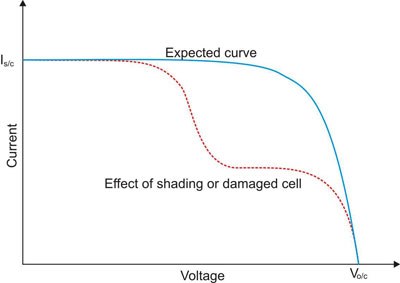
    An example of a stepped IV curve when one of the 2 strings is a panel short would look a bit like this orange curve - at the lower voltage both strings add to the  higher total current, but the other  knee is one string only. Here an operating point near the lower voltage higher current knee has the larger total area (total power) unless the other  string is a lot less, but ideally something closer to the blue curve is desired by having both strings with a voltage knee in a similar place.

  • We have established (through the energy efficiency report) that we need 35kWp of PV panels on the roof.

    Assumedly there's a definition in terms of actual energy performance somewhere, rather than just a rating. Do please check because this will affect what shading is acceptable, orientation etc, and also protect you against claims of underperformance in the future. You then need to do some calculations - or preferably, modelllng - to demonstate that it will meet that.

    1. When the inverter say max DC power 37.5kW should I assume that this is the total sum across all 6 strings that can be connected?

    As an overview, yes. But most of the time individual MPPTs also have separate ratings which you will need to check the manufacturer's data for. These may be neither symmetrical (I know of inverters which have an "A" MPPT greater than its "B" MPPT, the idea being you get a nice arrangement onto A with stragglers collected onto B) nor be a simple third of the total rating

    Should I assume that the 2 strings per MPPT are connected internally within the inverter in parallel?

    Yes. There will be no protection between strings "within" an MPPT group, unless otherwise specified. Hence for more than 2 strings you will likely need fuses to protect against reverse power overcurrents.

    Because if the two strings of each MPPT are internally connected in parallel then I have to balance the voltages of the 2 strings to be quite equal

    Yes they are and yes you do, exactly equal. I.e. same number of modules per string, in the same orientation.

    There are multiple "stages" within an inverter. An MPPT is a DC-DC converter which pushes DC current onto a common DC bus feeding the inverter bridge which converts the DC to AC. It is the MPPT which "chooses" the array operating voltage (by PWM shenanigans) to find the optimim point on the IV curve it's presented with, so having separate MPPTs means you can have different parts of the array operate independently, reducing mismatch effects.

    3. The AC power of the inverter is going to be balanced (current per phase) or it somehow depends on how I connect the strings on the DC side?

    Yes (unless somehow you've got several single phase inverters).

    Many inverters don't actually need a neutral (but many do for the auxiliaries, and lots would need to be reconfigured for G99 checks etc so don't omit it without reading the manual!)

    Any help will be much appreciated
    I know it's not a design manual but I strongly recommend you review the IET CoP for PV