My war against dual rcd boards

As each (RCD) Residual Current Device must not have more than 30% leakage current on it.
It's hard to see how dual (RCD) Residual Current Device boards can be fitted at all these days.
i come across so many dual rcd boards with solar, evse and heat pumps on them, these have all been recently installed.
i wonder if BS7671 should state: Dual (RCD) Residual Current Device boards shall not be fitted, unless it can be shown (and documented) that they are suitable for the combined leakage currents expected .
otherwise developers will keep specifying them and i will have keep educating them on the many reasons a type A rcd should not be shared with other equipment!.
maybe manuafactuers instructions should also state : not suitable for a shared rcd, for certain equipment.
Parents
  • The question that Graham asked was quite specific:

    However, if the lamp is damaged, and the user is being protected against accidental contact with live parts, say after the rectifier, would the type AC RCD operate is perhaps another?”

    in that he said “after the rectifier”, so assume there are some diodes charging a capacitor, which discharges to supply the DC current, and the input current is 25 mA at 230 volts, what is the DC output current and voltage?

  • You tell me. 

    The input is 6.44 W, so the product of the output current and voltage must be no more than that.

    If there is a DC fault, there is no reason to believe that a Type AC RCD would trip, but it might. Graham will correct me if I have misunderstood.

    LED car headlamps glow with a supply of nominally 12 V, so that would give potentially 0.5 A @ 12 V. The figure that I have in my memory for the resistance of a human body finger-to-toe is 2 kΩ, so now we are looking at a current of 12/2000 = 6 mA.

  • The figure that I have in my memory for the resistance of a human body finger-to-toe is 2 kΩ, so now we are looking at a current of 12/2000 = 6 mA.

    Indeed such a figure is quite credible- and  a glancing dry contact with mains is not normally fatal - just painful. But, not always ! and certainly there are enough fatalities to justify the desire to take steps to protect against mains shocks.

    That resistance falls if the shock current is sustained, as the skin chars at the point of contact, and the current then rises - the core of the body is much lower resistance, and damaged or wet skin removes most of that high resistance, allowing a far more dangerous current to flow.

    Also be aware that a lot of the small LED lights use a series capacitor dropper to set the LED current, and the mains current is higher than the wattage may suggest, as the power factor is poor. If the LEDs total 100V and a the rest is capacities, then the current is more than double the wattage divided by 230.

    Mike.

  • You tell me

    I asked AI to explain it, because it's a long time since I did this at college! The DC voltage will be around 330 volts:

    "In a simple diode-capacitor circuit (a half-wave rectifier with a smoothing capacitor), the capacitor charges to nearly the peak voltage (Vpeakcap V sub p e a k end-sub) of the AC input, which is about 1.414 times the input RMS voltage (Vrmscap V sub r m s end-sub), minus a small diode voltage drop (Vdcap V sub d). So, Vpeak≈(Vrms×1.414)−Vdcap V sub p e a k end-sub is approximately equal to open paren cap V sub r m s end-sub cross 1.414 close paren minus cap V sub d≈(×1.414)−, resulting in a DC output close to the peak value, not the RMS value, with some ripple.”.

  • Also be aware that a lot of the small LED lights use a series capacitor dropper to set the LED current, and the mains current is higher than the wattage may suggest, as the power factor is poor. If the LEDs total 100V and a the rest is capacities, then the current is more than double the wattage divided by 230.

    Yes, but Sparkingchip specified the input current and voltage, so in this example, the wattage of the LED itself is less than 6.44 W, say 3 W.

  • I too have dim and distant memories of a simple rectifier circuit, but I do not think that applies to LEDs.

    Without doubt, powerful LEDs need only 12 V (nominal) else my cars' headlamps would not work. That is why I used a value of 12 V. It may be that the voltage across an LED is lower, and the current correspondingly higher.

    Of course there might be a string of LEDs in series with a higher voltage across them.

    Filaments were so much simpler!

  • I asked AI about HID headlights, they are not something to mess about with!


    Automobile HID (High-Intensity Discharge) headlights use a ballast to transform the car's 12V power, requiring a massive
    20,000 to 26,000 volts for ignition, then settling to a steady 80-90 volts (or 42V for newer D3/D4 types) to operate the xenon gas arc, providing bright, efficient light. The ballast is crucial for both the high-voltage start-up and stable operation, making HID systems potentially dangerous if handled improperly.

  • The LED headlights probably run between 40-60 volts with the input voltage varying from 12 volts depending on the state of charge and loads.

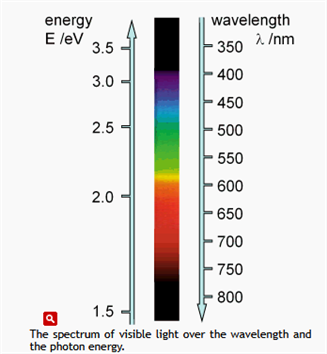
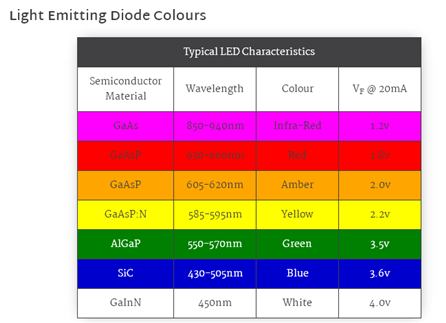
  • Indeed - the individual LED chips drop a voltage proportional to the shortest wavelength (highest energy photons) they emit. So for deep red LEDs, say something like 650nm, require about 1.75V  to generate the photons plus another about quarter to half a volt to get a sensible current flowing in the resistance of the 'ohmic contacts' between the metal and the semiconductor. The substrate itself is a cunningly formulated semiconductor chosen to encourage the electrons to drop down a gradient of just the right voltage for the desired colour.
      

    However, that is not the full story, to make a white LED needs more like 3V per chip as there either has to be blue, in the RGB 3 colour types, or some designs (with a yellow over-coating) function more like the old florry tube, in that the LED generates a hard blue-purple to soft UV light, that is used to excite a phosphor coating that then emits a broader 'warm white' spectrum.
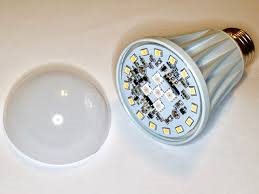
    A mains voltage  LED lamp has some tens of chips in series under the 'bulb'  This fairly typical example has 5 hard/cool white chips in the centre, and 18 warm fluorescent  type ones spaced around the periphery. 
      
    Then those pseudo filaments are typically up to 50-60 volts worth of blue/UV chips wired in series on a metalised or insulated 'ribbon' that is then dipped in the phosphorescent coating.

    Multiple such filaments may then be wired in series with a voltage dropping circuit, or be driven from a DC-DC converter concealed in the lamp base.

    Car LEDS have multiple parallel chains each of up to 3 LEDs in series with a current limiting control circuit.
    It is really nothing like as simple as the hot wire it tries to emulate.

    Mike.

  • The gas discharge car lights are indeed a marvel of HV tech, but in a car, with enough petrol to put the driver into orbit, 25kV sparks to ignite that fuel, and red hot catalyst glowing in the exhaust, in a single skin metal box that does up to 70mph, (honestly officer), the additional risk is actually 'small beer'. If they were indoors, they'd probably be banned Relaxed.

    Mike.

  • Mike, many thanks for the explanation - most interesting!

Reply Children
  • no probs, but be aware it is only skating over quite a lot of extra detail, several heavy books have been written on the subject of LEDs and mixed semiconductors more generally..

    The biggest operational problem for an LED compared to a normal lamp is that the internal resistance of many LEDs  has a negative temperature slope. A series resistor, or more likely, some current controlling electronics that emulates one,  is then required,  as if connected to a constant voltage, with nothing to throttle the voltage and limit the current from rising, there would be a tendency for things to either not turn on at all, or then to warm up and run away to self destruction.... (the one off noise emitting diode is not supposed to be a thing...)

    Mike.

  • Well, yes but LEDs have come on in leaps and bounds.

    Time was you had those rather feeble ones which could be used as indicators and they had to be treated with the same respect as ordinary diodes and transistors. Now they have all gone miniature.

    Recent developments in car headlights are extraordinary. Mine (2019 build) dance around and cut out the upper right quadrant to avoid dazzling oncoming traffic. The current model claims a 650 m range and can project images on to the road or, I assume, adjacent buildings. There are 84 LEDs per side and they use micro mirrors (but hopefully not smoke) to do the fancy stuff.

    (How's this for thread-drift? :-) )