Three days ago I said:
”The question that Graham asked was quite specific:
”However, if the lamp is damaged, and the user is being protected against accidental contact with live parts, say after the rectifier, would the type AC RCD operate is perhaps another?”
in that he said “after the rectifier”, so assume there are some diodes charging a capacitor, which discharges to supply the DC current, and the input current is 25 mA at 230 volts, what is the DC output current and voltage?”.
So presumably after the rectifier the current and voltage is peak, not RMS? So if the current and voltage is 25 mA at 230 volts AC measured RMS, then after the rectifier it should be 35,35 mA at 325 volts pulsed DC unless there are a few more electronic components to drop the voltage?
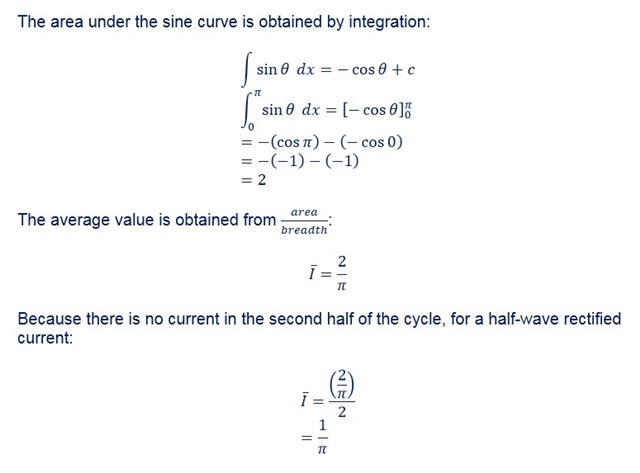
I think not. The "average" rectified current must be lower than the upstream a.c. because there is none for 10 ms in every 20 ms cycle. The RMS current of the pulsed DC is only 17.7 mA.
Some maths to follow. :-)
Some misunderstanding there. If it's a single loop its the same current all the way around the loop. And superposition..
Lots of careful misuse of apparently similar terms! Worse than trying to find a true earth..
If it's a single loop its the same current all the way around the loop.
Quite so. If the (earth) fault is after the rectifier, the "pulsed d.c." flows through the RCD, which is where the problem lies. If the type AC RCD does not trip, lives could be at stake.
And superposition
OK, so you have a 30 mA RMS half-wave rectified (pulsed d.c.) current and superpose 6 mA of smooth d.c. What is the combined RMS current?
If the type AC RCD does not trip, lives could be at stake
Which is the point.. (why we don't like RCDs that become 'blinded' by average DC flows)
The simplistic assumptions (e.g. no inductive/capacitive energy storage/filtering) produce worst case figures.
The very sharp corners between half cycles aren't that realistic and, if Fourier analysed, imply a high frequency harmonics content, which tends to be filtered by the general wiring etc (without additional components).
BigClive did some video on the workings of diode bulbs - worth looking at. I can't remember if the ones he looked at had a half or full wave rectification.
There are problems of nomenclature in the attempted mixing of the two signals, in that often the first includes the second (commonly because of an arbitrary zero marking).
A pulsed DC is a smooth DC and a pure AC (i.e. 'centred' about that smooth DC level)
If the type AC RCD does not trip, lives could be at stake
Which is the point.. (why we don't like RCDs that become 'blinded' by average DC flows)
The simplistic assumptions (e.g. no inductive/capacitive energy storage/filtering) produce worst case figures.
The very sharp corners between half cycles aren't that realistic and, if Fourier analysed, imply a high frequency harmonics content, which tends to be filtered by the general wiring etc (without additional components).
BigClive did some video on the workings of diode bulbs - worth looking at. I can't remember if the ones he looked at had a half or full wave rectification.
There are problems of nomenclature in the attempted mixing of the two signals, in that often the first includes the second (commonly because of an arbitrary zero marking).
A pulsed DC is a smooth DC and a pure AC (i.e. 'centred' about that smooth DC level)
Oh no it isn't (do we still have pantomimes?).
BS EN IEC 61557-6:2021 4.2.1 Note: A smooth direct current is a current with less than 10% AC ripple (peak to peak).
So-called, pulsed d.c. could have no smooth component.
problems of nomenclature
Exactly. Given that definition, the half wave rectified shape can never contain any DC component (which by most definitions is the 'smooth' component).
Probably drop into the 'superposition' of components discussion here. "Clearly defined areas of Doubt & Uncertainty"
We're about to take you to the IET registration website. Don't worry though, you'll be sent straight back to the community after completing the registration.
Continue to the IET registration site