You’re right—dual‑RCD boards are increasingly fragile in modern installs (PV, EVSE, heat pumps) because standing protective‑conductor currents should be limited to ~30% of IΔn (i.e., ≤9 mA on a 30 mA RCD) to avoid unwanted tripping, per BS 7671 Reg. 531.3.2 guidance.
The IET’s Wiring Matters (May 2021) shows typical leakage from today’s electronics accumulating across circuits—exactly the scenario that defeats shared RCDs on split‑load boards. Measuring and managing leakage at design/verification stages is advised.
For EV: BS 7671 Sec. 722 requires each EV point to be individually RCD‑protected (≤30 mA, all live conductors). Use Type A with 6 mA RDC‑DD or Type B if DC detection isn’t built in—another reason shared RCCBs are poor practice.
For heat pumps/variable‑speed drives, consider Type F/B and upstream coordination to avoid DC blinding; mixing loads behind one Type A RCCB is risky.
Pragmatic recommendation:
In short: don’t share Type A RCDs across modern power‑electronics unless you’ve proven leakage and compatibility; otherwise expect nuisance trips and reduced protection margin.
Now, if only it was as simple as the RCD tripping on any repetitive waveform with the correct RMS value, then a device designed to trip at some point below 30mA on a sine wave probably would on this too. However, as noted in the other post, the physics conspire to make it very hard to say much with any certainty at all beyond ' it'll need to be experimentally determined'. I think here transformer core saturation is more important than hysteresis, but that is probably one of the most material dependent parameters.
Nicely put. :-)
I can imagine an expert in court being examined by counsel: "Which part of the wave is not sinusoidal?" What would you say?
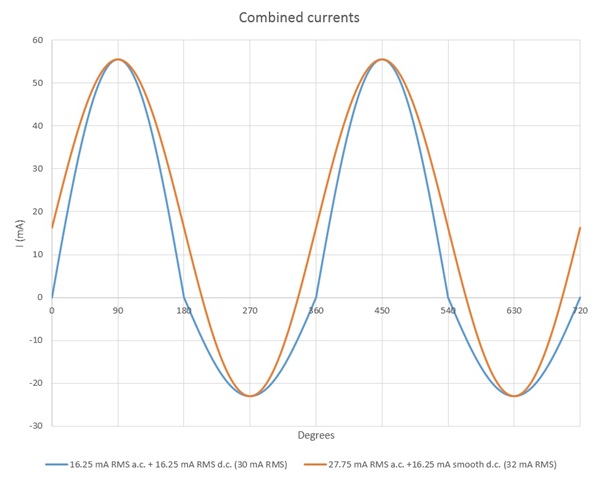
Here we have slightly more at 16.25 mA a.c. + 16.25 mA d.c. because the combined RMS is 30 mA. So, I thought let's get as close as possible with pure a.c. Problem is that the average current > 0, so it is necessary to add a little smooth d.c.
The graphs look pretty similar to me, but would either (or both) trip an RCD?

In my disassembled old unit there is a rectifier diode after the sense toroid which may be aligned with the trip solenoid's magnetic latch.
If it requires a negative going current then ?? .. need to see how the material hysteresis curve is biased, and internal circuit responses ?
Hope to get a sketch of the circuit soon.
For EV: BS 7671 Sec. 722 requires each EV point to be individually RCD‑protected (≤30 mA, all live conductors).
But consider the perhaps not unusual situation where the charge point has a 30mA RCD built-in (and likely a RDC-DD as well), but the soft skinned cable from the CU is concealed in a wall (so needs 30mA RCD protection to meet 522.6.202). Given the built-in RCD provides the individual protection, could the CU RCD, which is required only to protect the cable, not the EV, be shared? Ideally not perhaps, but in terms of meeting the actual requirements of the regs, as currently written?
- Andy.
Does the EVSE meet BS EN 61008 (RCCB), BS EN 61009 (RCBO), BS 7288 (Socket Outlet RCD ?
For the sake of argument, let's say the RCD function does meet BS EN 61008.
I know there was some debate about one particular brand a year or two back, where the manufacturer said it did while other distinguished observers begged to differ, so I'd hope that some manufacturers would have got their act together by now. Certainly I recall some early EVSEs simply incorporated ordinary DIN rail RCCBs or RCBOs - so some at least should have no doubts.
- Andy.
Ok if the EVSE has a approved/compliant RCBO at say 30mA then the upstream would probably need to use something like a 100mA or and S type/Delayed RCBO to avoid nuisance tripping issues.
then the upstream would probably need to use something like a 100mA or and S type/Delayed RCBO to avoid nuisance tripping issues.
Nope, need to be 30mA non-delayed to provide additional protection for the concealed cable.
There's no prohibition on daisy-chaining 30mA RCDs ... if fact it's mandatory in a few situations - e.g. caravan pitch socket and caravan incomer. The arrangement itself doesn't of itself introduce a risk nuisance tripping, merely the inconvenience of having to reset the other RCD (or both RCDs) when a genuine fault occurs (provided all the other design parameters are correct).
- Andy.
We're about to take you to the IET registration website. Don't worry though, you'll be sent straight back to the community after completing the registration.
Continue to the IET registration site