Plug-in Solar supposedly going to be 'easier'?

Hi all, new to the forum.

I've been reading (various media outlets are running with the story) that the government is planning to make it easier (no mention of safety) for consumers to connect solar PV panel inverter directly to the mains using a 3 pin plug and socket arrangement.

Considering all of the current guidance regarding the connection of a solar PV inverter to the mains (dedicated circuit, own RCD, no 3 pin plug), how is this all of a sudden going to be 'safe'?

The argument that 'Balcony Solar' is all the rage on the continent surely doesn't negate the potential risks all of a sudden. Surely the IET is in discussions with government and arguing that the dangers cannot simply be swept under the carpet?

Parents
  • It's going to be in the middle aisle of your local Aldi or Lidl very soon.

    Today's Government press release.

    No need to worry about compliance with BS 7671 'cos it will be changed to suit. Scroll down to the end:

    "The government will work with the Energy Networks Association, DNOs and Ofgem to update the G98 distribution code and wiring regulations BS 7671 to allow UK households to connect <800W plug-in solar panels to domestic mains sockets, without the need for an electrician and with tailored safety standards."

  • I saw that and smiled,  I suspect that the next obvious developments  will be a way to also permit plug-in battery storage  (that example is an 800W  (1600 W.hr so 2hrs at full load ) battery unit offered in Belgium).
    Then perhaps a bit of maximum power creep upwards towards a kW or 2, as it makes the solar thing far more effective, and can be used to reduce import and export so things are more self contained and keep the grid is less stressed.

    What I see (again), is regulation getting in the way, until there is a pinch point, and then getting out of the way again very fast.

    Mike

    PS 

    Edit - what I mean by fast here is 'fast for a government department' .

    The contract to perform a a study into this was awarded in October to Arceio in Milton Keynes,


    As far as I can see the dept has made its decision and is issuing its conclusions before the report has been delivered and published !! 


    see https://bidstats.uk/tenders/2025/W43/856948999 for some contract info.

    Note that above the trivial limit of 800 W is 'tolerated' on the Schuko connector by the VDE - the German standards body.

    Apparently a polarized touch proof connector such as the Weiland RST series is much preferred, and mandated above 800W.

  • The government will work with the Energy Networks Association, DNOs and Ofgem to update the G98 distribution code and wiring regulations BS 7671 to allow UK households to connect <800W plug-in solar panels to domestic mains sockets, without the need for an electrician and with tailored safety standards."

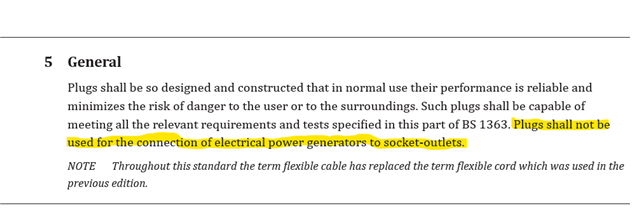
    There's a bit more to do than that .... including Plugs and Sockets (Safety) Regulations mandating BS 1363 ....

    BS 1363 has contained the highlighted statement since 2007.

  • that example is an 800W  (1600 W.hr so 2hrs at full load ) battery unit offered in Belgium

    €1750. Suppose that you charge it up during the day and use it all up in the evening, that would save about 40p per day = £150/year, so quite a long pay-back period.

  • There's a bit more to do than that .... including Plugs and Sockets (Safety) Regulations mandating BS 1363 ....

    Amending secondary legislation shouldn't be a problem, but it does demonstrate that ministers have not been well-briefed.

  • If this is really a good idea, and necessary for some people, I also agree standards shouldn't be used to stifle or bar innovation ...

  • long pay-back period.


    yes I agree - the economics of bigger systems are far more satisfactory., and should be encouraged. 
    I'm not sure with that one if you can unplug it and use it stand-alone for camping as well - the data sheet is a bit vague, and they don't seem to have stock available for another 6 months but want a deposit now, . so I'd avoid that exact model, except as an example of a possible future until they have actually been on sale for a while ;-) 

    these actually exist and are bigger and also do up to 800W back feeding. https://www.ecowizard.co.uk/battery-storage/ecoflow-stream-ultra-x/ 

    note when stand alone the inverter is 2300W but the grid back-feed is limited to 800W 

    regards Mike.

  • Presumably it will be a simple amendment: ".... unless the generator is compliant with [insert the, yet to be determined, reference to relevant product standard]"

    BS7671 would also benefit from considering and referencing more robust connection arrangements, such as the German use of the shrouded and locking Wieland RST connectors, or something equivalent.

    I recalled a website on historical electrical accessories featured an MK BS1363 plug which had sprung shrouds, albeit only over part of the pins to prevent inadvertent contact, I wonder if something similar could be achieved which would shroud the whole pin, though it would also need insulation at the end of the pin for a plug-in-solar type application. 

    flameport.com/.../ivory_mk_plug_sprung_sleeves.cs4

  • I recalled a website on historical electrical accessories featured an MK BS1363 plug which had sprung shrouds, albeit only over part of the pins to prevent inadvertent contact,

    I was thinking along similar lines - but more like the "safety" BC lampholders - i.e. an internal switch disconnects the pins when it's withdrawn. Of course it could be defeated by an extension lead - but then socket shuttering is defeated by the common "kettle lead" - so nothing new there.

       - Andy.

  • All great ideas, but the timescale to update a standard should not be under-estimated, even if everyone agrees on the technical changes necessary.

    In the case of shrouds or "plug removed switch" approach, suitable requirements will need to be written, along with verification Clauses for type testing the durability and functionality.

    Interesting times.

  • ministers have not been well-briefed.

    Agreed

    They seem to lack the knowledge and history.

    The Microgeneration Certification Scheme (MCS) was launched in
    2007.and went independent in April 2018, the scheme became independent of the government, transferring to the MCS Service Company Limited.  Its Purpose: is to serves as a quality assurance scheme for products and installers of renewable energy technologies, such as solar panels and heat pumps

    Question….What quality assurance will they be IF I buy is from Amazon and install myself?  Would it be plugged into and outdoor socket which MAY be questionable in the first place or do I cut the plug off and poke a whole through the fabric of the build and then wire up a new plug?

    Then there is BS7671 last few amendments say over the last 10 years with things like
    Regulation. (530.3.201) use of bidirectional and unidirectional devices
    What about Amendment 2 (2022)
    Regulation 716.443 requires surge protective devices (SPDs) to be installed where PV or energy storage systems are connected, reflecting the increased risk of transient overvoltages from lightning and switching events

    Regulation 716.514.1 requires clear labelling at the consumer unit, meter position, and point of connection to identify that a prosumer installation is present and to indicate the presence of multiple sources of supply


    How many of these DIY kits will comply with Regulation 716.514.1?

Reply
  • ministers have not been well-briefed.

    Agreed

    They seem to lack the knowledge and history.

    The Microgeneration Certification Scheme (MCS) was launched in
    2007.and went independent in April 2018, the scheme became independent of the government, transferring to the MCS Service Company Limited.  Its Purpose: is to serves as a quality assurance scheme for products and installers of renewable energy technologies, such as solar panels and heat pumps

    Question….What quality assurance will they be IF I buy is from Amazon and install myself?  Would it be plugged into and outdoor socket which MAY be questionable in the first place or do I cut the plug off and poke a whole through the fabric of the build and then wire up a new plug?

    Then there is BS7671 last few amendments say over the last 10 years with things like
    Regulation. (530.3.201) use of bidirectional and unidirectional devices
    What about Amendment 2 (2022)
    Regulation 716.443 requires surge protective devices (SPDs) to be installed where PV or energy storage systems are connected, reflecting the increased risk of transient overvoltages from lightning and switching events

    Regulation 716.514.1 requires clear labelling at the consumer unit, meter position, and point of connection to identify that a prosumer installation is present and to indicate the presence of multiple sources of supply


    How many of these DIY kits will comply with Regulation 716.514.1?

Children
  • Regulation 716.514.1 requires clear labelling

    712.514.1 does indeed. Would they have to be removable for when the system is unplugged?

  • Regulation 716.514.1 requires clear labelling at the consumer unit, meter position, and point of connection to identify that a prosumer installation is present and to indicate the presence of multiple sources of supply

    How could this ever be a requirement for an installation that had no "fixed wired" (for want of a better term) generation (even if it is 712 not 716 ... but MORE FUNDAMENTALLY 514.15.1, which is, to be brutally honest, absolutely necessary for conformity to the EAWR and CDM Regulations in ALL installation (that is, domestic, or otherwise, and regardless of whether the project is 'CDM notifiable') ?

    The installer would never be aware of the connection of the pluggable generation ?