d.c. colour coding - series connected batteries

I'm playing with a little battery/inverter system at the moment and come across a situation I've not hit before. I've got 4off 12V batteries, wired in series and for various reasons (servicing, portability & weight) I'd prefer to connect the batteries together using movable (insulated) cables rather than bare solid links. 

It's an unearthed system (on the d.c. side) so red for +ve and white for -ve according to table 51 - which is fine for the first and last - but the question arises - what colour should I use to identify the cables that run from one battery's +ve terminal to the next's -ve?

If the d.c. was -ve Earthed, I could argue that only the directly earthed terminal was 0V and everything else was +ve (if at different voltages but still +ve) so use red for all the interconnections as well (and likewise if it was +ve earthed the same logic would suggest white for all the interconnections) but as this system is floating, there's no one clear answer as far as I can see. All the positives and negative are relative. Does anyone have any better thoughts?

At the moment the cables are oversleeved in a nondescript colour heatshrink, then marked red at one end and white at the other ... which I think I can justify the logic of and "looks right" at the individual terminals, but can't help feeling is a bit unorthodox overall and might not pass the "principle of least astonishment" test should anyone else come across it (not that that's likely in this case).

All a bit of an academic question really, but is there is a proper answer out there, I'd be interested!

   thanks

           - Andy.

  • All a bit of an academic question really, but is there is a proper answer out there, I'd be interested!

    No, I don't think there's a proper answer unless one of the conductors is Earthed (so you have a blue conductor there).

    If the d.c. was -ve Earthed, I could argue that only the directly earthed terminal was 0V and everything else was +ve

    But then the L- terminal would be blue, not white, and possibly all other conductors red.

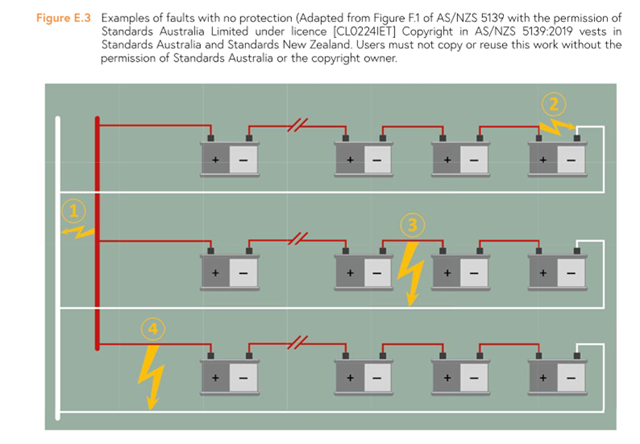
    I think the logic holds for unearthed batteries though.. .you could choose effectively whether you are using the white or red as the 'reference' and all interlinks use the other colour ... example below from the IET Electrician's Guide to Domestic Electrical Energy Storage Systems:

    I'd prefer to connect the batteries together using movable (insulated) cables rather than bare solid links. 

    I know you are experimenting and managing this arrangement,   , and will be aware of the hazards, but just for others who might read the thread without experience in battery systems, there are dangers involved in stringing batteries together like this, rather than using links that are as short as possible (and preferably not flexible).

  • No, I don't think there's a proper answer unless one of the conductors is Earthed (so you have a blue conductor there).

    It is an interesting question.

    It begs the question as to why conductors are identified in the first place. Clearly, in a multicore cable, they have to be distinguished from one another. I expect that in most cases, both ends cannot be seen at the same time.

    It also begs the question as to whether it is in scope for BS 7671 or whether another standard applies. If the string of batteries is treated as one battery (after all, each battery is already a number of cells in series), it may not be in scope.

    I am not sure that identifying each end of the cable is the answer: after all, the cable would work just as well the other way about. If the batteries are situated together, there really should be no confusion.

    All that said, you can duck the issue of colour altogether by identifying them numerically i.a.w. 514.5.4.

  • I know you are experimenting and managing this arrangement..

    Indeed - and it's proving to be a case of the least worst arrangement in the face of what feels like a lot of contradictory demands! Short solid links were indeed considered - but there are a few demands that mean the batteries would need to be disconnected occasionally. The battery manufacturers recommend a 6-monthly "equalization" procedure whereby the batteries are each charged individually and then left connected in parallel for 24h or so. Also the weight of the system is likely to mean that while I can move it about over flat-ish ground by its own wheels (wheelbarrow style) OK, if I ever needed to lift it into a vehicle or move it up steps or anything like that, it would be useful to be able to reduce the weight - so removing the batteries is a helpful option. Even with care, metal tools on bare battery terminals is going to be a significant risk - no less so out in the field, so insulated cables, insulating terminal covers and Anderson connectors seemed a least worst approach. The cables are completely oversheathed with heatshrink to provide some approximation to double/reinforced insulations and the each of the batteries has an an-built BMS which should in theory provide short circuit protection as well (although how reliably given the electronics involved seems up for debate still). Hopefully with 4 in series, the chances of all 4 BMS failing simultaneously is smaller. Don't get me started on the lack of data for things like short circuit currents for these types of batteries, the fact that most "auto" type fuses are probably entirely inadequate for breaking anything like the currents involved or that d.c. data for the better fuses seems to be have filed somewhere alongside hen's teeth (the retailer tells me the supplier say the manufacturer has OK'd the fuse for d.c. use within certain parameters, but the actual data sheets and the markings on the fuse itself say nothing other than for a.c..)

    The main mitigation is that on-one other than me is likely to be playing with it, so it's just my neck!

        - Andy.

  • I would favour use of a "non committal" such as yellow for the series connections. That is is simply personal preference and not mandated. In years gone by I would have used white, but that is now  "ruled out" as white is reserved for negative.

  • In terms of estimating short circuit currents, there is a reasonable inverse relationship with capacity, for any given internal construction - so all gel lead acids are close to the same curve, but wet lead acid cells are close to a similar curve with a different scaling factor. 

    https://www.galanto.com/en/internal-resistance-of-the-car-battery/


    The reason that automotive fuses are normally just fine in cars,  is that what we think of as PSSC is not as high as the mains. The 12V battery itself may have a 'golden spanner' short circuit current of a thousand amps, but you dont need too many metres of 25mm sq in the loop to start to bring that down noticeably. However, putting batteries in series for any given wiring loop length, increases that pro rata. Somewhere between 2 and 3 car batteries worth and you can strike and maintain an arc you can weld with, carefully, something simply not possible at 12V.  In case you have not seen it this has some background info.

    https://www.mersen.com/sites/default/files/files_imported_ep/TT-CPN1-Fuse-Operation-Under-DC-Conditions-EN.pdf

    Mike.

  • www.mersen.com/.../quote]

    Thanks Mike - that looks interesting - I'll have a read of that.

    Size and weight benefits led me down the LiFePO4 route rather than lead acid - most autmotive (e..g Mega) fuses weren't rated for "several thousand" amps at 48V nominal (can be over 58V in practice).

       - Andy.

  • There are special fuses, aimed at battery PV installations, but they are neither cheap nor commonly stocked.


    https://www.lawsonfuses.com/our-products-lawson-fuses/pv-applications/

    for example. 
    In EVs  where series parallel strings are common, the general approach is to allow the battery bank to be dismantled into safe to handle pieces with shrouded or otherwise protected contacts, and not to worry too much about fuses in the middle of the chains.
    Note that the 'high voltage'  (not the same voltage as our sort of 'high voltage') traction voltage cabling tends to be orange (while that to control airbags tends to be yellow) and car makers are a law unto themselves in terms of the meaning of other colours .

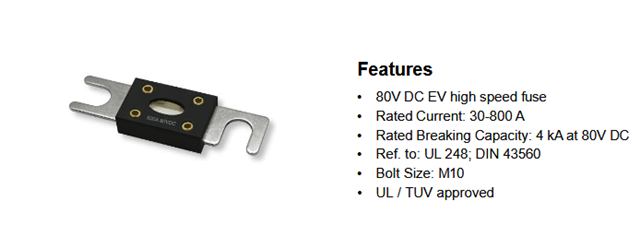
    For your sort of sub 100V Lithium application, these sort of bolt in things may be about right

    https://www.farnell.com/datasheets/4494707.pdf

    or perhaps https://www.farnell.com/datasheets/3860556.pdf

    If you really need more PSC, then dig deep for something like

    https://www.eaton.com/content/dam/eaton/products/electronic-components/resources/data-sheet/eaton-eac14-14x38-ev-fuse-data-sheet-elx1308-en.pdf

    reassuringly expensive 
    https://www.mouser.co.uk/ProductDetail/Eaton-Electronics/EAC14-50-3P? 

    regards Mike

  • It begs the question as to why conductors are identified in the first place. Clearly, in a multicore cable, they have to be distinguished from one another. I expect that in most cases, both ends cannot be seen at the same time.

    And I think the answer to that is different for an electrical or electronic installation, to a product, or item of machinery.