d.c. colour coding - series connected batteries

I'm playing with a little battery/inverter system at the moment and come across a situation I've not hit before. I've got 4off 12V batteries, wired in series and for various reasons (servicing, portability & weight) I'd prefer to connect the batteries together using movable (insulated) cables rather than bare solid links. 

It's an unearthed system (on the d.c. side) so red for +ve and white for -ve according to table 51 - which is fine for the first and last - but the question arises - what colour should I use to identify the cables that run from one battery's +ve terminal to the next's -ve?

If the d.c. was -ve Earthed, I could argue that only the directly earthed terminal was 0V and everything else was +ve (if at different voltages but still +ve) so use red for all the interconnections as well (and likewise if it was +ve earthed the same logic would suggest white for all the interconnections) but as this system is floating, there's no one clear answer as far as I can see. All the positives and negative are relative. Does anyone have any better thoughts?

At the moment the cables are oversleeved in a nondescript colour heatshrink, then marked red at one end and white at the other ... which I think I can justify the logic of and "looks right" at the individual terminals, but can't help feeling is a bit unorthodox overall and might not pass the "principle of least astonishment" test should anyone else come across it (not that that's likely in this case).

All a bit of an academic question really, but is there is a proper answer out there, I'd be interested!

   thanks

           - Andy.

Parents
  • All a bit of an academic question really, but is there is a proper answer out there, I'd be interested!

    No, I don't think there's a proper answer unless one of the conductors is Earthed (so you have a blue conductor there).

    If the d.c. was -ve Earthed, I could argue that only the directly earthed terminal was 0V and everything else was +ve

    But then the L- terminal would be blue, not white, and possibly all other conductors red.

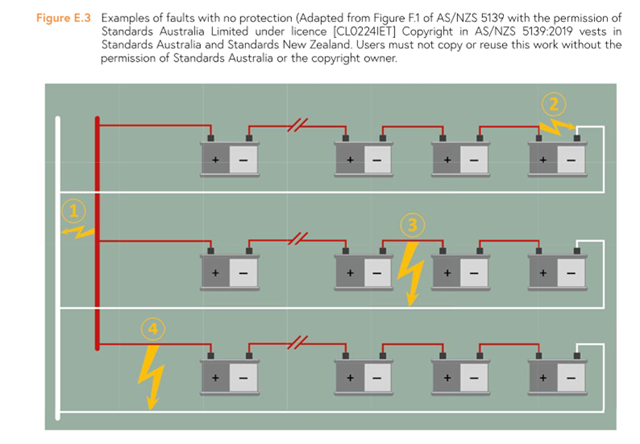
    I think the logic holds for unearthed batteries though.. .you could choose effectively whether you are using the white or red as the 'reference' and all interlinks use the other colour ... example below from the IET Electrician's Guide to Domestic Electrical Energy Storage Systems:

    I'd prefer to connect the batteries together using movable (insulated) cables rather than bare solid links. 

    I know you are experimenting and managing this arrangement,   , and will be aware of the hazards, but just for others who might read the thread without experience in battery systems, there are dangers involved in stringing batteries together like this, rather than using links that are as short as possible (and preferably not flexible).

  • No, I don't think there's a proper answer unless one of the conductors is Earthed (so you have a blue conductor there).

    It is an interesting question.

    It begs the question as to why conductors are identified in the first place. Clearly, in a multicore cable, they have to be distinguished from one another. I expect that in most cases, both ends cannot be seen at the same time.

    It also begs the question as to whether it is in scope for BS 7671 or whether another standard applies. If the string of batteries is treated as one battery (after all, each battery is already a number of cells in series), it may not be in scope.

    I am not sure that identifying each end of the cable is the answer: after all, the cable would work just as well the other way about. If the batteries are situated together, there really should be no confusion.

    All that said, you can duck the issue of colour altogether by identifying them numerically i.a.w. 514.5.4.

Reply
  • No, I don't think there's a proper answer unless one of the conductors is Earthed (so you have a blue conductor there).

    It is an interesting question.

    It begs the question as to why conductors are identified in the first place. Clearly, in a multicore cable, they have to be distinguished from one another. I expect that in most cases, both ends cannot be seen at the same time.

    It also begs the question as to whether it is in scope for BS 7671 or whether another standard applies. If the string of batteries is treated as one battery (after all, each battery is already a number of cells in series), it may not be in scope.

    I am not sure that identifying each end of the cable is the answer: after all, the cable would work just as well the other way about. If the batteries are situated together, there really should be no confusion.

    All that said, you can duck the issue of colour altogether by identifying them numerically i.a.w. 514.5.4.

Children
  • It begs the question as to why conductors are identified in the first place. Clearly, in a multicore cable, they have to be distinguished from one another. I expect that in most cases, both ends cannot be seen at the same time.

    And I think the answer to that is different for an electrical or electronic installation, to a product, or item of machinery.