Adding up current

In a ring final circuit
(Based on Paul Cooks commentary of the 17th edition)

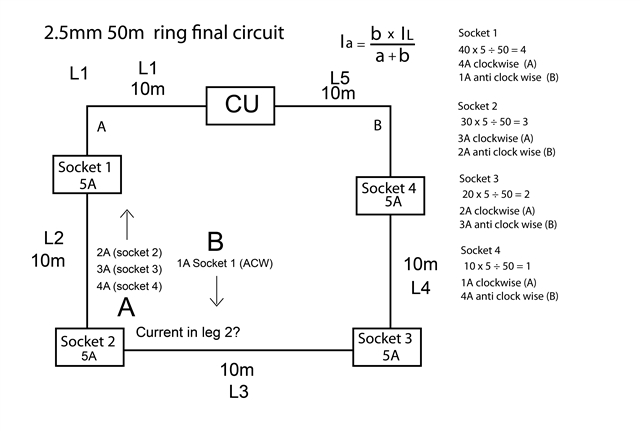
Very simple curent split using both legs of the ring

Not sure about adding up the currents in each leg
Take leg 2 Than will have the Ia of sockets 4,3 and 2
and the Ib of socket 1
How do these add up so you know the current in this leg?
Hope that makes sense
Thanks

Parents
  • You need to take the direction of the current (clockwise or anticlockwise) into account. E.g. 5A clockwise plus 3A anticlockwise on a given bit of cable gives a nett value of 2A clockwise. (Mathematicians would pick one direction as positive and so currents in the opporite direction are treated as -ve, so adding up works out).

    Taking a step back, the whole example is symmetric - same loading and same cable lengths - the left is an exact  mirror image of the right, so the currents must also be symmetric - anticlockwise current in L1 must be the same as the clockwise current in L5, likewise anticlockwise L2 must be the same clockwise L4 and so likewise clockwise L3 must be the same as anticlockwise L3 - i.e. L3 must be carrying zero current. If L3 carried any current it wouldn't be symmetric any more. Not true for the general case where loadings aren't so regular, but give you a way of sanity checking your calculations in this particular case.

       - Andy.

Reply
  • You need to take the direction of the current (clockwise or anticlockwise) into account. E.g. 5A clockwise plus 3A anticlockwise on a given bit of cable gives a nett value of 2A clockwise. (Mathematicians would pick one direction as positive and so currents in the opporite direction are treated as -ve, so adding up works out).

    Taking a step back, the whole example is symmetric - same loading and same cable lengths - the left is an exact  mirror image of the right, so the currents must also be symmetric - anticlockwise current in L1 must be the same as the clockwise current in L5, likewise anticlockwise L2 must be the same clockwise L4 and so likewise clockwise L3 must be the same as anticlockwise L3 - i.e. L3 must be carrying zero current. If L3 carried any current it wouldn't be symmetric any more. Not true for the general case where loadings aren't so regular, but give you a way of sanity checking your calculations in this particular case.

       - Andy.

Children
No Data