Adding up current

In a ring final circuit
(Based on Paul Cooks commentary of the 17th edition)

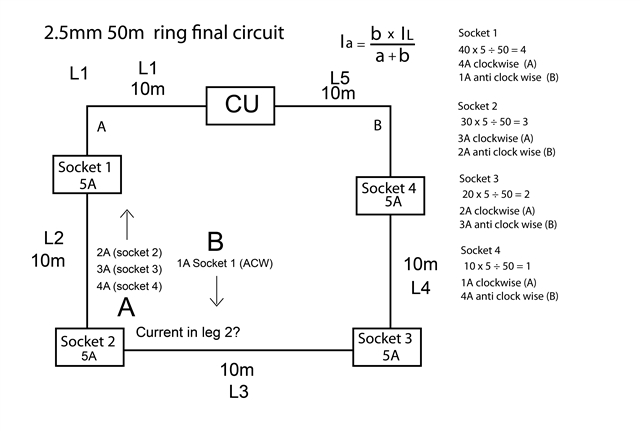
Very simple curent split using both legs of the ring

Not sure about adding up the currents in each leg
Take leg 2 Than will have the Ia of sockets 4,3 and 2
and the Ib of socket 1
How do these add up so you know the current in this leg?
Hope that makes sense
Thanks

Parents
  • Thanks for the replies.
    Yes I kind of understand an appreciate that we do not have currents crossing over each other in the one conductor.
    The current in any section is the result of all connected loads acting together,  and the current is what is is.
    With the ring sharing that current according to the resistance of the paths.


    re the clamp meter I understand the need to be on one conductor, as live and neutral should cancel out (Kirchhoff?) 
    unless there is some leakage.


Reply
  • Thanks for the replies.
    Yes I kind of understand an appreciate that we do not have currents crossing over each other in the one conductor.
    The current in any section is the result of all connected loads acting together,  and the current is what is is.
    With the ring sharing that current according to the resistance of the paths.


    re the clamp meter I understand the need to be on one conductor, as live and neutral should cancel out (Kirchhoff?) 
    unless there is some leakage.


Children
  • yes, Actually, if it helps your visualisation, a current, or in the case of the clamp meter that surrounds it, the resultant magnetic field  caused, is all about the  electrons being passed along from atom to atom, but realise there are far more electrons in the wire all wizzing about like bees in a swarm or slightly drunken dancers at the disco, but on average going almost nowhere in particular.

    Each atom of copper brings 2 free electrons to the party, and they get passed around (in various metals the no. of free electrons per atom varies, and in an insulator it is generally 'none') but even with hundreds of amps flowing , the no of electrons that actually arrive and cause another to drop out the far end, (we've all been to discos like that as well ) forming the net current, is a remarkably small fraction of the total, and it is all about the combined total.

    So in a 3 phase circuit with 3 identical resistive loads wired in a star, there is no current flowing in the neutral, and it is safe to take that wire away, and indeed 3 phase plugs and socket without neutral pins are made for situations where we can be sure of good phase balance.   

    The difference is that the electrons that are just buzzing about in there on average neither gain nor lose energy, though they may briefly do either, or even leave and come back in again, so while there may be very brief temperature fluctuations over atomically short distances  ("thermal noise")  the wire neither heats nor cools in the long term from their activity. Even though the current is a small fraction of the total, the energy from a current with an overall sense of direction with arrivals at one end and departures at the other is steady net loss from the electrons, into vibrating the atomic lattice, which we see as heating of the metal.

    If however one source pushes some electrons in at one point, and another removes some from the same point, there is no need for any  electrons to 'fight the way across the dance floor'  to push any out the other end, and no net current flow, no voltage drop, and no loss of energy and no heating, they are not part of the current flow.

    Mike.