A solar PV question

I think that I am getting to grips with solar PV, but slowly.

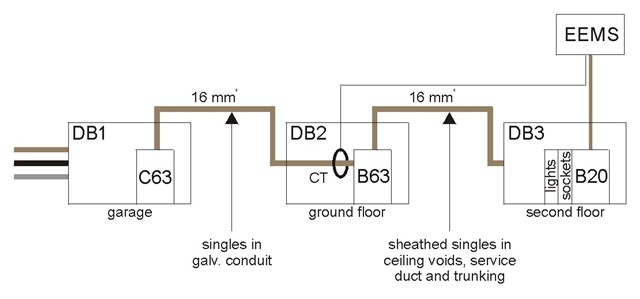
Annex D82 shows a typical domestic system. I do not intend to have load shedding, but there will need to be metering of the connection to the grid. Presumably, this is achived by putting a CT clamp on the relevant cable.

I would like to get the installation as ready as it can be for when I get a system put in. On the second floor, there is a small DB which serves one lighting and one socket circuit. For some reason which is unclear, the distribution circuit uses 16 mm² cable. So the easiest and most economical approach would be to wire the inverter output into the second floor DB as shown in the diagram below.

Whilst I have the floorboards up for other work, I thought that it would be useful to install a CT clamp. So, my question is whether there is a standard design, which would allow me to do so, or whether each manufacturer has their own specifications?

If any of you can see any other potential snags, do please let me know.
Parents
  • Worth considering if Solar PV would benefit from battery storage, will you get a EV (Electric Vehicle)

    If the answer to the above COULD be yes then ethernet cables / Structured cabling may be prudent from 

    Cut out to inverter

    Inverter to Battery

    inverter to EVSE

    Inverter to thermal storage (water tank)

    Ethernet cabling is far better than expecting the WiFi to work to the devices can communicate eg

    MyEnergi  Zappi > Eddi > Harvi        (other brands and models are available)

  • Sergio, thank you. Wiring all the way back to the meter tails is not feasible and I share your reservations about wireless systems, so the next best is a CT clamp in the house DB.

    I think that we will all have an EV at some stage, but there is plenty of capacity in the installation.

    Thermal storage sounds good and it would allow the CH boiler to be turned off in summer, but as Andy points out, I can buy gas for less than I can sell electricity. In any event, if I did not have a surplus of at least 3 kW, the economics rapidly become unfavourable.

    CTs come in a few different types

    So, it seems that the best I can do for now is to lay in some ethernet cable or perhaps a flexible duct with a pull-cord.

Reply
  • Sergio, thank you. Wiring all the way back to the meter tails is not feasible and I share your reservations about wireless systems, so the next best is a CT clamp in the house DB.

    I think that we will all have an EV at some stage, but there is plenty of capacity in the installation.

    Thermal storage sounds good and it would allow the CH boiler to be turned off in summer, but as Andy points out, I can buy gas for less than I can sell electricity. In any event, if I did not have a surplus of at least 3 kW, the economics rapidly become unfavourable.

    CTs come in a few different types

    So, it seems that the best I can do for now is to lay in some ethernet cable or perhaps a flexible duct with a pull-cord.

Children
  • perhaps a flexible duct with a pull-cord

    That's a good idea - twisted pair isn't good for everything - it's not always ideal for CT connections and my heat pump has a control system that runs over two-core flex with very definite instructions never to use UTP cables.

       - Andy.

  • CT connections and my heat pump has a control system that runs over two-core flex with very definite instructions never to use UTP cables

    Do we know why that non-use of UTP [unshielded twisted pair] cable is applied - perhaps the lack of shielding, or some aspect of the exterior sleeving? Two core flex isn't expected to heave any twist based shielding (as I understand it)

    Also, I’d initially misread it as being the Cat-X Ethernet cabling, which as a very similar TLA familiarity.. :doh: Open mouth

  • Do we know why that non-use of UTP

    Not entirely. As ever the manufacturer's instructions are heavy on what ("Never use shielded or twisted cables") and light on why. In the case of my heat pump I understand it's a propitiatory system, bit not that different from CAN bus, so should be fairly robust. They do specify a minimum c.s.a. - 0.75mm² for up to 50m and 1.5mm² above that, so I suspect simple resistance might come into it - which most twisted pair cables would struggle to compare with above very short distances. Others talk of characteristic impedance (but that goes over my head). There's also a stipulation to generally keep it 120mm away from power cables, so maybe they're just preferring to address interference issues another way. Or it might just be a case of they've not tested it using other cables, so won't guarantee or even recommend anything (even if it might work fine in practice). Or maybe they've had experience of "plumbers" trying to deal with UTP cables and haven't been impressed by the results...

    As it happens I did flood wire my house with CAT6 UTP when I renovated a few years ago, and it would have been very convenient to run the HP controls over that - but I ended up compromising and putting all the control boxes close to the heat pump and just using UTP for the temperature sensors on the thermal store (which seems to work fine).

       - Andy.

  • network cable is surprisingly inadequate in the current handling dept.  American wire gauge 23  (23 AWG)is the fattest stuff made, and that is about 0.25mm2  equivalent, while the skinny short hook-up stuff is either 26 or 28 AWG being 0.128 and 0.08mm 2 respectively. And quite often the cheaper stuff is not pure copper, but copper flashed aluminium or copper flashed steel. The practical upshot is that while perfectly OK for delivering logic signals of a couple of volts p-p into 100 ohms, it is not at its best for much more. Power over ethernet suffers quite severe percentage losses compared to any normal power system and is limited to a few hundred mA per core and uses voltages over 50V due to tens of ohms of line resistance.  Its also possible to overheat cheaper network cable with PoE running near the upper limits.

    I suspect its nothing more esoteric than a resistance / current handling requirement and to discourage the use of what might otherwise appear to be an attractively cheap cable.

    Mike

  • Looked up the CAN bus and it 120 ohm terminated at 'both ends', plus the physical layer isn't specified (so car manufacturers can make choices...). All fun stuff. 

  • Power over ethernet suffers quite severe percentage losses compared to any normal power system

    That's a good point. Not POE exactly but the bus does seem to provide power to the main programmer box - as it works without any other connection. So power handling/resistance may well be the limitation.

       - Andy.