Upstream downstream RCD test

GN3 advises that the test should be conducted upstream neutral to downstream line. It would appear that there is a functional reason but I would like some clarification. Yesterday I used the method to test several Contactum RCBOs. As per GN3 method at x1, all operated between 14 and 18ms. Reversing the probes to upstream line and downstream neutral, all operated but the instrument reported greater than 300ms. 

Parents
  • GN3 advises that the test should be conducted upstream neutral to downstream line. It would appear that there is a functional reason but I would like some clarification. Yesterday I used the method to test several Contactum RCBOs. As per GN3 method at x1, all operated between 14 and 18ms. Reversing the probes to upstream line and downstream neutral, all operated but the instrument reported greater than 300ms. 
    PD IEC/TR 62350 simply says 'The testing current should be applied between the upstream and downstream terminal of the RCD.' and does not make a recommendation.

    However, there is a good reason to test to the upstream neutral for safety, being that after the test, at least in traditional unidirectional circuits, if successful, the outgoing (load-side) line conductor ought to be 'isolated' from the supply, and in TN systems at least, the upstream neutral ought to be well-earthed, so this hopefully leaves the test equipment in a relatively safe state. In the UK at least, there is not always a need to isolate the neutral in TN systems, and RCDs need not isolate the neutral for the purposes of protection against electric shock (i.e. conforming to Chapter 41 of BS 7671).

    In an IT system, especially one in which there is no impedance earthing, it wouldn't make much difference.

    If you have your line test probe on the ‘upstream’ line terminal of the RCD then it will remain live after the RCD contacts have opened.

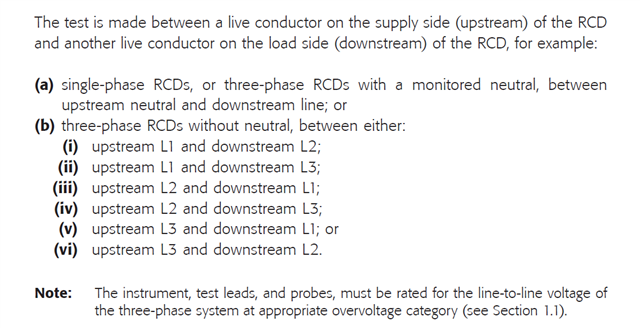
    I'm not so sure this is correct for all testers ... because the test method is also valid (if the test equipment is so designed) for testing three-phase RCDs in systems with no neutral, where only a downstream and upstream line conductor are available. Guidance Note 3 says the following:

    An example of test instruments that follow (b) in the clip above from GN3, is the Megger 1730 and 1740 series that are rated for three-phase systems (I understand some models are only suitable for single-phase circuits) ... but other testers with equivalent features in this regard are available of course.

    Such approach does not leave the tester quite as safely 'isolated' so more caution is needed by the operator.

  • I'm not so sure this is correct for all testers ...

    The 'voltage' theory of operation is mentioned in one or more IET publications and is mentioned in a small number of instrument manufacturer's manuals, but in the latter case the instruments are for single-phase use only.

    An alternative (but related) theory of operation suitable for both single-phase and three-phase use may be the measurement of the time for which the test current flows, from application until current flow is terminated by the opening of the RCD contacts?

  • with a resistive test load emulating the fault, a detection of either the voltage across it or the current through it, both amount to the same thing, and the detection is also the same thing, namely at least one pole in the fault loop to be opened.

    Mike  

  • with a resistive test load emulating the fault, a detection of either the voltage across it or the current through it, both amount to the same thing

    Having just drawn a quick diagram, that has become apparent . . . that will teach me to consider such matters this late on a Sunday evening! Slight smile

Reply
  • with a resistive test load emulating the fault, a detection of either the voltage across it or the current through it, both amount to the same thing

    Having just drawn a quick diagram, that has become apparent . . . that will teach me to consider such matters this late on a Sunday evening! Slight smile

Children
No Data