Upstream downstream RCD test

GN3 advises that the test should be conducted upstream neutral to downstream line. It would appear that there is a functional reason but I would like some clarification. Yesterday I used the method to test several Contactum RCBOs. As per GN3 method at x1, all operated between 14 and 18ms. Reversing the probes to upstream line and downstream neutral, all operated but the instrument reported greater than 300ms. 

Parents Reply Children
  • My thoughts revolve around the differences between voltage dependent and voltage independent RCDs

    (not to be confused with voltage operated ELCBs...)

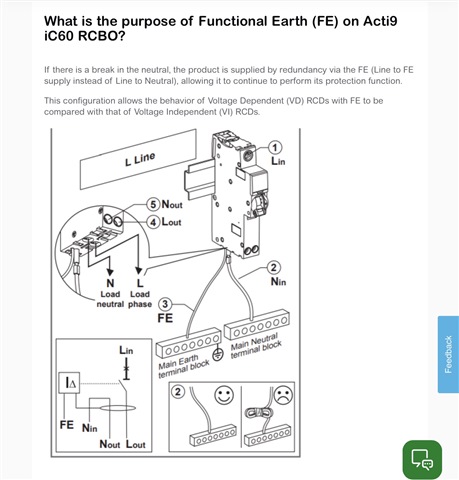
    With a FE connection, the RCD should still trip if the supply N is lost (and L and PE remain) but I don't think that helps us with a solid N devices, as even if the device has successfully opened, there's still 230V between load N and supply L.

       - Andy.

  • I am not giving you an answer, merely thinking out loud, with the earth test lead connected to the neutral downstream of a double pole RCD the earth fault path would be disconnected when the RCD trips, taking the earth reference away from both the RCD and the tester, not allowing the tester to complete the testing process.


    Voltage Independent Technology

    Residual current devices using Voltage Independent Technology can continue to operate in the event of a complete voltage loss or neutral break.

    • The toroid provides information on the leakage current and the power required to trip the device.
    • The electronic circuit and the relay are not connected to the electrical network. Power is provided only by the leakage current.
    • Even if there is an accidental break of the neutral conductor or a voltage drop, the entire electromechanical system will continue to operate, allowing the residual current device to trip.

    www.se.com/.../