Upstream downstream RCD test

GN3 advises that the test should be conducted upstream neutral to downstream line. It would appear that there is a functional reason but I would like some clarification. Yesterday I used the method to test several Contactum RCBOs. As per GN3 method at x1, all operated between 14 and 18ms. Reversing the probes to upstream line and downstream neutral, all operated but the instrument reported greater than 300ms. 

Parents
  • When we use the 0 and 180 test, does this mean it's effectively half wave rectified, or does it just reference the starting direction of the AC waveform?

  • In this context, the 0° and 180° test is not implying half-wave rectification.

    It is simply a phase-angle reference for the AC waveform:

    * 0° means the test is initiated with the voltage/current starting in the positive half-cycle.

    * 180° means the test is initiated with the waveform starting in the negative half-cycle.

    So the purpose is to check whether the equipment under test behaves differently depending on the polarity of the first half-cycle.

    If it were half-wave rectified, you would actually be removing one half of the sinewave, producing a DC component — that’s a different phenomenon entirely.

    So: it’s about waveform starting direction, not rectification.

Reply
  • In this context, the 0° and 180° test is not implying half-wave rectification.

    It is simply a phase-angle reference for the AC waveform:

    * 0° means the test is initiated with the voltage/current starting in the positive half-cycle.

    * 180° means the test is initiated with the waveform starting in the negative half-cycle.

    So the purpose is to check whether the equipment under test behaves differently depending on the polarity of the first half-cycle.

    If it were half-wave rectified, you would actually be removing one half of the sinewave, producing a DC component — that’s a different phenomenon entirely.

    So: it’s about waveform starting direction, not rectification.

Children
  • Ah, thank you for that clarification about the phasing of the starting point of the 'leakage' current. 

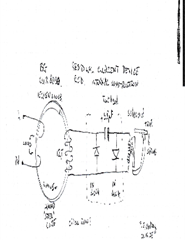
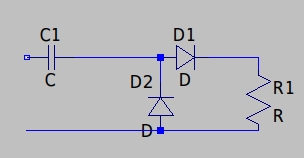
    When I pulled apart an old RCD (BG CUR8030; no alpha code), I noticed that internally it has a half wave rectification of the generated differential current transformer (CT) (i.e. it's output) such that only one half cycle of the CT output fed the trip solenoid, no doubt pre-aligned to the magnetisation of the closed trip latch (easier to 'break' that static magnetisation circuit.PDF

    This would clearly(?) imply that the reaction to the positive and negative half cycles would be 'different'. Newer devices may use different internal circuits (full wave rectified?)

  • internally it has a half wave rectification

    That doesn't look like a conventional half-wave rectifier circuit to me - if it was I'd expect a diode to be in series with the "load", not in parallel with it. With two of them, both ways round, I wonder it they're more to do with clipping overvoltages and protecting the coil from burning out - although zeners might perhaps be more conventional than IN4004s for that. Hopefully Mike will be along soon to explain...

       - Andy.

  • It's a (80Amp / 30 mA) RCD.

    It took me a while to understand the circuit (too much 'voltage' Thévenin based thinking!). It's first a CT, so needs a deliberate load. Ultimately that load is a pair of 1N4004's. (so ~0.7V type fwd bias)

    The trip solenoid has thousands of turns (estimate..) of really fine wire, and just needs break the magnetic loop that's holding the trip closed.

    Given the 12Turn step down, It'll be in the low mA range (30mA/12; AC) for the current trip (reminds me of POTS off hook relays which IIRC had 1mA detection.).

    That's my understanding, and I'm sticking with it, until a better one gets suggested Wink

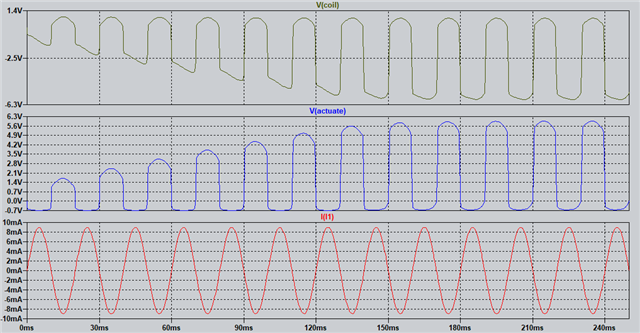
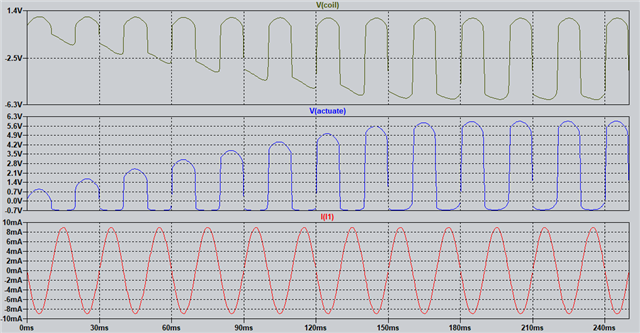
  • Mike is along, and I agree, that is not a normal rectifier - the actuation coil does not see a steady DC, rather something the is almost zero on one half cycle, and quite noticeably negative on the other. Waveforms in microwave ovens are similarly odd.

    other phase start

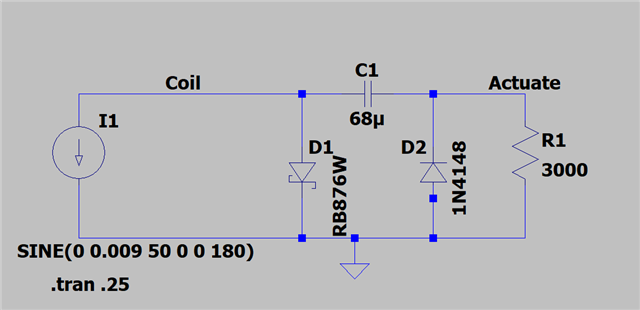
    The model. Note if D1 is not a zener then the voltages reached mean the sensing core would saturate horribly - perhaps it does but has already de-latched by then; as it is the integrals are not nice.
      I chose 10mA p-p as being about 3.5mA RMS ,a little over 1/12 of 30mA. The actuator coil resistance is a total guess, but it only alters the amplitude a bit, not the trend we want to understand, that it is not really a rectifier in the normal sense, more of a single sided pulsar.

  • Note if D1 is not a zener then the voltages reached mean the sensing core would saturate horribly

    Just to confirm that the diodes are the 1N4004 common place black rectifier diodes.Still have the bits..

    There's no indication of normal transformer core saturation just because the diodes are there.

    Perhaps you meant that the diodes 'saturate' in forward bias (~1A max withstand peaks up to 30A.). With the 12:1 turns ratio that's a L-N imbalance of 12A 'happily'.

    The other option is that the capacitor C1 (Tant bead) is being 'charged up' via D2 (fwd) and then discharges via D1 and the trip solenoid. (the flip-flopping of volts and currents here may have me confused..)

  • Hmm. been looking again at the micro cct board and interconnection. I could have confused myself about the connections. more soon.

  • So, I made a mistake. D2 is anti-parallel with D1. Thus the solenoid is fed via C1. Makes more sense,

    Though the capacitor reliability may take a slight hit. 99.9% of the time it'll have micro/milli volt signals as the potential 1mA AC (equiv 12mA leakage) keeps tickling the diode forward biases.

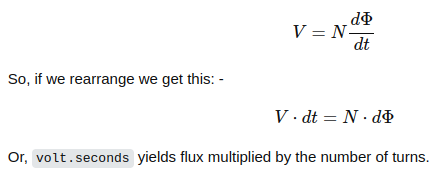
  • ah OK. No I did mean the core saturating - I would assume its less than 1cm2 cross section, and so incapable of supporting more than perhaps 0.25 volts per turn - that being more than a tesla.. A quick screen shot as the forum cant do nice formulae,

    given the units are metres squared seconds and Tesla, and all transformer steels saturate near the 1 Tesla mark, we can work back from 2pi* 50z to get the rate of change into pk volts (its not that far out to assume a triangle wave if you integration of cos or sin is rusty) chuck in a max delta flux of say 1 or maybe 1.5 tesla, and N of 12 and the time factor of 314 and get to a minimum core area.  But to save time RMS 1 volt ~ 2.8V-pp per turn needs a couple of square inches at 50Hz, and a touch less at 60.

    (

    Its also why in the SMPS we can have a few volts per turn, on an apparently  tiny core, the frequency is much higher - tens to hundreds of kHz, so the area falls in proportion, making things smaller lighter and cheaper, but by having square edged switching, pretty horrible from an EMC perspective.

    )

    Now 12th of that area would be the same voltage on 12T, and actually I bet the flux is constrained to an area less than that.  So the maximum RMS voltage on the 12T is only the odd volt or so RMS, much beyond that and the core will have lost all its mu, and the wire suddenly thinks its got less inductance.

    I must admit with 2 diodes and 1 cap I'd have expected this as a voltage doubler - schematic I was expecting below signature

    However, I never cease to be surprised at the variety of designs folk come up with. It may be just that the anti-paralel diodes are only there to take the heat out of any massive short circuit level imbalances that might damage the actuating coil but normally a suitably modest ring core size does that more cheaply. - see above.. Thanks for taking the time to look into it, more knowledge is always useful.

    Regards Mike.