Upstream downstream RCD test

GN3 advises that the test should be conducted upstream neutral to downstream line. It would appear that there is a functional reason but I would like some clarification. Yesterday I used the method to test several Contactum RCBOs. As per GN3 method at x1, all operated between 14 and 18ms. Reversing the probes to upstream line and downstream neutral, all operated but the instrument reported greater than 300ms. 

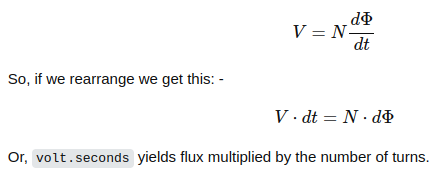
  • ah OK. No I did mean the core saturating - I would assume its less than 1cm2 cross section, and so incapable of supporting more than perhaps 0.25 volts per turn - that being more than a tesla.. A quick screen shot as the forum cant do nice formulae,

    given the units are metres squared seconds and Tesla, and all transformer steels saturate near the 1 Tesla mark, we can work back from 2pi* 50z to get the rate of change into pk volts (its not that far out to assume a triangle wave if you integration of cos or sin is rusty) chuck in a max delta flux of say 1 or maybe 1.5 tesla, and N of 12 and the time factor of 314 and get to a minimum core area.  But to save time RMS 1 volt ~ 2.8V-pp per turn needs a couple of square inches at 50Hz, and a touch less at 60.

    (

    Its also why in the SMPS we can have a few volts per turn, on an apparently  tiny core, the frequency is much higher - tens to hundreds of kHz, so the area falls in proportion, making things smaller lighter and cheaper, but by having square edged switching, pretty horrible from an EMC perspective.

    )

    Now 12th of that area would be the same voltage on 12T, and actually I bet the flux is constrained to an area less than that.  So the maximum RMS voltage on the 12T is only the odd volt or so RMS, much beyond that and the core will have lost all its mu, and the wire suddenly thinks its got less inductance.

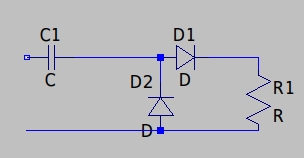
    I must admit with 2 diodes and 1 cap I'd have expected this as a voltage doubler - schematic I was expecting below signature

    However, I never cease to be surprised at the variety of designs folk come up with. It may be just that the anti-paralel diodes are only there to take the heat out of any massive short circuit level imbalances that might damage the actuating coil but normally a suitably modest ring core size does that more cheaply. - see above.. Thanks for taking the time to look into it, more knowledge is always useful.

    Regards Mike.