Adiabatic Equation

I am not an electrician but have a personal technical interest in understanding the Wiring Regulations.

I have become a bit confused by some contributions on the internet which seem to suggest that the adiabatic calculation will determine the size of CPC that will "cope with" a temperature rise to the maximum temperature permitted for a given cable type.

But as I understand it, it is the insulation which has to tolerate the temperature rise. This rise is caused by the heating effect (IsquaredR) of the current flowing in the CPC (and live conductor) under a dead short earth fault condition and which flows for the time it takes for the overcurrent protective device to disconnect the supply. Exceeding the maximum permitted temperature would permanently damage the insulation which I assume would no longer insulate.

Outside the parameters of the adiabatic conditions I assume that the conductors themselves could tolerate a very much higher and longer duration current, and hence temperature rise, before they themselves would become damaged. The only damage I can think of is that an unprotected conductor would melt like a fuse.

But for the adiabatic conditions of a known maximum level of earth fault current and a known OCPD disconnection time, the equation will determine the minimum size of CPC which would generate a temperature rise in the cable to the maximum permissible temperature for the insulation. In the case of a multi core cable like twin and earth, I assume that for an earth fault the heat contribution from the live conductor is not considered because the contribution from the smaller and hence higher resistance CPC will be much greater and more significant.

I will be pleased to hear from expert readers to confirm or otherwise clarify if I have understood the theory of this correctly . Thanks

Parents
  • But as I understand it, it is the insulation which has to tolerate the temperature rise. 

    Correct (the consideration is not just for the metallic conductor alone but also what's around it that sets the limit on acceptable temperature rise) - and that requirement is captured in the differing values for "k" (as per tables 54.2 to 54.6)

    The only damage I can think of is that an unprotected conductor would melt like a fuse.

    Or thermally damage the supports (think bare bus-bars) or even damage to the conductor's surroundings - e.g. setting fire to adjacent materials.

       - Andy.

  • Thank you @gkenyon, @Simon Barker, @mapj1 and @AJJewsbury for your feedback. 

    I'm digesting your comments and studying a bit more before I ask any further questions about them.

    In the meantime thanks

Reply
  • Thank you @gkenyon, @Simon Barker, @mapj1 and @AJJewsbury for your feedback. 

    I'm digesting your comments and studying a bit more before I ask any further questions about them.

    In the meantime thanks

Children
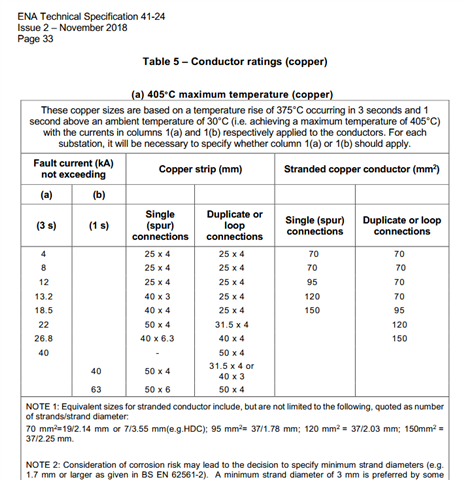
  • Mean while, although no figures  for hot bare copper, are in the wiring regs BS7671 it is interesting to look at the figures the ENA use for DNO type wiring at substations.
    Bare strips and bare stranded wire can be  used for earth bond interconnections to electrodes and between enclosures & so on.

      This table suggests that the  (smallest )bare copper 70mm2 cable is good for at least 8000  amp faults  for 3 seconds, but there is no insulation to damage. Note that at the end of the 3 seconds, the copper is at 405C - a temperature that would be put any kind of plastic insulation beyond use. The same document recommends no more than   325C for aluminium cored wire, and 400C for galvanized steel parts and a 250C rise for exposed bolted contacts however,...

    These are far higher fault current ratings than 'normal' can only be safely used when there is no part in contact that would be damaged by the heat. In a controlled location like a substation this is practical , as only competent persons are installing things, and the dangerous bits are in a locked compound or box, but even so if it were much hotter it would  leave scope to set fire to leaves, dust  or cobwebs, and as it is there are considerations of thermal expansion and stress on joints - hence the reduced limit on bolted connections  !.

    ref https://www.ena-eng.org/ENA-Docs/D0C3D1R/TS_41-24_181106101835.pdf
    regards Mike