USB charger outlet in Bathroom Zone2

I've been asked to add a USB charging port into a bedroom with a bath in it.

My understanding of BS7671 is that a room with a bath is a bathroom. As such the outlet would be in zone 2 of the bath.

Would I need to power the charger via a safety transformer and could this be built into a +IP4 enclosure similar to a shaver outlet

Thanks for your assistance

Parents
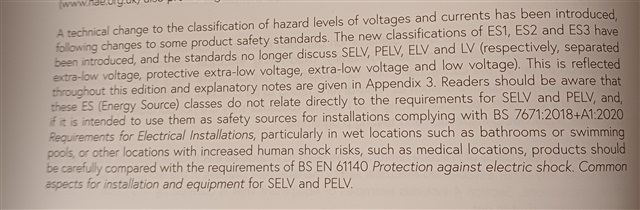
  • Can we clarify the use of Energy Source Classes 1, 2 and 3 for hazard levels of voltages and currents and the standards not discussing SELV, PELV, ELV and LV since 2020, six years ago?

    Reference IET Code of Practice In-Service Inspection and Testing of Electrical Equipment 5th Edition published 2020.

  • In what way "clarify" ?

    You refer to the IET Code of Practice for In-Service Inspection and Testing of Electrical Equipment from 2020, and will note that the prohibition on the use of sources to 414.3(iv) for certain of the Part 7 'special locations' was implemented in BS 7671:2018+A2:2022, which is a similar time-frame?

    The fact that there is no alignment with BE EN 61140 is the issue ... the products effectively use what we used to term 'limitation of discharge of energy' (although this is somewhat complicated by the use of semiconductors and doesn't fully align with 'limitation of discharge of energy' either ... but certainly neither SELV nor PELV as defined).

    I am in no way implying products to certain are dangerous per-say ... the fact is that BS EN 62368-1 only considers products for use in dry condition ... BS EN 60950-1 was no different in this regard; however, BS EN 60950-1 implemented SELV and PELV, which makes it a "horse of a different colour" when looking at supplies sourced from such products for use in certain special locations?

Reply
  • In what way "clarify" ?

    You refer to the IET Code of Practice for In-Service Inspection and Testing of Electrical Equipment from 2020, and will note that the prohibition on the use of sources to 414.3(iv) for certain of the Part 7 'special locations' was implemented in BS 7671:2018+A2:2022, which is a similar time-frame?

    The fact that there is no alignment with BE EN 61140 is the issue ... the products effectively use what we used to term 'limitation of discharge of energy' (although this is somewhat complicated by the use of semiconductors and doesn't fully align with 'limitation of discharge of energy' either ... but certainly neither SELV nor PELV as defined).

    I am in no way implying products to certain are dangerous per-say ... the fact is that BS EN 62368-1 only considers products for use in dry condition ... BS EN 60950-1 was no different in this regard; however, BS EN 60950-1 implemented SELV and PELV, which makes it a "horse of a different colour" when looking at supplies sourced from such products for use in certain special locations?

Children
No Data