Multicore cables in parallel - hysterisis (eddy currents)

Hi All,

Looking for a bit of a sanity check here!

I have reviewed an installation on site and found a number of circuits with multicore cables in parallel which are glanded into steel gland plates with no slot between the glands. I have raised this as an issue and the contractor is pushing back suggesting the problem only occurs with single cables in parallel and not multicore cables.

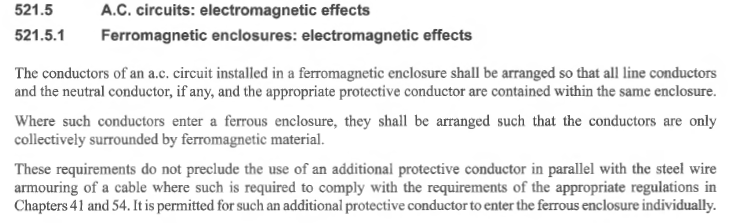
I have suggested the installation does not comply with 521.5.1, your comments would be welcome to confirm my sanity!
Thanks

Parents
  • Problems can occur with multicore cables, but only if there's an imbalance in the "going" and "return" currents in each cable. Normally such arrangements aren't permitted (521.8.1) and where cables are used in parallel things should be arranged so that there's a more-of-less equal division of currents - so again there should be a pretty good balance within each cable. I can see there may still be some small imbalance in practice - but as long as the imbalance is relatively small (<100A say) and we're talking thin steel sheet enclosures rather than 1/2" cast iron, the result is likely negligible (there is a suggestion that the whole 521.5.1 regulation can be safely ignored for DB where the imblance per hole is <100A (from memory).

       - Andy.

  • It rather depends how those multiple cores are wired. If for example  there are loads wired between say the L1 of cable 1 and any other phase or N of say cable 3 then you do fall foul of the '7671 advice exactly as much as you would if they were singles doing the same thing. If however all the 3 phases and neutral of any given sub-main, are co-located in the same cable, they are already passing through the same hole, and the magnetic effects are cancelling. If they are not, and wiring cannot be re-arranged to achieve this, then the hole needs to be made common to both cables by breaking the magnetic loop that surrounds any un-cancelled current. To do that the fastest cheapest way is a slot, to make a dumbell / dog bone shape, and then backfill with braze metal and grind level, or epoxy (HY60 or at a push Araldite rapid ?) and flushtop,  or leave it open to acquire a mixture of fluff and iron filings, depending on the installation quality and location of the offending panel... can you tell I'm not a fan of open slots?  Outdoors it tends to be leaves and bits of bird nest.

    If at any downstream point for example, the neutrals of two cables in different holes were exchanged or even combined, then there is scope for that out of balance trouble ..

    Mike

  • It rather depends how those multiple cores are wired. If for example  there are loads wired between say the L1 of cable 1 and any other phase or N of say cable 3

    That sounds rather like a borrowed neutral to me.

    As I understand it, there are two (or more) identical cables in parallel, so each takes half the current of the combined conductor. Let's draw 100 A in L1, 200 A in L2, and 300 A in L3. Because of the imbalance, you get about -173 A in N. So now we have 50 A, 100 A, 150 A, and -86 A in the conductors of each cable. That still leaves each cable balanced, so the arrangement is compliant.

  • Hi Chris,

    You're understanding is correct. While the hysteresis would be negligible the wording of 521.5.1 suggests all circuit conductors are collectively surrounded by ferromagnetic material. so my concern is with compliance of the wording, it may well be that 521.5.1 is written in a way that causes confusion and ought to be re-worded with a caveat for multicore cables in parallel?

  • I see what you mean. That would be a very literal interpretation. I have no problem with that, but in practice, there will be no difficulty.

    Being too literal could cause problems with any conductors in SWA in parallel. Would you have to combine their wire armour using some form of twin gland at the point of entry?

  • Even the armour itself would count as a ferrous enclosure - applying that interpretation of 521.5.1 would mean that using SWA for parallel applications at all would be out of the question.

      - Andy.

  • + ½

    I had thought about that and I think that the armour does satisfy the definition of "enclosure", etc. So, if you combine two or more enclosures, they become one enclosure. (We can ignore the gap which a brass gland provides.)

  • Not really - the wires in the SW armour are neither  magentically in good contact nor forming a closed magnetic path enclosing a net current.. Had you said welded conduit, I'd have no problem with the statement.

    I'm still not seeing the problem, so long as the cores in each cable form a complete circuit, that is to say that all 4 current carrying cores that carry associated current, are together.

    Actually, for sensiible thicknesses of steel box, and sensible hole sizes you need many tens of amps going out of one hole and coming back via another to raise things by a few degrees.

    Far more common, with unbalanced currents and it does apply to SWA or AWA as well, is the transformer-like problem of armours earthed at both ends forming a one turn loop for voltage pick up. Dog bone slots don't help much there, as that really is an eddy current effect .

    Its why single core SWA does not exist....

    Strictly, the problem we are discussing is not eddy current, rather it is magnetic hysteresis, though i appreciate even some publications that really should know better get confuse the two.

    Mike.

  • Hi,

    I'm not disputing the physics here. The question is compliance with BS7671.

    Gareth

  • The question is compliance with BS7671.

    The issue then is the word "collectively" - does it refer to all conductors of the circuit or merely some suitable collection of them. Certainly ambiguous (online dictionaries suggest both "as a group; as a whole" as a definition - so could be either way). Given the physics, "a suitable group" might not be an unreasonable interpretation.

    Also consider how the reg could apply to other situations - say a steel adaptable box used as a JB for lighting - it would be quite normal to take just the L and SL (without N) through one hole for a switch drop, SL and N through another to the light - so neither contain "all" the conductors of the circuit - but do contain a suitable (balancing) group.

       - Andy.

  • Also consider how the reg could apply to other situations - say a steel adaptable box used as a JB for lighting - it would be quite normal to take just the L and SL (without N) through one hole for a switch drop, SL and N through another to the light - so neither contain "all" the conductors of the circuit - but do contain a suitable (balancing) group.

    But 521.5.1 does not say that all of the conductors must enter (or leave) together. It simply says that the ones which do must go through the same hole.

Reply
  • Also consider how the reg could apply to other situations - say a steel adaptable box used as a JB for lighting - it would be quite normal to take just the L and SL (without N) through one hole for a switch drop, SL and N through another to the light - so neither contain "all" the conductors of the circuit - but do contain a suitable (balancing) group.

    But 521.5.1 does not say that all of the conductors must enter (or leave) together. It simply says that the ones which do must go through the same hole.

Children
  • Hi All,

    Thanks all for your comments!

    I have just spoken to the technical helpline at the NICEIC who have confirmed that all conductors of the circuit (even consisting of multicore cables) must enter the same aperture of a ferrous enclosure in order to comply with BS7671.

    Cheers

    Gareth

  • Again  this falls back to definitions, in this case 'circuit' which seems to mean something different in standards land, to the meaning for the broader world of electron herding. Current flowing out to a light switch and back does form a circuit in an electrical sense. - but in standards speak is only part of a circuit.

  • But 521.5.1 does not say that all of the conductors must enter (or leave) together. It simply says that the ones which do must go through the same hole.

    So how does that work with L & SL through one hole and SL & N through a different one?

       - Andy.

  • Expanding on that thinking, say we had a 3-phase supply and L1 & N left through one hole and L2 & L3 left through another ... good or bad? I suggest "it depends" - if all four fed a 3-phase load then bad, but if L1 & N fed a 230V single phase load and L" & L3 fed a 400V single phase load then I reckon all is well.

    So it's down to whether what goes through a single hole is balanced  - i.e. what we'd traditionally call a circuit (but doesn't match BS 7671's definition of a circuit which encompassed all conductors downstream of a protective device).

    The next question is whether we'd consider two multicore cables in parallel to be one "circuit" or two. From an overload perspective we assume two - since each cable needs only to be rated for its theoretical fraction of the whole current - without any margin for error - so it would be consistent to assume tha same principle applies and each cable carries only its intended currents - and hence would remain in balance - so treat each cable as its own "circuit".

       - Andy.

  • The next question is whether we'd consider two multicore cables in parallel to be one "circuit" or two.
    so treat each cable as its own "circuit".

    That solves one problem, but creates another. Now you would have to have two overcurrent protective devices.

  • So how does that work with L & SL through one hole and SL & N through a different one?

    Non-compliant! 

    Here's another one. Does a ring final whose cables enter at opposite ends of a back-box comply with 521.5.1?

  • Non-compliant! 

    It's that careless use/ definition of the word "circuit" that's makes these regs a problem isn't it ? - we see a similar problem in reverse where the literal wording for grouping factors don't seem to apply to multiple cables from the same circuit.

    However two currents are  flowing in two cables adjacent, - say two lengths of T & E going out & back to a socket on a ring final in trunking, they heat each other just as surely as if they were supplying two radials on different fuses  carrying the same two currents.

    Then there is the non-matter of neutrals in 3 phase sub-mains that feed 3 single phase loads, as this is not a shared neutral, even though the 3 phases may have one fuse each ;-) 

    This is probably just another one on the mercifully short list of where the letter of the regs can be read to either require things that are not always necessary, and in other cases not actually be sufficient for some corner cases. They are being squeezed out over successive revisions, but probably not as fast as folk are getting less keen to make a technically informed local interpretation.

    Mike