Sprinkler System Pipework Main Protective Bonding

Good Evening

New to the forum and was hoping some of the knowledgeable people on here could assist with a query on main protective bonding of sprinkler system pipework.

We look after a number of schools as part of various FM contracts and have had fixed wire electrical testing & inspection undertaken at the sites when required over the last 10-15 years. On a few of the EICR's we have received recently it has been highlighted that their is no main protective bonding to sprinkler system pipework, in the sprinkler pump house or where it enters the main plant room within the main school buildings.

This has never been picked up before and as it seems to be the case that their is none present at sprinkler pipework within any of the schools, I was wondering if their could possibly be a reasonable explanation that at design stage, it was deemed there was no requirement for this pipework to be bonded.

Thanks in Advance

Parents
  • Overall, without knowledge of the site, perhaps relevant photographs etc, it's impossible to provide a firm opinion in a Forum like this.

    There may also be differing opinions as to whether the pipework is, or should be considered to be, an extraneous-conductive-part, or needs to be bonded for safety during maintenance (as is the case with some water utility/treatment sites).

    There may also be a different answer (or opinion) depending on:

    • Whether the pump house is a separate building
    • If the building (or one or more of the buildings) involved has a lightning protection system (BS 7671 now refers to extraneous-conductive-parts importing a 'dangerous potential' not simply 'earth potential').
    • etc

    The answer might also depend on whether there are one or more locations that require (or are specified to have) supplementary protective equipotential bonding in the premises.

    Some inspectors code it wrong without testing to see if it required

    There are also differing schools of thought on the testing approach ...

  • Thanks for the reply I have been to site and took some photos.

    I tend to think it should be classed as an extraneous conductive part the same as the water and gas pipework,and therefore bonded where it exits the pump house into the ground and where it enters the plant room in the main building from the ground.

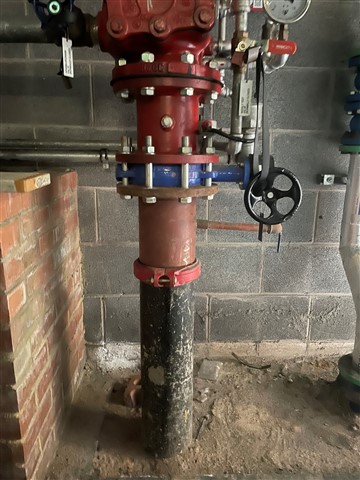
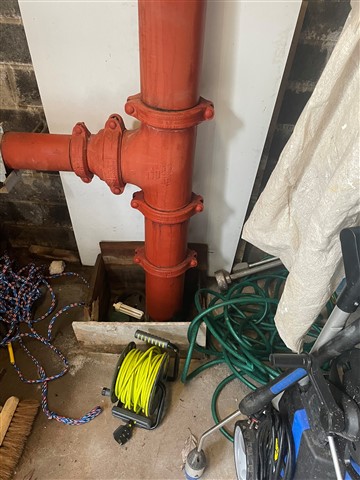
    Image 1 - Sprinkler Pipework Entering Plant Room (Main Building)


    Image 2 - Adjacent Water & Gas Supply Pipework With Main Protective Bonding

    Image 3 - Sprinkler Pipework Exiting Sprinkler Pump House

Reply
  • Thanks for the reply I have been to site and took some photos.

    I tend to think it should be classed as an extraneous conductive part the same as the water and gas pipework,and therefore bonded where it exits the pump house into the ground and where it enters the plant room in the main building from the ground.

    Image 1 - Sprinkler Pipework Entering Plant Room (Main Building)


    Image 2 - Adjacent Water & Gas Supply Pipework With Main Protective Bonding

    Image 3 - Sprinkler Pipework Exiting Sprinkler Pump House

Children
  • Unless it's just dipping through a slab into a 'services basement' type corridor, this is what I see from those pictures:

    Regardless of whether it's one building or two, it's definitely looking like an extraneous-conductive-part, as:

    • it's not part of the electrical installation,
    • it appears conductive (looks like steel pipes to me), and
    • it's introducing earth potential.

    Even if it's all in the same building, it goes into the ground (and is in contact with the ground, and back out again.

    If it's one building, depending in circumstances, there might be an argument for bonding it once only ... although because sections could be replaced with plastic, I'd err on the side of caution and bond it on each entry to the building.

    If it's two separate buildings, bonding needs to be applied separately in each building to meet the requirements of BS 7671 since 17th Edition BS 7671:2008.

  • Thanks again for taking time to reply Graham. I think we will look at getting this pipework bonded at each of the locations.