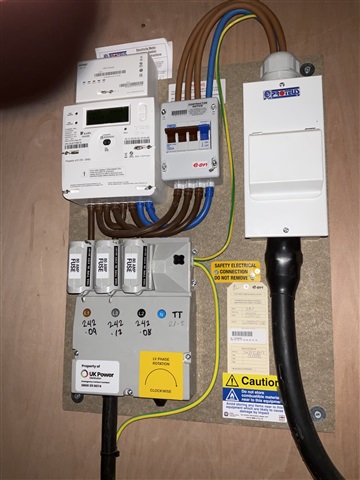
How good are you at telling the difference?
How good are you at telling the difference?
For a domestic or small commercial PNB you probably have to look outside of the building - see whether there's a a DNO transformer for just your property (or occasionally up to 4 close ones) and whether there's LV earthing at the transformer or anywhere else (easier to see with pole mounted ones).
It does beg the question of why bother though? In most cases the DNO reserve the right to change things - and typically that'll mean converting to PME - so rather like an old 'presented as TN-S' situation where we effectively have to treat it as PME anyway.
Big industrial PNB whether they have their own private transformer is presumably TN-S rather than TN-C-S anyway (otherwise they'd be in trouble with the ESQCR).
- Andy.

yuk! unbalanced neutral current by design. And no lower covers fitted over the rubber trouser sleeves.
I presume that's pilc with a newer head ?
If so TNS but treat as pme ;-)
Again no lower cover
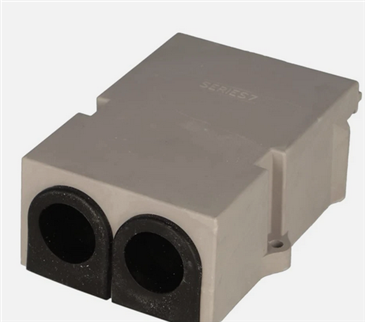
Naughty, especially on an older cable, as those rubber trouser sleeves only afford a soft single insulation over the stripped part of the live ends.
Mike

yuk! unbalanced neutral current by design. And no lower covers fitted over the rubber trouser sleeves.
I'm pretty sure I've seen 3-phase installations fed by three single core concentric overheads - so such things might not be too far from the norm in DNO land. I presume the incoming cables are modern concentrics with copper rather than steel "armour" - so no induced currents to worry about and the line conductors will have their own insulation underneath the trouser boot, so insulation+sheath overall. DNO's don't regard Ns as hazardous. Assuming the two supplies are on different phases the (and not too many nasty harmonics in the load) then the N current shouldn't exceed that of one phase, so no overloading issues. I might have preferred to see both cables run much closer together from an EMI perspective and perhaps the two N linked, just as a nicety and reduce N v.d. a bit.
- Andy.

Big industrial PNB whether they have their own private transformer is presumably TN-S rather than TN-C-S anyway (otherwise they'd be in trouble with the ESQCR).
Something interesting to consider.
At what point does TN-S become "TN-C-S (PNB)"?
If you want to be really pedantic, even a short stub of neutral conductor from the transformer, generator, etc., could be considered a PEN conductor?
So, is TN-S actually a thing? And depending on how you answer that, with a private transformer or generator, even with earthing at the source, how do we then consider Regulation 8(4) of ESQCR? No private supplies permitted? No 'island mode'?
If both phase are say loaded to 100A, then the neutral is - 100A, yes, as the missing third phase would sum to zero, and this is a worst case, but its horrible from an EMC point of view or for 3rd harmonics, and at any point those cables may go through a metal hole. Not to mention the massive extra magnetic field, some associated extra volt drop, and probably not great for loop hearing aids either.
Mike.

It’s not three-phase, but it does appear to be TN-C-S (PNB).

Not quite sure what the take-home message is there.
Is it the service head wired widdershins, or the use of its terminal block for a TT earth?
The phases are at 180 degrees, not 120.
We're about to take you to the IET registration website. Don't worry though, you'll be sent straight back to the community after completing the registration.
Continue to the IET registration site