


How good are you at telling the difference?
How good are you at telling the difference?
The new definition of PNB in part 2 seems to have suffered from a bit of cut & pate itus I think... for me the critical difference between PNB and PME is PNB has its N earthed at a single point (i.e. there's nothing multiple about it) - "a single source of voltage" has nothing to do with it (you can still have PV or other local generation with PNB).
- Andy.

ah split phase - how to win friends and confuse people ;-) at least the cancellation of third harmonics will be better. It is the sort of thing that's only really obvious with a meter to reveal the phasing and a look outside for the transformer arrangement. Perhaps if there is an HV line pair instead of a triple outside one does not need the meter.
Mike.

At what point does TN-S become "TN-C-S (PNB)"?
In my mind it's quite simple - where the path of the N current shares a conductor with the path between exposed-conductive-parts and the means of earthing.
I think a mistake has been made in describing the N tail from the transformer as a PEN conductor. Earthing is the concept of connecting an exposed-conductive-part to a means of Earthing. In the new Fig 3.9B the N conductor to the left of the N-PE link serves no earthing purpose - it's not connected to any exposed-conductive-parts - just the star point (transformers are earthed to the HV earthing system). Calling it a PEN causes confusion and rapidly reduces the whole situation to absurdity.
As I understand DNO documentation, there are two versions of PNB - the common one is TN-S in our terms, another (typically used where there's >1 customer) does have a PEN conductor and does carry some of the dangers of PME, despite having N earthed at a single point on the DNO side.
- Andy.

In my mind it's quite simple - where the path of the N current shares a conductor with the path between exposed-conductive-parts and the means of earthing.
I think a mistake has been made in describing the N tail from the transformer as a PEN conductor.
Now that BOB has arrived, I see what you mean, but I am not sure that I agree.
Suppose that the line conductor in my dishwasher comes into contact with the case (which probably happened a few days ago). The fault path would be back along PE to the neutral-earth link, across the link, and to the transformer along the N, which is now acting as PEN.
At what point does TN-S become "TN-C-S (PNB)"?
When the N-PE link is remote from the transformer.
Now you are going to ask what "remote" means.
If you want to be really pedantic, even a short stub of neutral conductor from the transformer, generator, etc., could be considered a PEN conductor?
But our friends in wigs would say that is de minimis and accordingly does not count.
The transformer across the road from here sits in its 4.5 m square enclosure. I would say that provided the earth is within that curtilage, the system was (when installed in 1959) TN-S. I have no idea what SSEN did when they changed the transformer a couple of years ago. If the N-PE link is now at the junction box under the highway, it begins to look more like PNB. There must still be separate N and PE conductors in the street main for the older houses which still have TN-S (see my earlier photograph).
That said, the modern houses have CNE service cables so best to treat everything as PME.
which is now acting as PEN.
It's part of the earth fault loop certainly, but I'm suggesting that's different to proving an Earthing function. The line conductor and transformer secondary winding also form critical parts of the loop, but we don't regard them a protective conductors.
According to part 2 Earthing is about connecting exposed-conductive-parts to Earth (via the MET) - rather than to the star point. In terms of trying to keep exposed-conductive-parts as a safe potential that makes sense to me. A break in the conductor between the N-PE link/electrode and the star point doesn't affect the earthing of exposed conductive parts - they all remain correctly connected to the general mass of the Earth. A break in a real PEN conductor is rather different (exposed-conductive-parts can become and remain at hazardous voltage w.r.t. true earth).
To label non-earthing N conductors as PENs starts to generate all sort of contradictory logic - every system (even TT or TN-S) then appears to be TN-C-S to some extent and we end up going down rabbit holes trying to re-interpret the ESQCR in ways that simply don't match the original words. It just becomes a mess..
- Andy.
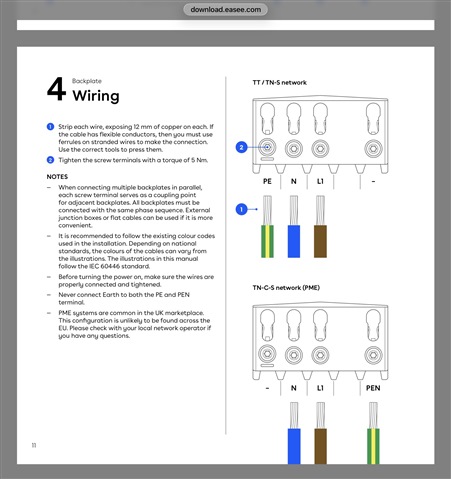
The wiring diagram in an Easee electric vehicle charging point instruction manual, which earth terminal should be used with a TN-C-S (PNB) earthing system?
Try figure 13 and 14 here: https://commercial.nationalgrid.co.uk/downloads-view-reciteme/63784 (on page 53)
- Andy.

where the path of the N current shares a conductor with the path between exposed-conductive-parts and the means of earthing.
Ah, so you mean a transformer 'tail' ... the neutral point is the actual star point of the transformer, and therefore the 'tail' is a 'neutral conductor' by definition?
I think a mistake has been made in describing the N tail from the transformer as a PEN conductor.
I'm not sure it's that clear.
Calling it a PEN causes confusion and rapidly reduces the whole situation to absurdity.
I agree, but if we work with existing definitions, and follow your definition of a PEN conductor, then we must reach the absurd conclusion?
As I understand DNO documentation, there are two versions of PNB - the common one is TN-S in our terms, another (typically used where there's >1 customer) does have a PEN conductor and does carry some of the dangers of PME, despite having N earthed at a single point on the DNO side.
I think in real terms, it's more like 'One does not need to conform to PME requirements, the other does ... although as we have seen elsewhere in this thread, at least where the DNO provides TN-S there's not always a guarantee that PME conditions won't apply.
The conclusion being that, only in TN-S and PNB systems supplied from only private transformers and generators, can we dispense with the requirements of BS 7671 relating to PME.
We're about to take you to the IET registration website. Don't worry though, you'll be sent straight back to the community after completing the registration.
Continue to the IET registration site