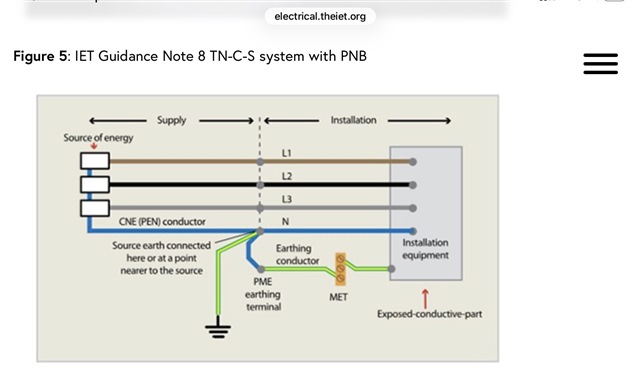
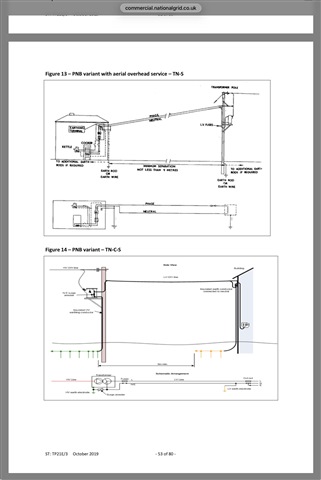
How good are you at telling the difference?
How good are you at telling the difference?

A break in a real PEN conductor is rather different (exposed-conductive-parts can become and remain at hazardous voltage w.r.t. true earth)
That can happen under some circumstances with 'private PNB' if things go awry.
I'm also not convinced that PNB always means 'earth is Earth' in a three-phase system with a broken PEN conductor, because the neutral balance will still be awry - the system won't be earthed at a star point. In private PNB where the transformer case is connected to the neutral, but not solidly to the PE system, you get ground currents that affect EPR.
The only saving grace about the transformer N-stub is it is far less likely to fail than cables are to be damaged.
According to part 2 Earthing is about connecting exposed-conductive-parts to Earth (via the MET) - rather than to the star point
That's simply because this is always the case for each of TN, TT and IT.
Due to debates on this topic at international level, the connection of a live conductor (usually the neutral) to earth is starting to be termed 'system referencing' ... BUT internationally, in single-phase systems not derived from a three-phase system, and split-phase systems, there technically is no 'neutral' ...

Ah, so you mean a transformer 'tail' ... the neutral point is the actual star point of the transformer, and therefore the 'tail' is a 'neutral conductor' by definition?
Yes, it's neutral - but just a neutral - it serves no Earthing purpose (i.e. it plays no part in connecting exposed-conductive-parts to the general mass of the Earth, so therefore isn't a PEN.(It might carry earth fault current, but so other conductors we don't call PEN or protective conductors).
and follow your definition of a PEN conductor, then we must reach the absurd conclusion?
Quite the reverse, I think..
- Andy.

The conclusion being that, only in TN-S and PNB systems supplied from only private transformers and generators, can we dispense with the requirements of BS 7671 relating to PME.
Agreed. Isn't the point here that the owner of the private transformer is also the consumer and that the one entity is responsible for the whole lot? No changes can be made to the network without the consumer's knowledge.
(Save in Downing Street. ;-) )
The conclusion being that, only in TN-S and PNB systems supplied from only private transformers and generators, can we dispense with the requirements of BS 7671 relating to PME.
Agreed (with possible exceptions where the DNO might guarantee or be legally obliged to maintain existing TN-S arrangements - perhaps to campsites or marinas). I think PME conditions should definitely apply to the TN-C-S version of PNB too - as that has all the troublesome aspects of PME - even the multiply earthed feature once consumer's bonds to extraneous-conductive-parts are added in.
For me, what's causing the confusion is that BS 7671 has taken the diagram of the TN-S version of PNB and labelled it TN-C-S. The real TN-C-S version has the electrode upstream of the N-PE link with a PEN conductor joining the too (which is the feature that causes much of the trouble). See the DNO diagrams I referenced earlier.
In any event DNOs generally reserve the right to alter any of their TN-S system into TN-C-S (whether PNB or not) - so the general assumption should be if you're using a DNO's earthing facility then PME conditions will apply.
- Andy.
PNB and PME is PNB has its N earthed at a single point
But equally, it's possible to have TN-C-S that's earthed at the source, insulated and sheathed 'neutral' conductor, until it's split out into PE and neutral ... in which case it's still TN-C-S, but the neutral only has one earth ... that wouldn't be PNB.
There are also different flavours of PNB that have been used in the past, and still present, even if new installations won't be like that, where:
- Up to 4 customers are served
- neutral not earthed at the pole-mounted transformer
- neutral earthed at each customer, with N-PE split at the service head.
Strictly, the conditions of PME are not always met by this version of PNB; however, it's still a 'multiple-earthed neutral' on the supply-side.
My understanding is that the TN-C-S(PNB) earthing arrangement is installed by the DNO to provide a minimum of 8.000 metres separation between the transformer HV earth system and LV earthing system provided for the customer by the DNO.
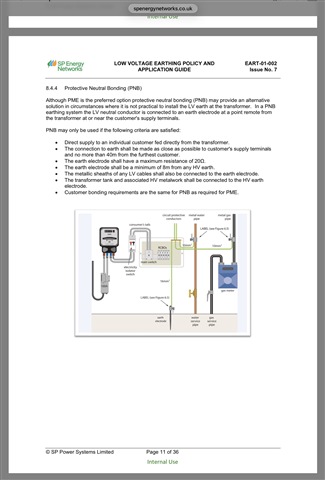
For me, what's causing the confusion is that BS 7671 has taken the diagram of the TN-S version of PNB and labelled it TN-C-S.
But it can't be TN-S, because it's not earthed at the source, so the neutral and protective functions are combined in part of the system. However, I agree it's not PME.
In addition, it's possible to have TN-C-S systems with a multiple-earthed neutral that does not meet PME requirements.
PME is a specific form of TN-C-S, where the neutral is earthed at multiple points to achieve certain conditions.
We're about to take you to the IET registration website. Don't worry though, you'll be sent straight back to the community after completing the registration.
Continue to the IET registration site