


How good are you at telling the difference?
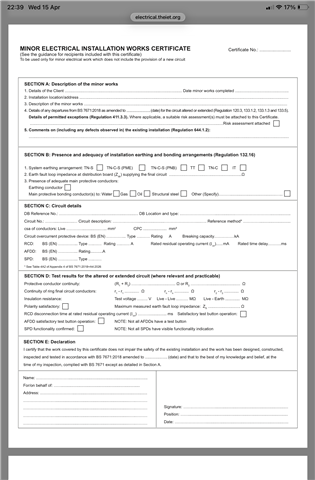
How good are you at telling the difference?
Above I referred to the installation instructions for EVSE made in Norway, which has a choice of two earth terminals for TT/TN-S or alternatively TN-C-S.
It appears that earthing as we know it is a bit of a novelty in Norway with an earthed neutral.
Here is a description of the Norwegian distribution network installation arrangements:
These are mainly two different types of power grids.
IT (Isolated Terra) is found in approximately 75 per cent of in Norway, and consists of either 1-phase (2 conductors) or 3-phase (3 conductors) plus earth (PE). There is 230V between each of the conductors and the neutral point of the transformer is not earthed, but is protected with a spark gap between neutral point and earth. Thus, there is no so-called zero conductor. To convert from IT to TN, a transformer must be used.
TN (Terra neutral) is used in almost all of Europe, and around 25 per cent of Norwegian electricity subscribers have this. TN consists of four conductors (three phase conductors and one neutral conductor) plus earth (PE). This means that you can extract 230V between each of each phase conductor and neutral conductor, and you get 400V between each phase conductor.

Which then gives some interesting wiring instructions for the Norwegian Zaptec EVSE.
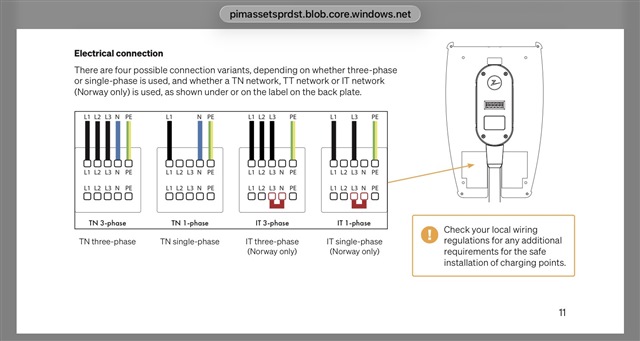

But it can't be TN-S, because it's not earthed at the source, so the neutral and protective functions are combined in part of the system.
I'm not following the logic - the conductor may be connected to Earth, but to my mind it's not providing any earthing functions, since it doesn't connect any exposed-conductive-parts to Earth (the transformer case, is always connected to the HV Earth).
The TN system describes the relationship of the power system to Earth and the relationship of the exposed-conductive-parts to Earth (see 312.2) - rather than the wider earth fault loop.
Even the definition of a protective conductor talks about it connecting exposed-conductive-parts, extraneous-conductive-parts, MET, electrode and the earthed point of the source (my emphasis) - not the star point..
By all the definitions I can find the conductor to left of the N-PE link in Fig 3.9B is neither an Earth conductor nor a protective conductor. To my mind it's simply a neutral conductor. Eveything else then follows on reasonably logically. No rabbit holes required.
- Andy.

By all the definitions I can find the conductor to left of the N-PE link in Fig 3.9B is neither an Earth conductor nor a protective conductor. To my mind it's simply a neutral conductor. Eveything else then follows on reasonably logically.
Given that the distribution system is out of scope, the definition of "earthing" in Part 2 does not necessarily apply.
The casing of a transformer may be connected to the HV earth, but isn't the star point earthed on the LV side? If so, the conductor in Fig. 3.9B is indeed serving the purpose of carrying the neutral current and earthing the star point.
Wow since when did the simple act of earthing get so complicated! I don't think it was always so things really need simplifying. Any how that first picture can't be a real installation surely if the supply people left me with something like that ide be very dis chuffed. In my road we have earthing to the outer lead sheath of the PÌLC cable except for in a recently rewired flat above a shop which has PME ie the neutral and earth are joined in the meter cabinet, also the earth is joined to the water pipe and the gas pipe so fairly standard. The water pipe is metallic all the way down to the ground. So what would you call the overall system? There are at least two places where they've added a copper rod laid in the ground and tied to neutral. So is it PME PNB TNS or what. I found by chance that I can get a continuity reading between earth and neutral there's no link in my supply so it's a bit of an odd one.
recently rewired flat above a shop which has PME ie the neutral and earth are joined in the meter cabinet
I found by chance that I can get a continuity reading between earth and neutral there's no link in my supply so it's a bit of an odd one.
Even with TN-S there is continuity. The impedance should be approximately the same as Ze. If you start adding more N-E links, the value will fall. Parallel paths.
There are at least two places where they've added a copper rod laid in the ground and tied to neutral. So is it PME PNB TNS or what.
If they've multiply earthed the neutral it's PME (TN-C-S).
- Andy.

That offset electrode arrangement is common with pole-pig installations in Hants and Wilts too, for the same reason, that a low enough resistance to consider it a 'cold' site and combine the earths is almost impossible to maintain.
The transformer pole (or poles if it is a cross-bar 'H' style) has the HV electrode at the base, and that earths the transformer tank, core and possibly bits of support metalwork, and is there to trip the earth fault detection at the other end of the 11 or 33kV. much as if a line had come down.
The bit of the ABC that is between transformer star and the LV electrodes is not really 'combining N and E functions in a consumer installation' , but it is important to see that cutting it does not have the same effect as cutting the equivalent conductor much beyond the first electrode. It does still unbalance the phases, and, as there is now nothing to pull down on the inter-winding capacitance, the 3 phase bundle can float up to some very nasty divided HV quantity, but on the other hand the earth and neutral do not become dangerous
There is a reason that where used to be is 4 bare singles, Aerial Bundle Cable is slowly replacing it - far better for all cores to break when a tree comes down, rather than just the one that leaves the rest alive.
Mike.
and, as there is now nothing to pull down on the inter-winding capacitance, the 3 phase bundle can float up to some very nasty divided HV quantity,
I wonder if it's quite as bad a that - after all the L side of the winding is still referenced, via connected loads, to Earth - not quite the referencing anyone would want, but still not really left to float entirely (at least not until someone turns everything off...)
- Andy.

If they've multiply earthed the neutral it's PME (TN-C-S).
TN-C-S ... yes.
Multiple earthed neutral ... yes. (By this, I'm not implying it meets the "MEN" rules as used in Australia and New Zealand.)
"PME" ... Not necessarily. If it's limited to 4 customers, full PME rules might not be used.
We're about to take you to the IET registration website. Don't worry though, you'll be sent straight back to the community after completing the registration.
Continue to the IET registration site