Is there an error in 312.2.1.1?

There appears to be an error in 312.2.1.1 Single-source systems.

Note 4(b): "Regulation 8(4) of the Electricity Safety, Quality and Continuity Regulations (ESQCR) prohibits the use of a public distribution network neutral as a protective conductor in consumers' installations."

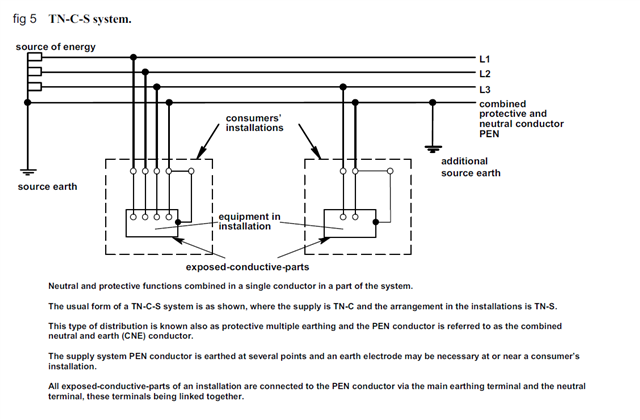
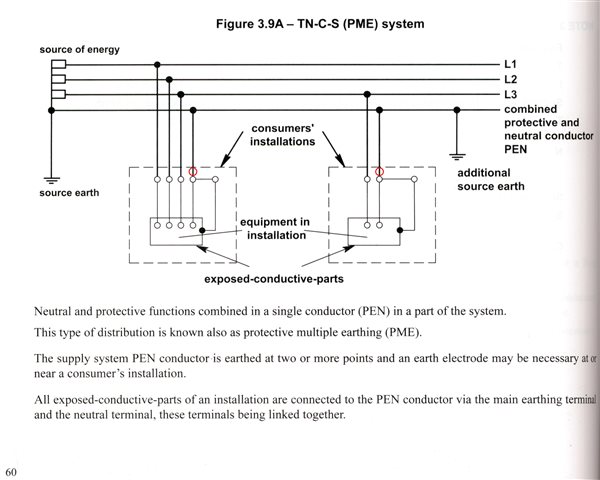
So why is a short length shown in Figure 3.9A, circled in red below? (I realise that the figure is not new.)

I appreciate that the aim may be to show the distinction between the TN-S and TN-C-S (PNB) systems where there is no link on the consumer's premises on the one hand, and TN-C-S (PME) where there is a link in each of them on the other hand.

The fact is that the service head, which contains the link, is part of the network, so the links in Figure 3.9A ought to be shown outside the dashed box. Alternatively, the boxes could be re-labelled as "consumers' premises".

As a point of interest, an electricity meter is normally to be situated on a customer's premises (Paragraph 1(3) of Schedule 7 to the Electricity Act 1989), so the adjacent service head will be situated on the same premises.

ESQCR defines “consumer’s installation” as "the electric lines situated upon the consumer’s side of the supply terminals together with any equipment permanently connected or intended to be permanently connected thereto on that side", and “supply terminals” as "the ends of the electric lines at which the supply is delivered to a consumer’s installation" (Reg 1(5)). “Supply neutral conductor” is "the neutral conductor of a low voltage network which is or is intended to be connected with earth, but does not include any part of the neutral conductor on the consumer’s side of the supply terminals".

Given that the network and consumer's installation are unambiguously demarcated at the supply terminals, it follows that Note 4(b) cannot be correct. Whether the supply terminals are the output of the service head or the output of the meter does not change the argument.

What R.8(4) of ESQCR states is "A consumer shall not combine the neutral and protective functions in a single conductor in his consumer’s installation." In other words, it prohibits a consumer from using any of his own neutral conductors as a protective conductor rather than a public one. I suggest that the distinction is more than trivial.
Parents
  • If the dotted line was redrawn through the middle of the circles, then it would be right.  As drawn, it implies that the DNO's cutout is part of the consumer's installation.

  • If the dotted line was redrawn through the middle of the circles, then it would be right.  As drawn, it implies that the DNO's cutout is part of the consumer's installation.

    The diagram in Fig 3.9A isn't new. It is unchanged from Fig 3.9 in BS 7671:2018+A2:2022 ... in fact, image below is from 16th Edition BS 7671:2001+A2:2004. I believe it was introduced in BS 7671:2001.

    So, the image has been incorrect in respect of UK public PME supplies since it was first introduced over 25 years ago.

  • Would that warrant a corrigendum for BS7671 18th AMD4 to correct the long standing issue?

  • Some more thought might be  needed.

    Not all countries that use BS 7671 * have an ESCQR type act that prohibits a customer side NE conductor sharing, and in some places, as well as in many other countries wiring regs, the equivalent link is legally under the control of the consumer.  

    (Note that in other places  - Australian MEN for example - you are allowed more than one NE link by design, so long as what is in effect a private PEN to an outbuilding or similar  is suitably installed and sized. ) 

    In this country, unless the supply is at HV,  it is clearly the DNO's to own, but to move the dotted lines to make the drawing UK only, might not be desirable. 

    If the dotted lines were removed,  it could  also could be read as allowing one consumer to have two main supplies, and that is not really what is wanted either.

    It is also perhaps worth pondering the intention of the ESCQR, which I suspect was more to discourage earthed concentric wiring and the LV equivalent of single wire earth return, than be too detailed about how DNOs interconnect their TNS and TNC wiring 

    regards Mike

    * to name a few, Qatar, Malta, UAE Cyprus Mauritius, St Lucia,Saint Vincent and the Grenadines, Sierra Leone, Sri Lanka, Trinidad and Tobago, Uganda,  ..  Not sure how rigorously the rules are enforced in all these places however, having seen some odd things on my travels..

Reply
  • Some more thought might be  needed.

    Not all countries that use BS 7671 * have an ESCQR type act that prohibits a customer side NE conductor sharing, and in some places, as well as in many other countries wiring regs, the equivalent link is legally under the control of the consumer.  

    (Note that in other places  - Australian MEN for example - you are allowed more than one NE link by design, so long as what is in effect a private PEN to an outbuilding or similar  is suitably installed and sized. ) 

    In this country, unless the supply is at HV,  it is clearly the DNO's to own, but to move the dotted lines to make the drawing UK only, might not be desirable. 

    If the dotted lines were removed,  it could  also could be read as allowing one consumer to have two main supplies, and that is not really what is wanted either.

    It is also perhaps worth pondering the intention of the ESCQR, which I suspect was more to discourage earthed concentric wiring and the LV equivalent of single wire earth return, than be too detailed about how DNOs interconnect their TNS and TNC wiring 

    regards Mike

    * to name a few, Qatar, Malta, UAE Cyprus Mauritius, St Lucia,Saint Vincent and the Grenadines, Sierra Leone, Sri Lanka, Trinidad and Tobago, Uganda,  ..  Not sure how rigorously the rules are enforced in all these places however, having seen some odd things on my travels..

Children
  • Not all countries that use BS 7671 * have an ESCQR type act that prohibits a customer side NE conductor sharing, and in some places, as well as in many other countries wiring regs, the equivalent link is legally under the control of the consumer.  

    We only need to concern ourselves with the UK when considering changes in BS 7671. Although it's true that other countries do use BS 7671, or cite it in specifications for construction design and build, it would be up to that country, or the specifier, to address any national inconsistencies.

    In this country, unless the supply is at HV,  it is clearly the DNO's to own, but to move the dotted lines to make the drawing UK only, might not be desirable. 

    I agree, for a number of reasons. Not least, trying to show this "on or before" the border of the consumer's installation is quite difficult.

    It is also perhaps worth pondering the intention of the ESCQR, which I suspect was more to discourage earthed concentric wiring and the LV equivalent of single wire earth return, than be too detailed about how DNOs interconnect their TNS and TNC wiring 

    Or, perhaps, discourage multiple earthed neutrals in the consumer's installation too. Diverted neutral currents can cause safety issues for those working on the distribution network cabling under certain circumstances ... particularly true now we are moving to more installations capable of islanding.

  • If you worry about a drawing from 2001, it is quite instructive to compare the current rules  with its  ancestor on that topic (The Electricity Supply Regulations 1988 - only superseded in 2002, when the ESCQR  came into law - so about a year after the offending diagram was created ).


    The earlier legislation was far more nuanced about NE bonds, and had a lot of technical details, maximum distances, copper areas and so on, but did not actually prohibit a PEN consumer side, subject to certain limitations. - see regulation 7. The same legislation also enshrined in law, the 20 ohm maximum electrode impedance and 1 ohm hot site/cold site distinction that are now both reduced to more of a rule of thumb.

    regards Mike

    'The supplier shall not connect or permit the connection of, or continue, a supply to any part of a consumer’s installation where the supply neutral conductor is, or is intended to be, used to connect any circuit protective conductor in that part of the consumer’s installation with earth unless he is satisfied so far as is reasonably practicable, that  .. '

    and a list of minimum cross-sections, and maximum resistances Is not at all the same as the blanket ban


    'A consumer shall not combine the neutral and protective functions in a single conductor
    in his consumer’s installation.'

    so maybe when drawn, it was OK.