Can you have too many SPDs?

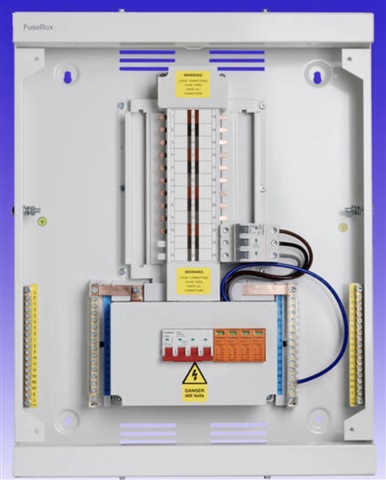
If you have a three-phase distribution board with a four pole three-phase SPD preinstalled by the manufacturer and then install a linking kit to convert the three-phase board to single-phase you end up with three SPDs in parallel on the same phase.

Is that potentially an issue?
www.tlc-direct.co.uk/.../FBTPN03FBX.html

Parents
  • The short answer is 'No'

    all that it means is that the peak current surge it can survive is 3 times higher than you might expect, or if you prefer, for any given surge the over voltage is what it would have been for a current spike of a third of the size.

    The only reason that we don't always fit that much volume of SPD is the wasteful economics of buying an oversized  device.

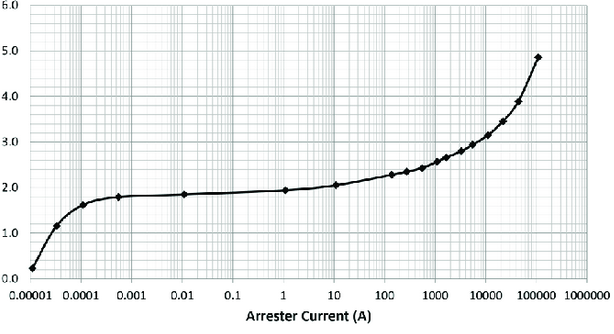
    All solid state arrestors have an I/V curve similar in trends to this, though this is data for one that is not a mains one, (for supplies of ~ 1kV I think )normally the voltages and currents are in the far left region , well below the turn on voltage,  once the device turns on then over several orders of magnitude of current (mA to tens of amps) we see the voltage rises quite slowly.
    Only as current enters the kA region do we see the voltage clamping action start to fail and the voltage take off. The pulse power and duration that can be safely handled without dangerous overheating is more or less in proportion to the volume of material as the failure mode is thermal. 

    Mike.

Reply
  • The short answer is 'No'

    all that it means is that the peak current surge it can survive is 3 times higher than you might expect, or if you prefer, for any given surge the over voltage is what it would have been for a current spike of a third of the size.

    The only reason that we don't always fit that much volume of SPD is the wasteful economics of buying an oversized  device.

    All solid state arrestors have an I/V curve similar in trends to this, though this is data for one that is not a mains one, (for supplies of ~ 1kV I think )normally the voltages and currents are in the far left region , well below the turn on voltage,  once the device turns on then over several orders of magnitude of current (mA to tens of amps) we see the voltage rises quite slowly.
    Only as current enters the kA region do we see the voltage clamping action start to fail and the voltage take off. The pulse power and duration that can be safely handled without dangerous overheating is more or less in proportion to the volume of material as the failure mode is thermal. 

    Mike.

Children
No Data