Who from the IET is working with the government to allow <800W inverters to be 'plugged in'?

The UK government made the following announcement at the end of March (www.gov.uk/.../government-to-make-plug-in-solar-available-within-months) regarding Balcony Solar/Plug-in Solar. The following section features in the 'Notes To Editors' at the end of the announcement.

"The government will work with the Energy Networks Association, DNOs and Ofgem to update the G98 distribution code and wiring regulations BS 7671 to allow UK households to connect <800W plug-in solar panels to domestic mains sockets, without the need for an electrician and with tailored safety standards."

So who is the government working with at the IET/JPEL64 to make these changes to BS7671? Or is the government simply going to bypass the IET and make amendments willy nilly?

Parents
  • In respect of BSI committee work (BS 7671 is developed by a committee jointly managed by the IET and BSI, but that follows the BSI rules for developing standards) specific discussions in committees cannot be shared. Similarly, content of standards and draft standards can only be discussed when they are published, or made available as drafts for public comment.

    Would those rules prevent someone confirming whether a committee (or indeed which sub committee) had been asked to consider a particular request or requirement?

    The comments on RCD operation seem somewhat unclear to me. Mark started off taking about a certain type of RCD that the Germans had the foresight to drop many years ago (which I take to be AC types) - but the article says "But some older RCDs were never designed for electricity flowing back into the circuit" - but bi-directionality is a completely different feature - and not one universally found even in the latest RCDs. I suppose we should add in single pole switching RCDs (mostly RCBOs) where the local generation isn't separated from Earth when the RCD trips, so the shock hazard persists until inverter shutdown - again a problem that isn't mitigated by ensuring your installation is up to current standards.

       - Andy.

  • This surely  is the point - they are not aimed at the folk who have a large semi-detached with roof area and driveway - they can probably get a full size hard wired system, and have the ability to afford it. They are aimed at those renting a mid terrace with a flat roof on the bit at the back that used to be a coal-shed and outside loo, and is now an annex to an inadequate  kitchen,  So there will be a few square metres of panel at best, and perhaps some pretty ropy installation mechanics done by family and friends, or maybe some dodgy Dave and his  mate at the pub who also works as a builder's labourer. But that's fine, because its a sector of society that will otherwise never get reached by the current formal channels, and needs to be somehow, anyhow. 
    Having lots of the thing plugged into the same house, or into lots of flats in the same block or many houses on the same phase (every third house) in a street, the mutual support and self power problem is the same, and it is solved.

    Basically they all free-run slow, and correct against the grid. If there is no grid, then the group will slow down as they time off each other, and within a few cycles drop off due to an out of frequency fault. 

    Actually one might take the experimental argument that if 960W (800 W plus max tolerance) is demonstrably OK, as per continental in practice experience,  on a 16A radial in 1,5mm2,  then maybe rather more power is OK on a 16 or 20A radial wired in 2.5mm2, and more still on a 32A ring final  or socket on a 32A 4mm2 radial or larger cooker supply.

    About the only thing that could get sketchy with UK wiring practice would be tapping into the common 1mm2 (6A) lighting circuit, and with LED lights, even that is very lightly loaded nowadays , but a lot of older houses of a certain era still have no or only partial lighting CPC. As far as I know, most of the continent does not separate lights and power in that way, preferring one radial for lights and power in each  zone of the building. This lends itself in 3 phase areas to a couple of 16A radials per phase on a 32A supply.

    Mike

  • So there will be a few square metres of panel at best

    The system on special offer at Lidl is now sold out, but the two panels are almost exactly 2 m² each.

    Interestingly, whilst the Quick Start Guide has the system plugged in on the Continent, it is hard-wired in UK (page 07).

  • The description on that webpage of the registration is also instructive, I cannot imagine an English  equivalent of Sie müssen aber, wie auch Solarspeicherbatterien, im Markenstammdatenregister der Bundesnetzagentur angemeldet werden.

    You shall however, and also with Solar Storage Batteries,   in the Official Data Register of the Federal Network Operator be registered... 

    Apparently registration and de-registration is a simple Internet operation,  the German rules do not apply to the whole EU, specifically note that users in the Czech republic may not export to their public grid at all see configuration instructions for how to do that.
    Aldi may be leading, but the German technical  approach is clearly not the only one.

    Mind you, I bet these will turn up in all sorts of places and not all will be registered.

    regards

    Mike

  • G98 is not an appropriate standard for plug in solar so quoting is doesn't really help (as identified at the start of this thread).  In particular, G98 is built around hard wired equipment with a degree of tolerance to voltage / frequency fluctuation, with a reasonably long delay in ceasing generation so as to avoid unfortunate events where the grid might suddenly lose a significant chunk of generation at a national level because all the solar systems shut down.

    With plug in solar, the trade-offs have to be different.  Plug in solar, by its nature, can be unplugged and the risk presented by a plug remaining live (or a connected circuit remaining live after a RCBO has tripped) for more than a few milliseconds is intolerable.  Plug in solar will either need a separate standard akin to G98, or a significant update to it.  Of course, plug in solar will as a result be an inherently less stable source of generation (more accurately load reduction!) for the grid than "normal" solar and that is something that those who operate the grid will need to buy into if plug in solar is expected to achieve significant scale.

    As I noted in one of the other threads on this subject, there is a class of devices (inverter / chargers often used on road vehicles / smaller boats, operating in parallel with a shore supply) which have much commonality in terms of shutdown requirements with plug in solar - I don't know what standards they adhere to (I suspect there may be none applicable with respect to loss of mains detection) but whatever approach is taken there seems to work and perhaps might work for plug in solar.  I suspect that "line interactive" computer UPSs also need to detect loss of mains in order to avoid their plugs being live on loss so there might be some standardisation or learning in that area too.

    An equipment standard on the subject of fast loss of mains detection and disconnection of plug in equipment connected to a separate power source would be a sensible thing to exist if it doesn't already given the various classes of device which might benefit from such a standard.

  • the trade-offs have to be different.

    I agree entirely. The Germans felt it necessary to have their own standards as installation conditions vary across nations. As I recall Germany tends to use TN throughout, whereas we have a mixture of TN and TT installations - so while compromise of the effectiveness of RCDs might "only" result in loss/reduction in additional protection there, here it might mean basic ADS is compromised. The Germans have decided on somewhat different overall parameters too (e.g. the overall rating) so there's no precedent to comply with a single common standard (at least not in the short term - longer term no doubt a common denominator will emerge).

    I think we should keep our minds open to other means of achieving similar ends too - e.g. if it were to be decided that the last major stumbling block was the loss of additional protection to other outdoor equipment fed by the same final circuit (e.g. cut lawnmover lead) then consumer advice to revert to using plug-in RCDs for their garden equipment (as they would in days past if the sockets weren't 30mA RCD protected) might be an adequate compromise.

    But if on the other hand we decided that the only practical way forward was for inverter shut-down time had to be so fast (on top of typical RCD actual opening times) that neither ADS nor additional protection was significantly compromised, then that's what we should stipulate. (Cue others to point out technical limitations!). We don't necessary have to be limited to what has already been produced.

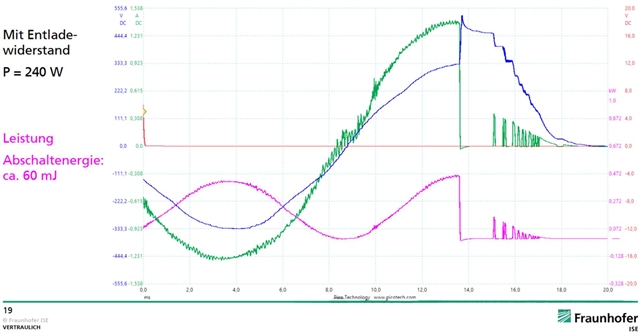
    From the German paper showing waveforms on unplugging:


    it seems that the current drops to zero just about instantaneously (green line) - perhaps a signal such as that could be used to trigger a much more prompt shutdown (or at least disconnection from the mains side).

       - Andy.

    (edited to fix diagram)

  • It would not be hard though to add one line about plug in units  to the annex of G98 that covers loss of mains,  and make it the same as the standard for domestic and commercial equipment with a plug on it (EN IEC 62368-1:2024)  where no more  specialized standard applies.

    That would require that pins must not remain "hazardous live" above ES1 limits for longer than 2 seconds after the mains plug is withdrawn.

    Something like

    'units connected by a removable plug with accessible pins shall meet the residual voltage requirements of EN 6236801, and residual voltage be below ES1 limits within 2 seconds of removal'

    Now I've typed than in a few seconds at a cost of pence, so realistically, a joint govt and experts committee should be able to manage something similar in a few months and at a cost of millions.;-) 

    In this context, depending what voltages appeared, those ES1 limits could require the voltage to fall below 60V DC or 30V RMS AC, if the available short circuit current at that time was more than 2mA DC or 0.5mA RMS AC respectively.

    This long standing requirement is one reason we have bleed resistors on filter capacitors and brakes on very large motors that otherwise generate while spinning down.

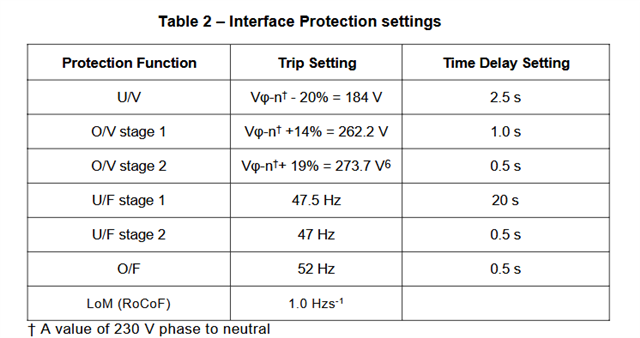
    That 2 second figure compares to G98 table 2 - while a modest under voltage should  hold on for ~ 2,5 seconds note that the thing that will operate when unplugged is the 2nd level fast under frequency detection of 0.5 seconds.  I suspect that most units will be fine with little or no adjustment.

    note that the reputable German balkony  units seem to do all this, and also claim to stop inversion within 200ms of mains loss, and to be below 60V residual voltage on the pins within 2 seconds.


    Mike.

  • That 2 second figure compares to G98 table 2 - while a modest under voltage should  hold on for ~ 2,5 seconds note that the thing that will operate when unplugged is the 2nd level fast under frequency detection of 0.5 seconds.  I suspect that most units will be fine with little or no adjustment.

    There is no time delay for RoCoF ... and this will operate if the power is completely removed.

    However, there is a delay whilst it's detected, so when we are looking at single-pole RCBOs protecting the final circuit, the inverter can continue to generate after the 40 ms disconnection time ... perhaps up to 100 ms. So, instead of max 40 ms for RCBO to disconnect, it's now 140 ms. OK for a fault to Earth in TN and TT systems, but NOT where the RCD is required to provide additional protection because someone is in direct contact with live parts (broken case of equipment, cut lawnmower lead etc.).

  • I take the point, but the risk to the user is not much changed as the lawnmower itself  was always allowed to hold up the voltage by generating as it spins down - that's the less than 2 seconds to less than 30V RMS. The fixed wiring is held to  a very different standard to the appliances that connect to it, in many ways actually, not just this.

    If someone is between live and true earth, having cut an extension lead plugged into the same circuit as their plug in solar, the RCD will still do its task in time. This is just yet another appliance that adds some pulse-stretching to the voltage on the disconnected side. Actually I can imagine having fully loaded washer or a tumble dryer on the same circuit as the victim may be  more problematic than a mower, as there is no deliberate braking action and stopping time maybe longer. 

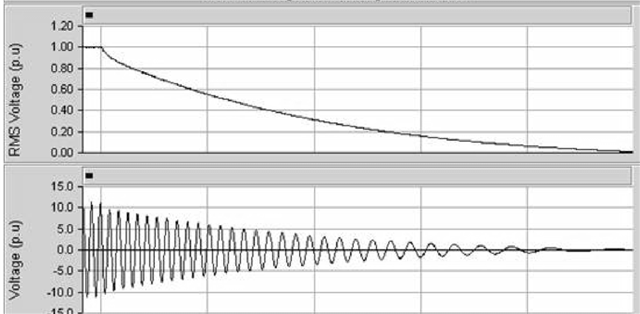
    In these example graphs, the power is cut at the first vertical line, after the first 2 mains cycles, and the Vertical grid-lines are 0.2 second intervals, so this whole plot shows a machine that stops generating altogether in about a second, as both voltage and frequency decay.
    Scaling the starting voltage from 230V, this example passes  below ES1 limits by 0.6-0.8 seconds. This is from a paper about designing control circuits for traditional  induction motors.  Big motors on inverters and VSDs don't behave like this of course and in any case it is all horribly variable with what else is plugged in at the same time and the impedance  reactance that is presented to the line, these are very clean plots.


    regards,

    Mike.

  • However, there is a delay whilst it's detected, so when we are looking at single-pole RCBOs protecting the final circuit, the inverter can continue to generate after the 40 ms disconnection time ... perhaps up to 100 ms. So, instead of max 40 ms for RCBO to disconnect, it's now 140 ms. OK for a fault to Earth in TN and TT systems, but NOT where the RCD is required to provide additional protection because someone is in direct contact with live parts (broken case of equipment, cut lawnmower lead etc.).

    Once the RCBO protecting the final circuit opens, on a plug-in / balcony solar inverter with no solid neutral-pe link at the inverter, what is the current path for the person receiving an electric shock?

    [Edit] Yes I was thinking of single module, SP+N RCBOs, where the neutral is switched. Agree, if it is purely SP with solid neutral, then the fault current is back via the neutral-pe link at the cut-out.

  • many older rcbo are single pole only. some are labelled SP+N which means anything the manufacturer decided on that day . in a proper double pole or single pole with switched neutral which is also bi directional i cant see the fault current path.

Reply
  • many older rcbo are single pole only. some are labelled SP+N which means anything the manufacturer decided on that day . in a proper double pole or single pole with switched neutral which is also bi directional i cant see the fault current path.

Children
No Data