Who from the IET is working with the government to allow <800W inverters to be 'plugged in'?

The UK government made the following announcement at the end of March (www.gov.uk/.../government-to-make-plug-in-solar-available-within-months) regarding Balcony Solar/Plug-in Solar. The following section features in the 'Notes To Editors' at the end of the announcement.

"The government will work with the Energy Networks Association, DNOs and Ofgem to update the G98 distribution code and wiring regulations BS 7671 to allow UK households to connect <800W plug-in solar panels to domestic mains sockets, without the need for an electrician and with tailored safety standards."

So who is the government working with at the IET/JPEL64 to make these changes to BS7671? Or is the government simply going to bypass the IET and make amendments willy nilly?

Parents
  • In respect of BSI committee work (BS 7671 is developed by a committee jointly managed by the IET and BSI, but that follows the BSI rules for developing standards) specific discussions in committees cannot be shared. Similarly, content of standards and draft standards can only be discussed when they are published, or made available as drafts for public comment.

    Would those rules prevent someone confirming whether a committee (or indeed which sub committee) had been asked to consider a particular request or requirement?

    The comments on RCD operation seem somewhat unclear to me. Mark started off taking about a certain type of RCD that the Germans had the foresight to drop many years ago (which I take to be AC types) - but the article says "But some older RCDs were never designed for electricity flowing back into the circuit" - but bi-directionality is a completely different feature - and not one universally found even in the latest RCDs. I suppose we should add in single pole switching RCDs (mostly RCBOs) where the local generation isn't separated from Earth when the RCD trips, so the shock hazard persists until inverter shutdown - again a problem that isn't mitigated by ensuring your installation is up to current standards.

       - Andy.

  • I take the point, but the risk to the user is not much changed as the lawnmower itself  was always allowed to hold up the voltage by generating as it spins down - that's the less than 2 seconds to less than 30V RMS. The fixed wiring is held to  a very different standard to the appliances that connect to it, in many ways actually, not just this.

    If someone is between live and true earth, having cut an extension lead plugged into the same circuit as their plug in solar, the RCD will still do its task in time. This is just yet another appliance that adds some pulse-stretching to the voltage on the disconnected side. Actually I can imagine having fully loaded washer or a tumble dryer on the same circuit as the victim may be  more problematic than a mower, as there is no deliberate braking action and stopping time maybe longer. 

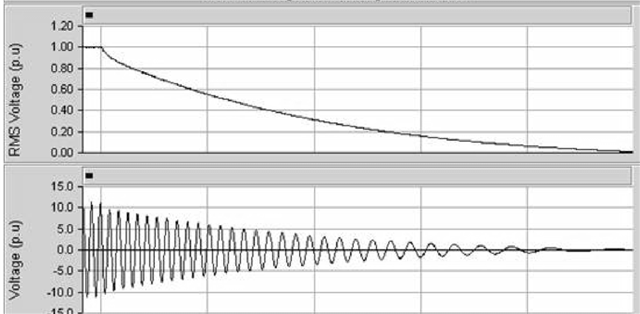
    In these example graphs, the power is cut at the first vertical line, after the first 2 mains cycles, and the Vertical grid-lines are 0.2 second intervals, so this whole plot shows a machine that stops generating altogether in about a second, as both voltage and frequency decay.
    Scaling the starting voltage from 230V, this example passes  below ES1 limits by 0.6-0.8 seconds. This is from a paper about designing control circuits for traditional  induction motors.  Big motors on inverters and VSDs don't behave like this of course and in any case it is all horribly variable with what else is plugged in at the same time and the impedance  reactance that is presented to the line, these are very clean plots.


    regards,

    Mike.

  • However, there is a delay whilst it's detected, so when we are looking at single-pole RCBOs protecting the final circuit, the inverter can continue to generate after the 40 ms disconnection time ... perhaps up to 100 ms. So, instead of max 40 ms for RCBO to disconnect, it's now 140 ms. OK for a fault to Earth in TN and TT systems, but NOT where the RCD is required to provide additional protection because someone is in direct contact with live parts (broken case of equipment, cut lawnmower lead etc.).

    Once the RCBO protecting the final circuit opens, on a plug-in / balcony solar inverter with no solid neutral-pe link at the inverter, what is the current path for the person receiving an electric shock?

    [Edit] Yes I was thinking of single module, SP+N RCBOs, where the neutral is switched. Agree, if it is purely SP with solid neutral, then the fault current is back via the neutral-pe link at the cut-out.

  • many older rcbo are single pole only. some are labelled SP+N which means anything the manufacturer decided on that day . in a proper double pole or single pole with switched neutral which is also bi directional i cant see the fault current path.

  • That depends if its an early single pole breaking RCBO, or a modern 2 pole one.

    Edit, I was beaten to it !!

    mike.

  • I take the point, but the risk to the user is not much changed as the lawnmower itself  was always allowed to hold up the voltage by generating as it spins down - that's the less than 2 seconds to less than 30V RMS. The fixed wiring is held to  a very different standard to the appliances that connect to it, in many ways actually, not just this.

    If someone is between live and true earth, having cut an extension lead plugged into the same circuit as their plug in solar, the RCD will still do its task in time. This is just yet another appliance that adds some pulse-stretching to the voltage on the disconnected side. Actually I can imagine having fully loaded washer or a tumble dryer on the same circuit as the victim may be  more problematic than a mower, as there is no deliberate braking action and stopping time maybe longer. 

    In these example graphs, the power is cut at the first vertical line, after the first 2 mains cycles, and the Vertical grid-lines are 0.2 second intervals, so this whole plot shows a machine that stops generating altogether in about a second, as both voltage and frequency decay.
    Scaling the starting voltage from 230V, this example passes  below ES1 limits by 0.6-0.8 seconds. This is from a paper about designing control circuits for traditional  induction motors.  Big motors on inverters and VSDs don't behave like this of course and in any case it is all horribly variable with what else is plugged in at the same time and the impedance  reactance that is presented to the line, these are very clean plots.

    I'm not in agreement with this 100 %.

    Yes, there's the "wind down" time of certain appliances (not all); BUT:

    1. With the lawnmower lead, the lawnmower has stopped, because I cut the lead ... that's why I picked up the now accessible energized part - I'm not picking up the lawnmower end !

    2. Even taking into account a "wind down", that time is on top of the RCD disconnection time. When adding plug-in PV, the wind-down time is added to the disconnection time of the RCD plus the RoCoF detection time of the inverter.


    We know that, if you cut one corner, accidents might happen, but they'd be unlikely. However, the more corners you cut, the more risky things become.

    Whichever way you look at it, we are degrading the protection currently offered by BS 7671, in the full knowledge that that doesn't protect all of the people all of the time ...

  • Whichever way you look at it, we are degrading the protection currently offered by BS 7671, in the full knowledge that that doesn't protect all of the people all of the time ...

    I agree, but my point is more that  we already do that every time we plug any appliance in that holds up the voltage for some short time after the breaker breaks - and there are more of those than just inverters, plenty in common use. As another example we also weaken the protection against direct contact when we plug in a bedside lamp and the protection damage with every flex. 

    Perhaps the lawnmower lead is not the best example for what I was trying to say.

    The corollary of course is that a perfectly safe  fixed wiring system that we dare not plug anything into is not a very useful thing, 

    We only need to protect the people , to about the same level that we already have, when real products are plugged in,  To modify a common safety strap-line, just a few deaths is not really enough. 

    Mike

  • We know that, if you cut one corner, accidents might happen, but they'd be unlikely. However, the more corners you cut, the more risky things become.

    Whichever way you look at it, we are degrading the protection currently offered by BS 7671, in the full knowledge that that doesn't protect all of the people all of the time ...

    Well then this is where the organisations and institutions developing and operating with BS7671 need to come in with some cost-effective, efficient solutions to support consumers to adopt these low cost balcony / plug-in solar solutions in a safe way.

    Does it need some educational guidance producing, that these plug-in systems should be connected to socket circuits protected by suitable double pole, or true SP+N RCDs/RCBOs and that the consumer should budget for getting the circuit's RCD/RCBO upgraded? Is there a technical solution, in terms of the inverter's built in protection settings and response times for these situations?

    Does BS 7671 follow the approach of VDE of advising use of an dedicated, economical plug/socket for these, so that where possible they are connected to their own dedicated circuit? Maybe working with the ENA and having some clear supporting guidance to ensure new circuits for plug-in solar can be installed as economically, lowest cost possible to avoid them being plugged into the socket circuits?

    There's measures which could be taken to reduce the risk from these devices, to steer consumers towards safer installation arrangements.

  • 1. With the lawnmower lead, the lawnmower has stopped, because I cut the lead ..

    Not necessarily - I've seen leads that have been "shaved" - exposing (at least) one of the conductors (and maybe thinning it a bit) but not completely severing either of them.

      - Andy.

  • Question - TN disconnection times are based on a touch voltage of half the line voltage - 115V-ish so 0.4s - while TT disconnection times (due to much higher impedance between c.p.c. and Earth) are based on full 230V touch voltages - 0.2s (or 200ms) - so why 40ms for additional protection where the assumption is also that the victim is exposed to 230V?

       - Andy.

  • I agree, but my point is more that  we already do that every time we plug any appliance in that holds up the voltage for some short time after the breaker breaks - and there are more of those than just inverters, plenty in common use. As another example we also weaken the protection against direct contact when we plug in a bedside lamp and the protection damage with every flex. 

    Hi Mike, not sure you missed the following points:

    • the appliance is still going to hold up the voltage after the additional disconnection time, so it is definitely worse.
    • When I cut the lawnmower lead, there's an assumption there's always an appliance connected somewhere else on the circuit that holds up the voltage for a short period of time. Not necessarily. But if there is, see previous bullet.
Reply
  • I agree, but my point is more that  we already do that every time we plug any appliance in that holds up the voltage for some short time after the breaker breaks - and there are more of those than just inverters, plenty in common use. As another example we also weaken the protection against direct contact when we plug in a bedside lamp and the protection damage with every flex. 

    Hi Mike, not sure you missed the following points:

    • the appliance is still going to hold up the voltage after the additional disconnection time, so it is definitely worse.
    • When I cut the lawnmower lead, there's an assumption there's always an appliance connected somewhere else on the circuit that holds up the voltage for a short period of time. Not necessarily. But if there is, see previous bullet.
Children
  • For me, the question is what is a reasonable (supply) hold up time for an appliance.  As mapj1 has pointed out, there is a standard for this (EN IEC 62368-1:2024) which imposes some limits.  I suspect that in many cases a solar inverter should be able to do a lot better as I suspect that standard is written around things like lawnmowers and vacuum cleaners where there is no cycle by cycle control of current drawn / returned.

    If we take the pure solar (no battery) case, solar is a constant power device (at least over the timescales we are talking about here) - in most cases in the event of a protective device trip I would expect the inverter output to over or under voltage and trip within half a cycle or so.  It is only in the case where the loading on the inverter side of the protective device is such that a stable equilibrium can be reached at a voltage within the permitted range that the delays associated with RoCoF or similar come into play.  Have the studies been done to understand what proportion of the time that might happen?  Is it practical to reduce the permitted voltage range to somewhat narrower than standard so as to reduce the likelihood of that happening?

    The solar plus battery case is more complex.  The simple solution is to force the interface to the supply to act like constant power solar if export is to occur.  That doesn't prevent the equipment itself having UPS like sockets but there will need to be a contactor to disconnect the inverter from the supply once loss of mains is detected.  That contactor will mean that systems featuring batteries will be slower to disconnect than pure solar (unless we're willing to accept a solid state device for that function?).

  • In this case I'm considering the main holding-up appliance is the solar inverter - its not clear what happens when you put multiple holding-up appliances in parallel or which ones you want to disconnect. 

    The situation is of course cleaner when the solar unit is on its own radial on its own special plug and socket, which is not much different to hard wiring,  and that should be the gold standard, but see my gripe in the other thread about the accidental consequences of the plug and socket legislation as to why we seem unable do the dedicated connector in the UK.

    The question is how much more dangerous is it if we throw caution to the winds and plug an inverter in anywhere, compared to any other combination of appliances with more or less hold-up

    Mike

    PS

    This non-standard plug is not as common as it used to be ;-)  but we need to remember why we once needed that sort of safety campaign and compulsory plug and socket stuff, so we we know where we came from in terms of common/acceptable behaviour.