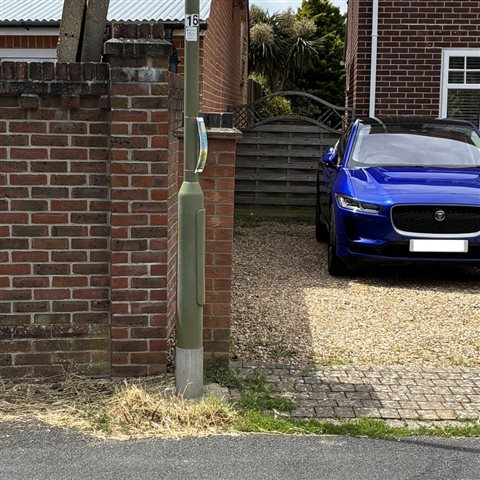
Simultaenous Contact

Good afternoon all, 

I am seeking the collective views of the group regarding the issues we are currently encountering within the EV installation environment in relation to simultaneous contact.

In simple terms, we are seeing a significant number of installations where customers have lamp posts located within their driveways. In many of these cases, it is not possible to achieve the recommended 2.5‑metre separation distance.

My position is that, where physical separation cannot be achieved, the application of layered protection at the EV charge point and associated switchgear would leave the customer in no worse position than prior to the installation. It is accepted that the proposal only outlines protection on the vehicle, but there are no other solutions for industry, are we with the protection detailed taking enough measures to carry out an install and in affect leave the install without a subsantial increase in risk?

My proposed approach to managing simultaneous contact risk would follow a structured hierarchy as set out below:

  • Can the maximum separation distance be achieved?
  • Can barriers or enclosures be installed to prevent simultaneous contact?
  • If neither of the above options are achievable, can layered protection provide an acceptable level of risk mitigation?

With layered protection, the proposed measures would include:

  • Installation of a compliant open‑PEN (O‑PEN) protective device
  • Provision of a double‑pole 30 mA Type A RCBO
  • Use of a charge point - M3 21 mA protection

Based on the above, the assumption is that, if all protective measures are correctly installed and verified, the installation would incorporate:

  • Automatic disconnection within the required times
  • Residual current protection
  • Open‑PEN fault detection

This combination of protections would significantly reduce the likelihood of a fault condition persisting for any meaningful duration.

On this basis, the key question for consideration is:

Where physical separation and barriers are not achievable, would it be considered acceptable to proceed with installation relying on this layered protection approach?

  • How about uPVC gutter pipes like these 112mm Half Round Gutter 3m Black | Toolstation https://www.toolstation.com/112mm-half-round-gutter-3m/p81698?store=GJ&utm_source=googleshopping&utm_medium=feed&utm_campaign=googleshoppingfeed&gad_source=1&gad_campaignid=21016232523&gclid=Cj0KCQjw2_TQBhCnARIsAF3-XhxYX-1Xei6mTKP1NEiGorrpVvl1_2peeJEQoCMik2lrNtDv_XeO1C8aAqNMEALw_wcB

    Two of them could be clamped together with large jubilee clips to fit snugly around a 100mm lampost. And there is larger guttering available 150mm half round guttering | Search | Toolstation share.google/CwX7IKAwmBkA5LA2p for 150mm lamposts. 3 could be used in "trefoil" for odd sizes.

    Might have to have windows of perhaps plexiglass so that the lamp post id labels could be read. Or copy labels on the outside 

    Cheap and cheerful, and the DNOs might go for it, as all you need is a screwdriver to access for maintenance 

  • Totally understand.  Postal workers and delivery drivers also dislike them (Walls) as it makes them walk further

  • Thanks for this Olympus, I am unsure how we would be able to continually monitor this, with the maintenance perspective? Would maybe need to be signed as per client.

  • The reality we are facing is that the bonding or linking of earthing between the EV charge point and adjacent street furniture is, in many cases, not practically achievable.

    BS 7671 won't let you just bond two separate earthing systems together, see Regulation 542.1.3.3. In considering the fault currents that might flow, as indicated in my previous post, the fault currents can be from the HV supply system to either supply ... outside the scope of BS 7671.

    This leaves us reliant on DNOs and local authorities to provide a solution, which, at present, is not materialising at the pace or scale required.

    But the DNOs operate the HV systems to which the LV systems are connected. It could well be the case that there is no magic wand here.

    I recognise that this introduces a departure from Regulation 411.3.1.1 in respect to the linking of exposed-conductive-parts. However, given the practical constraints, there are very limited options available that would enable an installation to proceed while remaining commercially and operationally viable.

    The problem is that the departure undermines a basic premise of BS 7671, and also introduces risks that BS 7671 (and OPDDs) are not designed to handle. I'm not sure, therefore, it's a logical step to say 'no less safe' as required by Regulation 120.3.

    I also note that some manufacturers are positioning earth conductor leakage monitoring within their charge points as a means to disregard simultaneous contact risk. My concern is that this appears to be a recharacterisation of M3-type protection and, in isolation, does not seem to provide a fully compliant solution under BS 7671.

    Any organisation is entitled to their opinion, and of course, I'm only providing an opinion here based on the facts as I see them.

    BS 7671 is agreed by industry consensus and public comment. It is in turn based on international standards HD 60364 series, and IEC 60364 series, both developed by agreement between international experts, and which have the exact same requirement as Regulation 411.3.1.1 in BS 7671. 

    So hopefully you can understand why I am unable to say that it's OK to use another approach which does not (at present) have consensus, and in fact undermines the consensus provisions "because it's inconvenient for what we want to do now". 

    More broadly, the issue is being amplified by the government’s push on off-street parking grants, which is increasing the volume of installations encountering simultaneous contact challenges without a corresponding, standardised industry solution.

    The Simultaneous Contact issue is not new. OZEV publish information on it themselves. It's been a key part of the risk assessment in the IET Code of Practice for EV Charging Equipment Installation since the very first Edition in 2012. The IET CoP is also developed by industry consensus and subject to public comment.

    The particular provision in Regulation 411.3.1.1 of BS 7671 is not new. 

    I would welcome your thoughts on whether a clearly defined layered protection model could form part of an interim, risk-managed approach for these scenarios, or whether the position remains that these installations should not proceed until a fully compliant solution is available.

    Please see above. I'm not saying that the risks can't be managed somehow, but there needs to be a consensus-based approach agreed in the correct industry forums.

    In terms of 'position', we can only go off what's published in BS 7671 and the IET Code of Practice for Electric Vehicle Charging Equipment Installation at the present time. It is my opinion that this is the only reliable conclusion to draw.

    In terms of an actual 'determination', only a court of law can provide an interpretation of standards for a given set of circumstances, as advised by BS 0.

  • This is the kind of issue we are seeing folks.

    That situation looks remarkable familiar.

    Fortunately, I am separated from the street lamp, which is more or less on the boundary, by a 2 m high brick wall.

    By contrast, the neighbours will need to be careful where they put the EVCP for their recently-purchased Jaguar.

  • Yes Chris - however the argument would be, the car can be parked at the end of that drive. If there is a 7.5 metere lead as standard then there is a sim contact risk there. The reality is there is a risk there as soon as an installer walks away from that property. There is no legal agreement dictating or limitating where that car is parked. 

  • Mind you with a 7,5m lead for a lot of houses, even ones with some sort of driveway,  it is actually perfectly possible to park next door, or on the pavement, and maybe the roadside for that matter, and still uncoil enough lead to plug in an EV.

    Do we worry about adjacent houses charging EVs on the street ? There must be a similar concern if we do. 
    It is perhaps just as well that most modern garden electrical items like mowers, hedge trimmers and pressure washers are double insulated or this would be a problem we already had, and more so, as very few folk will grip firmly  onto a car for very long while its plugged in, unlike a power tool. 

    The govt seems happy to allow on street charging from cables to the house, so this is probably already happening.

    https://www.gov.uk/guidance/apply-for-the-electric-vehicle-ev-pavement-channels-grant


    https://www.gov.uk/government/publications/cross-pavement-solutions-for-charging-electric-vehicles/cross-pavement-solutions-for-charging-electric-vehicles

    Mike.

  • Just to be clear: are we saying that the EVCP box, the end of the charging lead, or the nearest part of the car must be more than 2.5 m away from the lamppost?

  • Just to be clear: are we saying that the EVCP box, the end of the charging lead, or the nearest part of the car must be more than 2.5 m away from the lamppost?

    I think the assumption is that the car is "class I" - so the whole thing is classed as an exposed-conductive-part - so last option. It would have all been so much simpler if they'd made them Class II....

       - Andy.

  • But is the car an exposed conductive part? To be such, it needs to fit the definition and so must be considered "equipment". As per 113.1, the regulations only apply to equipment that is selected for the installation.