Calibration of Approved Voltage Indicators and Proving Units.

There was an old discussion on this 7 years ago but it is locked now. In any case there was no definitive answer provided at the time. In years gone by, I would have thought that AVIs and PUs either work or they dont.

But searching online today, Martindale recommend that their AVI's and PU's do need calibrating. This has prompted me to rethink and I note that in GS38 point 30 talks about all test equipment being maintained by a competent person and one of the common errors being failing to verify correct function of illumination (eg indicator/lamp/neon).

If something were to go wrong, and it turns out the AVI and PU were not calibrated within the last 12 months, I can imagine this wording above being used to attribute blame to the person who was undertaking the proving dead.

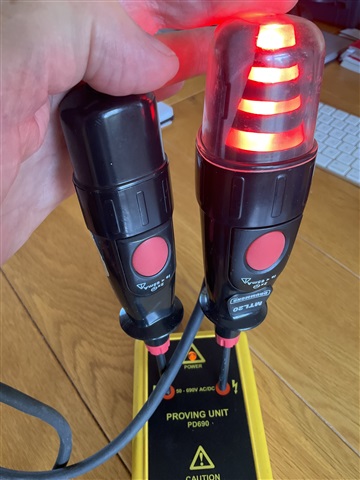
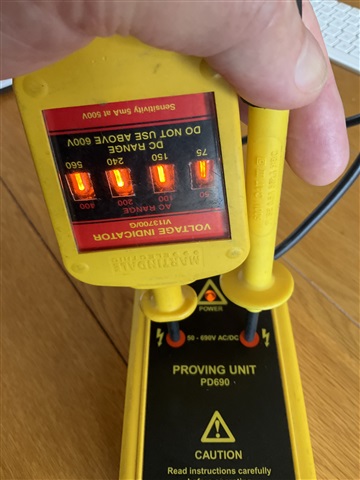
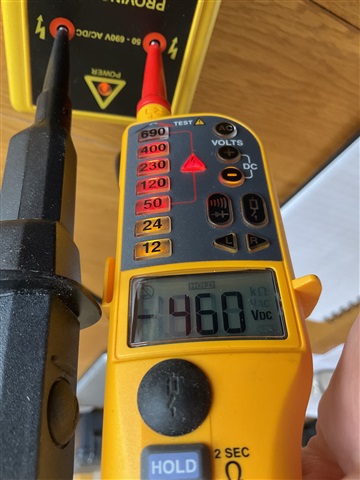
When we prove the AVI with the PU, we are putting voltage onto the AVI and simply seeing that the lamps light up, but the PU just puts out the max voltage it is capable of, it doesnt step up or down each voltage level individually, so we dont control the level it is proving at. 

What's other peoples thoughts? I am considering now that we do need to calibrate these items.

Parents
  • When we prove the AVI with the PU, we are putting voltage onto the AVI and simply seeing that the lamps light up, but the PU just puts out the max voltage it is capable of, it doesnt step up or down each voltage level individually, so we dont control the level it is proving at. 

    That is a very valid point to discuss. It might seem like we're saying that "calibration" of the voltage detection levels is needed. Indication of voltage levels are crudely achieved by a component ladder (e.g. resistor-neon or resistor-LED), and are not designed to be that accurate overall.

    However, the voltage indicator is not intended to be an accurate display of a measured voltage ... it is, in fact, what it says on the tin "for indication purposes only" only. If you want to measure the actual voltage, use an appropriate test instrument such as calibrated MFT or GS-38 conformant, calibrated, 'electrician's multimeter', with or without an appropriate shunt resistance where necessary.

    Further 'proving dead' is not really a correct statement of what we are doing.

    Quite simply, we can't 'prove dead' because we are looking for the absence of something (electromotive force ... voltage). 'Absence of evidence is not evidence of absence' is the basic premise.

    What we are doing, is what we reasonably can do, to gather sufficient 'circumstantial evidence' there is no substantial voltage detectable.

    So, no, I don't think it's the case that a voltage indicator should be either calibrated, or relied upon for an accurate reading of voltage ... even if no lights light up, there may be some voltage there, although hopefully it's low enough not to sting us too badly !

    Don't forget also, that we are being encouraged not to rely on one detection method alone, but check the absence of EMF/voltage by other means too ... e.g. non-contact and single-pole-contact voltage detector as well ... just in case. Again, these are 'indication only' devices, i.e. can be self-checked on a known-good supply at the time of use.

    ... And then we employ further safe working practices like the use of insulated tools etc., just in case, even when we have gone through the 'making dead' procedure.

  • 'making dead' procedure

    Maybe that term could or should be changed to "NOT LIVE" as proving dead sound like statement absolute, whereas 

    "NOT LIVE" or  "POTENTIALLY NOT LIVE" would be more Succinct

    I am sure the name convention would spark a very polar response.

  • Further 'proving dead' is not really a correct statement of what we are doing.

    Quite simply, we can't 'prove dead' because we are looking for the absence of something (electromotive force ... voltage). 'Absence of evidence is not evidence of absence' is the basic premise.

    Exactly. However, the proving unit does provide conclusive evidence that all four lamps of the approved voltage indicator are still functioning.

Reply
  • Further 'proving dead' is not really a correct statement of what we are doing.

    Quite simply, we can't 'prove dead' because we are looking for the absence of something (electromotive force ... voltage). 'Absence of evidence is not evidence of absence' is the basic premise.

    Exactly. However, the proving unit does provide conclusive evidence that all four lamps of the approved voltage indicator are still functioning.

Children