


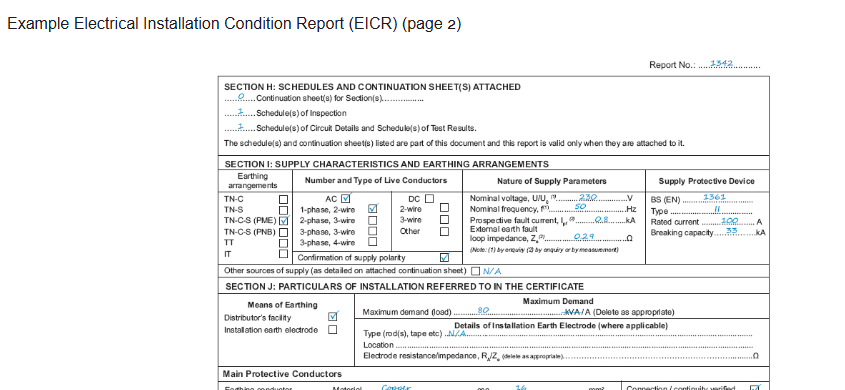
I have just noticed this change requiring the maximum demand to be stated on the new EICR template. Is this possibly a copy and paste mistake or is there a rationale behind it?
I have just noticed this change requiring the maximum demand to be stated on the new EICR template. Is this possibly a copy and paste mistake or is there a rationale behind it?
The other way of tackling this problem is to use actual maximum demand data for the installation - get the customer to obtain their half-hourly import metering data from their supplier, then you can use that to determine the actual highest average demand over a half-hour period, which might be a reasonable representation of the demand in thermal terms.
Potential weakness of that approach is it doesn't tell you the maximum instantaneous demand, or MD over shorter periods, or what the maximum demand might be under a different occupier (more people in household, different habits/routines affecting diversity etc).
But at least it is based on real, accurate data - settlement metering is accurate to within a couple of percent. Only fly-in-the-ointment is where there's solar/battery installed which then needs some more difficult analysis adjusting for solar/battery energy flows.
I'm surprised there's not a more formal, defined process for how Maximum Demand should be determined because with it being inherently probabilistic, rather than purely deterministic, it opens up the space for significant differences in how different people might determine the value, the electrical equivalent of 'how long is a piece of string?'.

The other way of tackling this problem is to use actual maximum demand data for the installation - get the customer to obtain their half-hourly import metering data from their supplier, then you can use that to determine the actual highest average demand over a half-hour period, which might be a reasonable representation of the demand in thermal terms.
Interesting idea, but would that not require a smart meter?
Moreover, presumably, it is the electrician's job to get the info.
I'm surprised there's not a more formal, defined process for how Maximum Demand should be determined
In which case, the term is pretty meaningless.
30A per 1000ft² (or 32A per 100m²)
what the maximum demand might be under a different occupier
That formula puts us well beyond the rating of the DNO's fuse, but there are only two of us, so most rooms are unused most of the time.
Of course that could change markedly when we sell/leave feet-first.

Interesting idea, but would that not require a smart meter?
Moreover, presumably, it is the electrician's job to get the info.
Yes but most homes already have smart meters and ultimately all homes will have them, so I don't see that as a problem in the longer term.
I don't know what it's like with all suppliers, but some already have a function for the customer to download their half-hourly data, so it's a simple job to then just find the maximum value, or rank them to find the top X half-hour periods.
Either way, now that smart metering is available and half-hourly data from them is increasingly available, it seems only logical that the Wiring Regulations ought to reflect this to make more accurate, data-driven assessments of MD,
Yes but most homes already have smart meters
It's still only at 70 % in the UK I believe. Technically "most" but still around 30 % that don't.
ultimately all homes will have them, so I don't see that as a problem in the longer term.
That will almost certainly be the case, because even though there's no legal requirement (yet), the fact is that meters have a finite life, and the options for a non-SMART meter, even for companies that have some older technology that's still in date, will vanish in the future.
the Wiring Regulations ought to reflect this to make more accurate, data-driven assessments of MD
BS 7671 does not specify what means is used to identify 'maximum demand', so I don't see a need to change BS 7671.
I would, however, bring out the following points:
So, in summary, I think:
(a) BS 7671 has appropriate requirements in its current form;
(b) the main smart meter might be able to be used to provide the 'maximum demand' for the distributor (taking into account any changes being made to the installation, see point 4 above); and
(c) meter data alone can't be used to rate circuits and equipment in the installation according to BS 7671 ... there's more than one 'maximum demand' for an installation ... or at least different parts/components forming it.
That feels like a statement that "maximum demand" is too poorly defined to be of any meaningful use. Not only is it not defined temporally (1msec, 1sec, 1min, 10min 30min, 1hr, 2hr, 5hr?) bit it is also not defined positionally in an installation. How is anyone expected to enter a figure on any document?
When I was having a discussion with the DNO about MD for my own property I had the ability to provide a graph of maximum RMS current vs. duration which seemed to be a lot more meaningful but very few people will have that granularity of metering.
Just to add, note that some DNOs explicitly permit a short term demand of up to 100A on installations fitted with an 80A fuse - who knows what an electrician is expected to write on an EICR in that case...
Just to add, note that some DNOs explicitly permit a short term demand of up to 100A on installations fitted with an 80A fuse - who knows what an electrician is expected to write on an EICR in that case...
Given the fusing curves, they don't really have a choice, if you think the company fuse is the only current limiting object they have at their disposal.
Actually its not a bad fit to reality in terms of overheating meter tails and things either - the cable does not instantly combust at a 20% overload, rather it slowly heats up over several minutes eventually reaching a new equilibrium temperature, that is a bit above further above ambient, than that intended for meeting the full lifespan prediction in an ambient of 30C. That time constant is very long for transformers and buried cables and shorter for things with less thermal mass.
If the ambient is below 30, or the overload ceases before it even reaches that state, it may not be even stressed in terms of life reduction.
It is after all quite possible to wire a shower in 2.5mm2 cable and see it last for many years, despite the horrendous overload, on paper, until someone visits who takes more than ten mins at a time in the shower ;-)
Regards Mike.
We're about to take you to the IET registration website. Don't worry though, you'll be sent straight back to the community after completing the registration.
Continue to the IET registration site

